
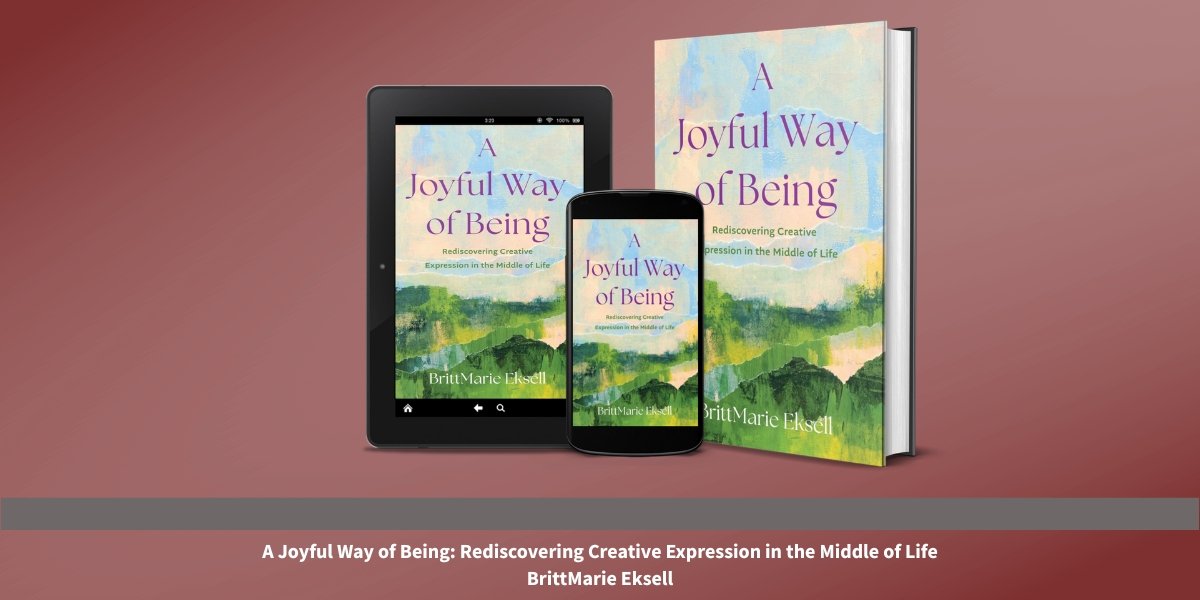
BrittMarie Eksell’s A Joyful Way of Being Reimagines Creativity as Emotional Survival in Midlife

By: Joselin Suarez
There is something quietly disarming about A Joyful Way of Being. BrittMarie Eksell is not trying to convince readers to become extraordinary. She is not promising reinvention, breakthrough success, or a better personal brand. In a self-help landscape packed with aggressively cheerful manifestos and endless optimization rhetoric, that restraint feels almost radical. The book approaches creativity less as a talent to master and more as a way of staying emotionally awake while moving through the second half of life.
Eksell writes with the calm confidence of someone who has spent decades listening to people rather than performing expertise on them. Her background matters here. Born in Stockholm, trained as a textile designer at Pratt Institute, and later earning degrees in art therapy and health psychology, she brings both artistic instinct and clinical experience to the book. That combination gives the material a kind of grounded warmth that many inspirational books desperately want but rarely achieve. You never get the feeling she is trying to “fix” the reader. The tone is closer to accompaniment than instruction.
What makes the book land emotionally is its refusal to treat creativity as productivity. Eksell is not obsessed with output. She keeps returning instead to curiosity, memory, sensory experience, and emotional permission. Again and again, she nudges readers back toward the imaginative impulses many people abandoned somewhere between adulthood, work obligations, grief, parenting, illness, or plain exhaustion. Her argument is not that everyone secretly wants to paint masterpieces or publish novels. It is that many people slowly lose access to parts of themselves as they try to become functional adults.
That idea could have easily become sentimental, but Eksell avoids that trap because the book is rooted in real emotional terrain. Her years working in cancer hospitals, creating spaces for creative expression, give the softer reflections genuine weight. You can feel the difference immediately. When she talks about creativity as healing, it does not sound abstract or decorative. It sounds observed. There is an understanding beneath the writing that emotional expression is sometimes most necessary when people are confronting fear, aging, uncertainty, or loss.
Structurally, the book moves through client stories, personal memories, reflective exercises, and small creative invitations that feel manageable rather than performative. Some readers expecting an energetic workbook packed with colorful charts and life hacks may initially find the pace unusually meditative. Eksell lingers. She allows silence into the material. Oddly enough, that slower rhythm becomes part of the book’s appeal. It creates room for reflection instead of constantly pushing toward self-improvement milestones.
What stayed with me most was the absence of pressure. So many books about creativity quietly reproduce the same perfectionism they claim to challenge. This one does not. Eksell repeatedly gives readers permission to make things badly, slowly, privately, and inconsistently. There is something deeply relieving about that. At times, the prose even feels grandmotherly in the best possible sense. Patient. Unhurried. Entirely uninterested in turning vulnerability into a marketing strategy.
By the end, A Joyful Way of Being feels less like a manual and more like a steady hand on the shoulder. Not every reader will connect with its softer cadence, but for those exhausted by performative self-improvement culture, Eksell offers something increasingly rare. A creative life that does not depend on spectacle to matter.
In A Joyful Way of Being: Rediscovering Creative Expression in the Middle of Life, BrittMarie Eksell encourages readers to reconnect with creativity and purpose in meaningful ways. You can learn more about the book on Amazon.
