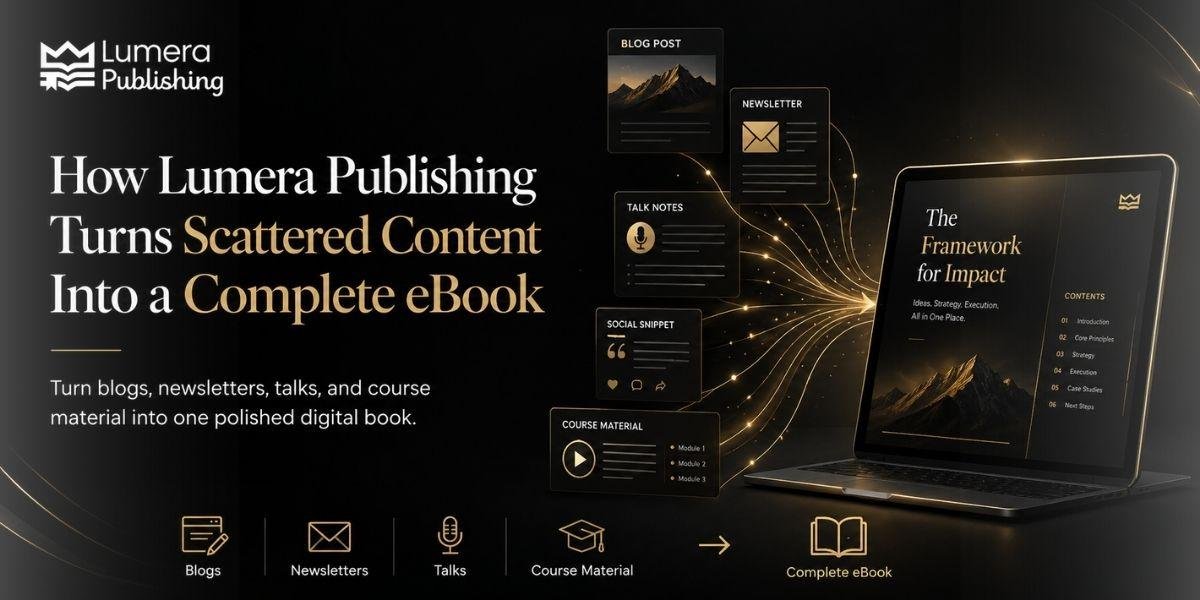
How Lumera Publishing Turns Scattered Content Into a Complete eBook

If you have been creating content for any meaningful length of time, there is a strong chance you already have the foundation of a book. Blog posts, newsletters, conference talks, podcast notes, social media threads, course lessons, and recorded presentations often hold more value than creators realize. The problem is not that the material is missing. The problem is that it is scattered across different platforms, formats, and archives, making it difficult for readers to experience it as one clear, useful body of knowledge.

Lumera Publishing helps creators, professionals, coaches, speakers, and business owners turn that scattered content into a complete, polished eBook. Instead of letting years of work sit unused in separate places, Lumera organizes, rewrites, expands, and formats the material into a professional digital book that can be sold, shared, or used to build authority. The result is not a loose collection of old posts. It is a structured eBook with a clear purpose, consistent voice, and a designed reader experience.

You May Already Have the Foundation of a Book

Many creators underestimate the amount of usable material they have already produced. A few years of blog posts can contain the foundation for several chapters. Newsletters often include practical advice, personal stories, audience questions, and useful teaching moments. Conference talks and webinars usually contain structured ideas that have already been presented to an audience. Even social media content can reveal recurring themes, key messages, and insights that may benefit from a longer life.

The challenge is that this content is often fragmented. One idea may be buried in an old blog. Another may exist only in a slide deck. A useful explanation may be hidden inside a video transcript or newsletter archive. On their own, these pieces may help for a short time, but they rarely create lasting value. Lumera Publishing identifies the strongest parts of that material and turns them into something complete, organized, and easier to follow.

Why Scattered Content Needs Professional Structure

Turning existing content into an eBook is not the same as copying and pasting old material into one document. That approach usually creates a book that feels repetitive, uneven, and disconnected. Blog posts often repeat introductions. Talks may rely on spoken rhythm that does not work on the page. Social media posts are usually too brief to stand alone as full sections. Course material may need clearer explanations for readers who are not inside a classroom or coaching program.

This is where professional eBook development can make a difference. Lumera Publishing looks at the full body of content and finds the central message that ties everything together. From there, the team creates a clear structure, arranges the material into logical chapters, removes repetition, fills in missing gaps, and rewrites the content so the final book reads smoothly from beginning to end. The goal is to make the eBook feel intentional, not assembled.

How Lumera Publishing Shapes Existing Content Into an eBook

Lumera Publishing begins by reviewing the material a client already has. This may include articles, blogs, newsletters, podcast scripts, interviews, course outlines, presentation notes, or social media content. The team studies the material to understand the client’s message, audience, tone, and overall goal for the eBook.

Once the strongest direction is clear, Lumera develops an outline that gives the book shape. This outline acts as the blueprint for the entire project, showing how each chapter will build on the one before it. The scattered pieces are then organized into sections, rewritten where needed, and expanded with new connecting content so the book has a natural flow. Transitions are added, weak sections are strengthened, and repeated ideas are refined.

After the manuscript is complete, Lumera prepares the eBook for digital publishing. This includes formatting the book so it displays cleanly across devices and platforms. The finished result is a professional digital product that feels complete, credible, and ready for readers.

The Value of Repurposing Content Into a Book

Repurposing existing content is an efficient way to create an eBook because much of the thinking has already been done. The ideas have already been developed. The examples have already been used. The message has already appeared in front of an audience in one form or another. Lumera Publishing helps turn that earlier effort into a more structured asset.

A completed eBook can support a business in several ways. It can be sold as a digital product, offered as a lead magnet, used to support a coaching or consulting offer, or added to a professional bio to build credibility. It gives creators something tangible to show for the work they have already done. Instead of letting valuable content disappear into archives, the eBook gives it a new purpose and potentially a longer shelf life.

Common Mistakes Lumera Helps Authors Avoid

One of the biggest mistakes creators make is trying to include everything. Not every post, talk, or lesson belongs in the final book. Strong repurposing requires careful selection. The most relevant material should support the main aim of the eBook, while weaker or unrelated content should be left out.

Another common mistake is failing to create a consistent voice. Content created over several years often changes in tone, style, and level of detail. Without professional rewriting, the final manuscript can feel uneven. Lumera Publishing smooths those differences so the book sounds unified and professional.

A third mistake is ignoring the reader’s journey. A good eBook should guide the reader from one idea to the next. It should feel clear, useful, and complete. Lumera builds that journey by adding structure, transitions, explanations, and chapter flow, making the final book easier to read and potentially more useful to the audience.

Turning Old Work Into New Value

The real benefit of this process is that it creates new value from work that already exists. Content that once served a single campaign, newsletter, post, or event can become part of a lasting digital product. A scattered archive becomes a professional eBook. A collection of separate ideas becomes a clearer message. A creator’s years of effort can be leveraged to attract leads, support authority, and reach new readers.

For bloggers, speakers, coaches, consultants, educators, and business owners, this can be a practical way to become a published author without starting from a blank page. Lumera Publishing helps turn existing material into a complete eBook that looks polished, reads smoothly, and supports ongoing professional goals.

Creators who already have blogs, newsletters, talks, course material, or social content can request a quote from Lumera Publishing to explore how their scattered content may become a finished eBook.

About Lumera Publishing

Lumera Publishing is a full-service, fee-based book publishing company based in New York, USA. The company offers ghostwriting, editing, formatting, cover design, publishing, and book marketing services for authors across various genres, helping writers self-publish professionally while keeping 100% of their rights and royalties.

Learn more at lumerapublishing.com or call +1 (888) 477-8199. Media contact: info@lumerapublishing.com

Full Circle: The FIFA Fan Festival Returns the World to Centennial Olympic Park, 30 Years After the Games

Thirty years after Atlanta lit the Olympic cauldron and introduced itself to the world, the city is doing it again on the same ground. On June 11, Centennial Olympic Park, the gathering place built for the 1996 Summer Olympics, opens as the official home of Atlanta’s FIFA Fan Festival, transforming downtown into a free, open-air hub for a global tournament. For a city that has spent three decades building on its Olympic moment, the symbolism is impossible to miss: the park that announced Atlanta’s arrival on the world stage is now the stage again.

A Park Built to Welcome the World

Centennial Olympic Park was created as the social heart of the 1996 Games, a 21-acre public space carved out of downtown to give visitors and residents a place to gather between events. It became the emotional center of that summer, and it has remained one of Atlanta’s most iconic civic spaces in the decades since. Hosting the Fan Festival there is a deliberate choice by the City of Atlanta and the Georgia World Congress Center Authority, which are jointly producing the event, and they have been explicit about the resonance. In 2026, the park marks 30 years since it first welcomed the world.

That continuity is the story. The same grounds that hosted the Centennial Games, and that carry the weight of both triumph and the tragedy of the 1996 bombing, will once again fill with international crowds, music, and the shared experience of a global event. For Atlanta, the Fan Festival is less a new chapter than a return to a role the city has played before.

What the Festival Looks Like

The 2026 version takes over the entire footprint of the park, divided into four programming zones designed for fans of all ages. At the center is a main stage anchored by a towering video screen that will broadcast live matches from across the tournament, effectively turning the park into a citywide watch party. Between games, the stage hosts concerts, performances, and special events. The remaining zones include a family-friendly space for younger fans, a food zone showcasing local flavors, and a cultural hub built around the international character of the crowd.

Admission to the main festival is free, though registration is required, with fans reserving a digital pass for each day they plan to attend. The festival runs on select days across the tournament, opening June 11 and continuing through mid-July, scheduled around Atlanta’s eight World Cup matches at Mercedes-Benz Stadium, temporarily renamed Atlanta Stadium for the tournament, including a semifinal on July 15. For those seeking more than general admission, upgraded experiences are available, ranging from elevated viewing areas with bar access to air-conditioned hospitality suites, but the core promise is a free public space open to anyone willing to register.

The Opening and the Access

The festival launches with a ceremonial kickoff featuring civic leaders, a countdown, and a symbolic “Opening Kick” to mark the start. The downtown location is built for access: Centennial Olympic Park sits steps from Mercedes-Benz Stadium and is served directly by MARTA, which organizers and transit officials are encouraging fans to use given heavily restricted parking around the venues on match days.

The Fan Festival also anchors a far wider web of free programming spreading across metro Atlanta, from watch parties at The Battery beside Truist Park to neighborhood festivals in Decatur, Marietta, and the Upper Westside. But the park remains the official heart of it, the place the city is pointing the world toward, and the venue carrying the most history.

Why the Symbolism Matters

For Atlanta, the choice of venue is more than logistics. The 1996 Olympics were a defining moment in the city’s modern identity, a coming-out party that reshaped its skyline, its infrastructure, and its sense of itself as a global city. Returning the world to Centennial Olympic Park invites a direct comparison between the Atlanta of 1996 and the Atlanta of today, a city that has grown into a center for film, music, business, and culture in the intervening decades.

Organizers have leaned into that framing, describing the festival as rooted in global legacy, civic pride, and community, and casting the park as a space that once again brings people together to celebrate the world’s game. The language echoes the spirit of the Olympic bid that put Atlanta on the map, repurposed for a tournament rather than a Games.

The deeper point is what the through-line says about the city. Atlanta has spent thirty years proving the Olympics were not a one-time spotlight but the start of a sustained ascent. The Fan Festival, free and open in the park that started it all, is the city’s way of marking that arc, welcoming the world back to the exact spot where it first made its case, and showing what it has become in the years since. The cauldron is long extinguished, but on June 11, the grounds beneath it light up again.

The Non-Surgical Answer for Spinal Stenosis in Charlotte

By Dr. Goodman, DC, and Dr. Bradberry, DC | ReliefNow Laser Charlotte | Charlotte, North Carolina

How Spinal Stenosis Limits Older Adults in Charlotte

Lumbar spinal stenosis is the most common reason for spinal surgery in adults over 65 in the United States. It is also one of the conditions most responsive to structured non-surgical care, particularly when that care focuses on the inflammatory and soft tissue factors involved in the symptoms. Many older adults in Charlotte, Pineville, Matthews, and Gastonia notice the same pattern. Their walking distance shortens. Their legs cramp during sustained upright activity. Leaning forward brings a measure of relief. These are familiar signs of stenosis, and they often appear gradually over months or years.

A 2013 review in the New England Journal of Medicine estimated that symptomatic lumbar stenosis affects roughly 11 percent of the general population, with prevalence rising sharply after age 60. Research published in Spine has shown that the degree of canal narrowing on imaging does not reliably predict how severe a patient’s symptoms will be. That gap points to a useful conclusion. Functional, inflammatory, and soft tissue factors contribute meaningfully to the walking limitation that patients actually experience.

What Non-Surgical Care Targets in Stenosis Symptoms

The structural narrowing of spinal stenosis cannot be reversed without surgery. The inflammatory and soft tissue components that influence how much the narrowing impairs nerve function are modifiable, and non-surgical care concentrates on those components. This distinction matters for patients weighing their options because it explains why two people with similar imaging can have very different day-to-day function.

At ReliefNow Laser Charlotte, the Regenerative Medical Laser™ protocol uses medical-grade, near-infrared laser energy, an approach often described as photobiomodulation. Researchers have studied photobiomodulation for chronic spinal conditions, including stenosis-related presentations, and a 2019 systematic review in Pain Research and Management examined its use in this setting. The clinic applies this therapy as one part of a broader, individualized plan rather than as a stand-alone fix.

How the Charlotte Team Approaches Stenosis Care

Dr. Bradberry’s CCSP training includes specific competency in postural assessment and the paraspinal soft tissue restrictions that tend to develop in stenosis patients from a compensatory, forward-flexed posture. Dr. Goodman’s neurokinetic therapy training helps identify hip flexor tightness and gluteal inhibition patterns that can add mechanical loading to an already compromised spinal canal. Working together, the two doctors assess the structural, mechanical, and cellular dimensions of stenosis rather than relying on a single modality.

For Charlotte patients who have already received a surgical recommendation, the clinic offers a thorough non-surgical evaluation. That evaluation gives patients a clinical second opinion to consider alongside any surgical option, such as a laminectomy, before they decide on a path forward.

To learn more, visit ReliefNow Laser Charlotte’s non-surgical pain clinic (do-follow). Patient education is also available through the ReliefNow Nation video channel (no-follow).

Contact: ReliefNow Laser Charlotte, 4601 Park Rd, Suite 100, Charlotte, NC 28209 | 704-527-7246.

About the Authors

Dr. Eric Goodman, DC, studied at UNC-Charlotte and Palmer College, with post-graduate training in neurokinetic therapy, acupuncture, laser therapy, rehabilitation, and nutrition. Dr. Douglas Bradberry, DC, graduated from the University of Florida and earned honors at Palmer College, holds the CCSP credential, and has worked with Olympic-level athletes. Both practice as providers in the national ReliefNow® network, founded by Dr. Robert Hanopole, DC.

Disclaimer: This article is for informational purposes only and does not constitute medical advice. Consult a qualified healthcare provider before beginning any treatment program.

Dr. Paul Sran: The Stanford Educator Bringing Financial Literacy to Those Left Out of the Conversation

By: Tom White

For generations, access to quality financial education has reflected the same inequalities it might otherwise help address. Professional guidance, sophisticated investment knowledge, and long-range financial planning have historically been concentrated among those already positioned to benefit from them. Dr. Paul Sran, a Stanford-trained academic and financial educator, has spent his career working to expand access to these skills.

His central argument is simple but meaningful: financial literacy is a foundational skill that most Americans are never formally taught. The absence of that education can have long-term implications for individuals navigating complex financial decisions.

“The financial knowledge that shapes long-term stability has never been evenly distributed,” Dr. Sran says. “People are making consequential decisions every day without the frameworks they need. That is an educational problem before it is anything else.”

Dr. Sran’s academic path began at Stanford, where doctoral study provided him both analytical tools and a perspective on how knowledge can become a gated resource. After completing his PhD, he intentionally focused his work on educating individuals who often do not have access to professional financial guidance.

“When we talk about financial literacy, we tend to frame it as a personal responsibility,” he says. “But the people with the least access to financial education are also the ones with the least margin for error.”

This perspective situates Dr. Sran’s work within broader conversations about educational equity. Research shows that personal finance education is largely absent from American public school curricula, leaving many adults to learn through informal sources. The outcomes of this gap are measurable: lower savings rates, higher levels of personal debt, and limited exposure to structured financial concepts.

Dr. Sran focuses on making foundational financial concepts accessible to people without formal business or economics training. He emphasizes clarity, practical application, and understanding the psychology behind financial decision-making.

“Understanding how money works is not the same as having a lot of it,” he says. “Financial literacy is about developing judgment, and judgment can be taught.”

A key dimension of his approach is behavioral economics, which highlights the difference between what people know and how they act under financial pressure. Dr. Sran’s educational programs aim to help learners understand the mental patterns that shape decision-making, rather than simply providing instructions.

“Information alone doesn’t change behavior,” he explains. “The challenge is helping people recognize how they think about money, not just what financial concepts exist.”

Recent shifts in the labor market have made financial literacy increasingly important. Independent work, career transitions, and economic uncertainty now affect broader demographics. The traditional financial infrastructure, including long-term employer relationships and defined benefit pensions, has diminished, increasing the need for accessible education.

Dr. Sran also emphasizes equity in financial learning. While affluent individuals have access to advisors, planners, and professional networks, many Americans do not. His work aims to provide the conceptual tools for individuals to make informed decisions about their finances independently.

“The goal isn’t to replace professional advice,” he says. “It’s to ensure people have a foundation to understand concepts, recognize when guidance may be needed, and evaluate information critically.”

As conversations around economic inequality and educational access continue, financial literacy is gaining recognition as an important social and educational topic. Dr. Sran’s work contributes to addressing this gap through education, mentorship, and a consistent focus on reaching individuals historically underserved by traditional financial institutions.

Disclaimer: This article is intended for educational purposes only. It does not constitute financial advice, an endorsement of any products, or a recommendation to take specific financial actions. Readers should seek independent professional guidance for personal financial decisions.