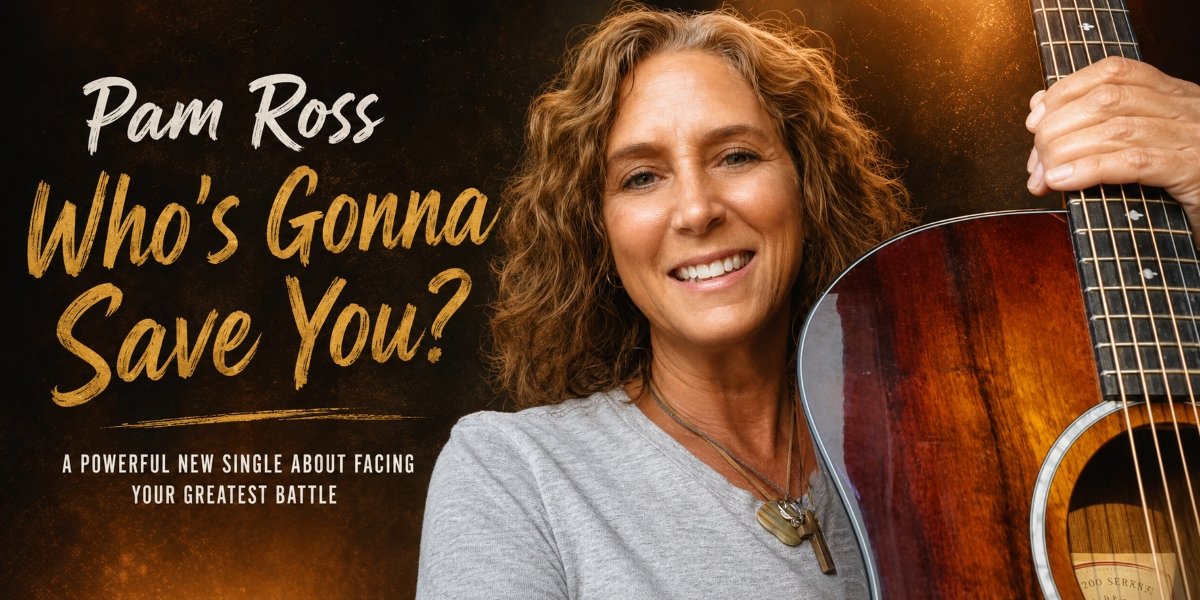
Pam Ross Faces Down Her Inner Demons on the Striking “Who’s Gonna Save You?”

By Marcus Ellington

Pam Ross has made a career out of refusing to fit neatly into one genre, moving between country, Americana, roots rock and singer-songwriter territory with the confidence of an artist more interested in emotional truth than formatting. On her latest single, “Who’s Gonna Save You?”, that genre-blurring instinct serves an especially personal piece of songwriting. Darker and more introspective than much of Ross’ catalog, the track turns the familiar language of salvation inward, asking what happens when the greatest threat to our happiness comes from ourselves.

It’s an uncomfortable premise, and Ross wisely keeps it that way.

“Who’s Gonna Save You?” grew out of a period of physical and professional frustration. Ross was recovering from surgery on two ankle tendons when another song she had pitched to an artist was rejected. Success was hardly absent from her life: Ross had already been building considerable independent momentum, including winning the 2024 Josie Music Award for Female Multi-Genre Artist of the Year. But accomplishments have a funny way of becoming invisible when disappointment takes over.

Ross picked up her guitar, and the frustration became a song.

The resulting track isn’t a conventional empowerment anthem. There is no three-minute transformation from despair to invincibility. Instead, Ross explores the space where ambition collides with insecurity and where past mistakes can become louder than present achievements.

At the center of it all is a killer hook: “God might save you from someone else, but who’s gonna save you from yourself?”

It’s the kind of lyric that can carry an entire song because it works simultaneously as confession, warning and question. Ross isn’t rejecting faith or the importance of support from others. She’s recognizing something harder: friends, family and faith can offer a lifeline, but eventually a person has to be willing to grab it.

Musically, the production understands the assignment.

Ross contributes multiple instrumental parts, joined by FJ Ventre on bass, George Hindenach on drums and Yvan Petit, with the musicians assembling their contributions separately rather than tracking together as a band. Yet the finished product doesn’t feel pieced together. There’s an organic cohesion to the performance, with the players resisting the temptation to overcrowd a song that benefits from space.

One of the recording’s most effective characteristics happened almost by accident.

Ross originally composed “Who’s Gonna Save You?” in G major. While playing it on keyboard, she accidentally struck a G minor chord and immediately recognized that the song belonged somewhere darker. She rewrote it in the minor key, a seemingly small decision that dramatically alters the emotional temperature of the track.

It was the right call.

The minor-key setting brings an ominous undercurrent to Ross’ vocal without pushing the production into melodrama. Her delivery is similarly controlled. She doesn’t perform vulnerability so much as inhabit it, allowing weariness and frustration to creep naturally into the phrasing.

That restraint separates “Who’s Gonna Save You?” from songs that mistake emotional intensity for vocal volume. Ross doesn’t need to shout about the battle because the listener can hear it happening beneath the surface.

The accompanying music video extends that battle visually through the recurring image of fire. Ross conceived much of the video’s imagery while running and listening to the song, eventually deciding to build the concept around a blaze representing frustration, destruction and the inability to recognize one’s own successes.

The most effective moment arrives after the symbolic destruction: Ross retrieves a half-written song from the dying fire.

She burned it, but she didn’t abandon it.

That image contains the sliver of hope that keeps “Who’s Gonna Save You?” from becoming nihilistic. The song recognizes self-destructive impulses without surrendering to them. There is still something worth pulling from the ashes.

It also represents the maturation of Ross as a songwriter. She has spoken about how, as a teenager and into her 30s, she could write a song in less than 30 minutes and rarely revise it. Her approach today is markedly different. Songs may take days or weeks. Rewriting has become part of the process, as has co-writing and a more deliberate study of the craft.

“Who’s Gonna Save You?” benefits from that patience. The writing feels conversational but purposeful, personal without becoming so specific that listeners can’t enter the story themselves.

That’s important because Ross’ private struggle is hardly hers alone.

In the carefully curated world of social media, achievement is public while disappointment usually remains off-camera. Artists announce awards, streams, chart positions and sold-out shows. They rarely announce the rejection that arrived that morning or the moment they wondered whether any of it was working.

Ross flips that script here.

For an artist whose career continues to expand from her North Carolina base to frequent Nashville performances and appearances in Austin during SXSW, “Who’s Gonna Save You?” could have been another opportunity to celebrate momentum. Instead, Ross uses that momentum to take a creative risk, exposing the doubts that accolades don’t necessarily erase.

The result is one of the strongest songs in her growing catalog.

With “Who’s Gonna Save You?”, Pam Ross isn’t offering listeners a rescue plan. She’s offering recognition, the reassuring realization that even accomplished people sometimes struggle against the voice telling them they haven’t accomplished enough.

Sometimes the person who needs saving and the person capable of doing the saving are one and the same.

How Showcase Atlanta Turned the FIFA World Cup Into a $1.2 Million Small Business Accelerator

When the FIFA World Cup arrived in Atlanta this summer, Mayor Andre Dickens had a specific mandate for the event: it would happen with the city, not to it. Showcase Atlanta, the nonprofit initiative Dickens created to make good on that promise, released its tournament recap this month with numbers that suggest the approach worked. More than 1,900 small businesses were onboarded into its Vendor Directory since January. Over 500 of those businesses were connected to vending, contracting, and partnership opportunities tied directly to World Cup activations. And $1,222,500 in grants, programs, and business resources flowed into the local economy through the initiative.

The month closed on July 19 with the Celebration of Soccer and Sound in Piedmont Park, a free public event produced with ONE Musicfest and headlined by Ludacris, where thousands of attendees gathered across three viewing areas for a championship match watch party. Nearly 70 local small businesses vended on site, and vendors reported steady sales throughout the day.

Key Takeaways

  • Showcase Atlanta onboarded more than 1,900 small businesses into its Vendor Directory since January 2026, connecting over 500 to vending, contracting, and partnership opportunities during the FIFA World Cup tournament month
  • The initiative invested $1,222,500 in grants and business resources, including $500,000 for a Downtown Pop-Up Opportunity Fund, $100,000 in digital marketing grants, $102,500 in Google Ad Credits, and $30,000 in youth entrepreneurship funding
  • 54 food trucks participated in the Global Grub Alley activation, reporting nearly $250,000 in combined sales over 16 activation days
  • 13 small businesses received micro-grants through a partnership with Invest Atlanta to open storefronts in vacant downtown spaces during the tournament
  • Eight community watch parties were funded across neighborhoods including Cascade Heights, Summerhill, Little 5 Points, and Chastain Park, with individual events drawing between 150 and 800 attendees
  • The Celebration of Soccer and Sound in Piedmont Park on July 19, headlined by Ludacris, closed the month with nearly 70 local vendors and thousands of attendees

$1.2 Million in Grants Built a Pipeline, Not Just a Party

The $1,222,500 in total investment broke down across several programs designed to create business infrastructure that would outlast the tournament. The largest single allocation was $500,000 for the Downtown Pop-Up Opportunity Fund, a partnership with Invest Atlanta and Downtown Atlanta, Inc. that placed 13 small businesses into vacant downtown storefronts during the tournament period. The program gave local entrepreneurs physical retail space in high-traffic locations at a moment when foot traffic in the downtown core was at its highest point in years.

Digital marketing grants totaled $100,000, with an additional $102,500 in Google Ad Credits distributed to help small businesses reach customers online during and after the tournament. A Youth Entrepreneurship Accelerator supported eight founders between the ages of 16 and 21 with funding, training from Boost and the Mayor’s Office of ONE Atlanta, mentoring, and vending opportunities. One participant, Devin Mitchell, founder of SOKA, reported $4,000 in sales and gained over 200 followers through the program.

Invest Atlanta also closed six microloans totaling $63,000 through its Atlanta Readiness Loan Fund, along with a $50,000 loan from its Community Loan Fund to Kick Sweets Treats, a soccer-themed dessert shop located steps from Centennial Olympic Park. The capital deployment connected the tournament’s cultural energy to tangible financial tools that small business owners could use to build or expand their operations.

390 Vending Opportunities Across the Tournament Month

Showcase Atlanta created more than 390 vending opportunities across its activations, including the Global Grub Alley food truck program, the Atlanta Cultural Exchange, and the Celebration of Soccer and Sound. Many businesses vended at multiple events throughout the month, building repeat customer bases and testing new markets.

The Global Grub Alley program engaged 54 food trucks over 16 activation days, with participating vendors reporting nearly $250,000 in combined sales. The Atlanta Cultural Exchange ran eight activation days and hosted over 15,000 visitors for free cultural programming, featuring more than 300 artists and creatives alongside a Showcase Atlanta Vendor Village.

The pipeline also extended into existing Atlanta institutions. Showcase-supported businesses moved from the Vendor Directory into vending positions at the FIFA Fan Festival at Centennial Olympic Park. The initiative partnered with Hartsfield-Jackson Atlanta International Airport on a business expo and with Atlanta Beltline, Inc. on Beltline Fest. Corporate training partners including Square, Google, and Verizon delivered more than 30 workshops that engaged over 1,000 entrepreneurs in topics spanning marketing, AI tools, cybersecurity, event readiness, and digital commerce.

Neighborhood Activations Reached Residents Without Match Tickets

One of Showcase Atlanta’s stated goals was ensuring the World Cup experience reached residents who never set foot inside Mercedes-Benz Stadium. Community Engagement Grants funded eight neighborhood watch parties in Cascade Heights, Summerhill, South Bend Park, Little 5 Points, Perry Park, Chastain Park, Elizabeth Baptist Church, and City of Refuge on Joseph E. Boone Boulevard. Grant winners reported crowds ranging from 150 to more than 800 at individual events. Each grantee was required to incorporate community businesses into their activations.

Five local artists created a series of six commemorative pins distributed at events throughout the tournament, each attached to a back card spotlighting Atlanta small businesses and attractions. The 404 pin, designed by George F. Baker III, honored legacy businesses. The Lemon Pepper Stepper, by Sanithna, celebrated the city’s wing culture. A total of 1,750 pins were distributed across several activations.

Capture the Flag ATL, a citywide scavenger hunt with nine flag locations, sent residents and visitors into neighborhoods beyond the downtown core to discover small businesses. 17 Miles United connected hubs across town in partnership with eight local run clubs on June 13, creating a moving portrait of Atlanta as one connected city from Mercedes-Benz Stadium to Ponce City Market. A community ticket program gave seniors, youth, and neighborhood residents the chance to attend matches in person.

The Infrastructure Stays After the Tournament Leaves

Showcase Atlanta’s vendor directory, training programs, and neighborhood partnerships are structured to continue beyond the World Cup. Atlanta is scheduled to host major conferences, college football games, and Super Bowl LXII in February 2028. The businesses, merchant associations, and community networks built through the 2026 program are intended to serve as the foundation for those future events.

The initiative’s earned media reach totaled 1.58 billion impressions, with coverage focused on amplifying small businesses and communities throughout the city. A targeted Meta advertising campaign in drive-market states generated 190,625 platform-reported impressions, inviting regional visitors to stay for Atlanta’s small business scene beyond the matches. Total organic social media impressions reached 2.5 million.

A Workforce Expo connected more than 2,100 job seekers to employers. Ten business and merchant associations were engaged, and eight corporate partners activated programming throughout the tournament period.

Frequently Asked Questions

What is Showcase Atlanta?

Showcase Atlanta is a nonprofit initiative created by Mayor Andre Dickens to ensure that major global events happening in Atlanta create pathways for local small businesses, entrepreneurs, neighborhoods, and community organizations to participate and benefit directly from the economic activity those events generate.

How much did Showcase Atlanta invest in small businesses during the World Cup?

Showcase Atlanta invested $1,222,500 in grants, programs, and business resources. This included $500,000 for a Downtown Pop-Up Opportunity Fund, $100,000 in digital marketing grants, $102,500 in Google Ad Credits, and $30,000 in youth entrepreneurship funding, among other allocations. Invest Atlanta also closed $113,000 in microloans and community loans to tournament-connected businesses.

Will Showcase Atlanta continue after the FIFA World Cup?

Yes. The vendor directory, training programs, and neighborhood partnerships are designed to continue operating beyond the tournament. Atlanta is scheduled to host Super Bowl LXII in February 2028, and Showcase Atlanta’s infrastructure is intended to support small business participation in that event and other large-scale gatherings.