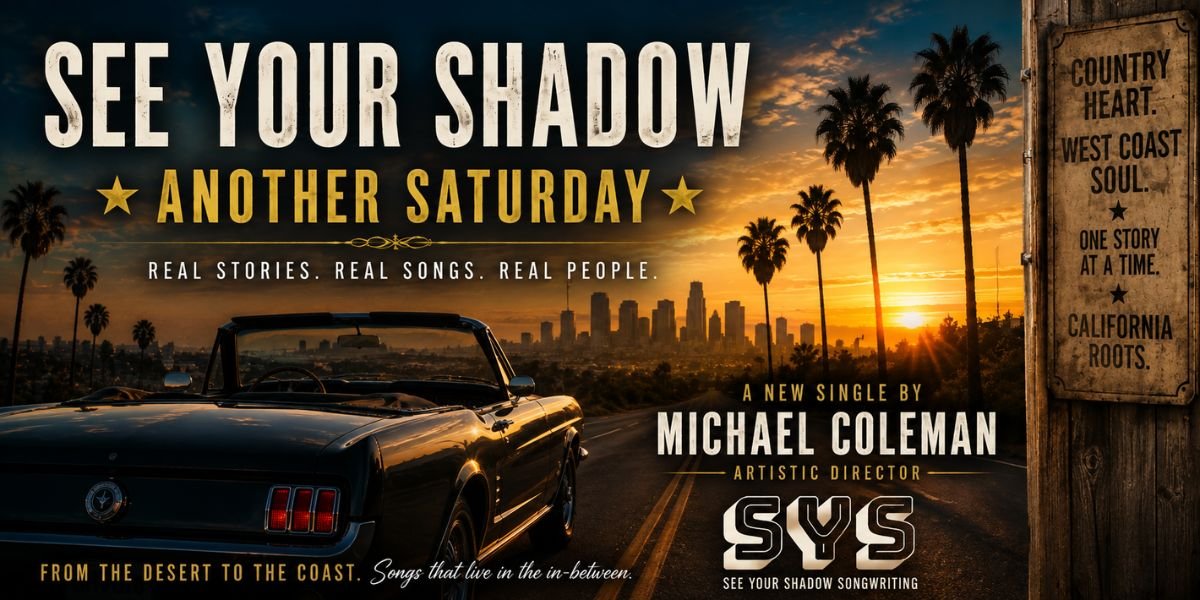
See Your Shadow’s “Another Saturday” Finds the Blues Beneath the Country Heart

By: Caleb Monroe

Atlanta understands what happens when musical borders start disappearing.

This is a city where gospel can become soul, blues can become rock, country can rub shoulders with R&B, and almost anything can eventually find its way into hip-hop. Long before Nashville completely claimed the title of Country Music City, Atlanta was an important center for early country recording and broadcasting. Fiddlin’ John Carson recorded what became an early country hit here in 1923, and WSB’s Barn Dance later carried country music across the region.

That history makes Atlanta an interesting place from which to hear See Your Shadow’s“Another Saturday.”

Because underneath the country arrangement, Michael Coleman has written something Atlanta has always understood particularly well: the blues.

Not blues in the strict musical sense. There’s no requirement for twelve bars or a guitar crying from some smoky Edgewood Avenue doorway. The blues here is emotional, the realization that Saturday night promised escape and Sunday morning hasn’t arrived yet, leaving somebody alone with everything they were trying to forget.

Coleman, the songwriter, producer, and Artistic Director behind Phoenix-based See Your Shadow, opens the song after the party has ended.

A woman wakes in a haze.

There’s a stranger beside her.

She sends him away.

And she’s alone again.

That isn’t Nashville fantasyland. There are no tailgates, perfectly distressed jeans, bonfires or trucks parked beneath suspiciously cinematic moonlight. “Another Saturday” lives in the part of the weekend most songs conveniently skip: the morning after.

Atlanta should appreciate that.

This city’s musical identity was built partly through the collision of rural Southern traditions with urban life. Atlanta’s early country scene drew on Appalachian folk music while existing alongside blues and gospel traditions, helping create a musical environment far more complicated than neat genre labels suggest.

“Another Saturday” has that same refusal to stay emotionally tidy.

Coleman’s protagonist used to be somebody’s wife. Now she’s trying to determine who she is without that identity. Her Saturday-night encounters offer temporary companionship, but Coleman makes clear that physical proximity isn’t the same thing as connection.

That’s where the song starts cutting deeper.

She’s not really looking for another man.

She’s looking for herself.

The second verse is particularly effective because Coleman avoids explaining everything. His character steps from the shower, looks into the mirror, and searches through her closet for something cute that still fits.

On paper, that’s mundane.

Inside the song, it’s devastating.

The clothes represent something bigger. Bodies change. Relationships change. Years disappear. The person reflected in the mirror doesn’t always resemble the person we still carry around in our heads.

Coleman lets the listener make that connection.

Good Southern storytelling has always worked that way.

You don’t explain the wound. You show somebody walking differently because of it.

And Coleman isn’t interested in judging his character for how she’s walking.

That’s probably the most admirable thing about “Another Saturday.” A cheaper song would turn this woman into a morality lesson. Another might celebrate her behavior as liberation. Coleman does neither.

She’s wounded.

That’s enough.

The bridge crystallizes the idea: when you don’t know what’s coming next, protecting yourself from further scars becomes almost impossible.

It’s an insight that would sound perfectly natural coming from a blues singer.

Atlanta’s country pedigree makes that connection particularly appropriate. Georgia’s Old-Time Fiddlers’ Conventions, held in Atlanta from 1913 through 1935, helped give important early exposure to performers including Carson, Gid Tanner, Riley Puckett and Clayton McMichen. The city’s musical history has never belonged exclusively to one sound; country, blues, and other Southern traditions developed in close proximity.

Michael Coleman seems to understand instinctively that genre matters less than emotional truth.

See Your Shadow itself isn’t constructed like an ordinary band. Coleman works through what he calls a “Network of Stars,” bringing different musicians and vocalists together to serve individual compositions. That puts the song, not the personality cult surrounding the performer, at the center of the enterprise.

The results have been impressive. See Your Shadow has accumulated multiple independent music honors and a string of eight consecutive chart-topping singles, including “I Will Tell Jesus You Said Hello,” “My Worth,” “Missing West Virginia,” and “Whatever on the Rocks.”

Yet “Another Saturday” feels like a particularly revealing entry in the catalog because it demonstrates Coleman’s willingness to sit beside uncomfortable characters.

Atlanta listeners should understand that impulse.

This is, after all, a city whose music has repeatedly found poetry in survival.

And survival isn’t always heroic.

Sometimes survival is getting out of bed.

Sometimes it’s taking a shower.

Sometimes it’s staring into the closet and trying to find something that makes you recognize yourself again.

Sometimes it’s making the same mistake next Saturday because you’re still figuring out how not to.

That’s the uncomfortable truth at the center of “Another Saturday.”

Coleman doesn’t give his protagonist a miraculous ending. He gives her something more valuable: dignity.

In a genre that can occasionally divide the world too easily into good women, bad women, faithful lovers, and cheating hearts, See Your Shadow leaves room for somebody more complicated.

Somebody human.

Atlanta helped prove more than a century ago that country music could transform ordinary Southern lives into recorded stories heard far beyond the city limits. In 1923, Carson’s Atlanta recording sold so unexpectedly well that its initial pressing quickly disappeared, helping demonstrate a commercial audience for this emerging music.

A century later, the technology has changed completely.

The reason we listen hasn’t.

We still want somebody to tell us a story that feels true.

On “Another Saturday,” Michael Coleman does exactly that.

And somewhere between the country heart and the blues underneath it, See Your Shadow finds something Atlanta has always known:

The best Southern music doesn’t judge the wounded.

It gives them a song.

Atlanta Holds the Highest Concentration of Black-Owned Businesses in Any Major U.S. Metro, and a Growing Ecosystem Is Building on That Foundation

Atlanta’s share of Black-owned businesses stands at 10.7% of all firms across the metropolitan area, the highest concentration in any major U.S. metro for the fourth consecutive year, according to data from the Atlanta Regional Commission and LendingTree’s annual analysis of U.S. Census Bureau figures. That rate is more than three times the national average of 3.4%, and it reflects a business formation pipeline shaped by decades of institutional policy, a dense HBCU network, and an emerging generation of industry-specific accelerators and conferences now choosing Atlanta as their home base.

Key Takeaways

  • Atlanta’s Black-owned businesses account for 10.7% of all firms in the metro area, the highest rate among major U.S. metros for the fourth consecutive year, surpassing Fayetteville, N.C. (9.9%) and Washington, D.C. (9.4%).
  • More than 13,000 Black-owned firms operate in the city, contributing to a statewide total of over 180,000 across Georgia.
  • The Atlanta City Council officially recognized August 2026 as Black Business Month, crediting policies introduced by late Mayor Maynard Jackson in 1974 as foundational to the city’s entrepreneurial ecosystem.
  • One in four Black-owned businesses nationally operates in health care and social assistance, a sector that generated over $2.6 billion in sales among Black-owned employer firms in metro Atlanta alone.
  • The BCMC ATL Summit, a four-day business education conference for product-based entrepreneurs, will take place in Atlanta September 24-27, 2026, reflecting the city’s growing role as a national convening point for Black-owned business development.

A Half-Century of Policy Created the Conditions for Today’s Numbers

Atlanta’s position as a national hub for Black entrepreneurship did not emerge by accident. The trajectory traces directly to 1974, when Maynard Jackson, the first Black mayor of a major Southern city, mandated that 25% of all contracts for the expansion of what was then Hartsfield Airport be set aside for minority-owned firms. At the time, less than 1% of city contracts went to Black-owned businesses. By the beginning of the 1980s, minority and women-owned firms participated in 30% of the city’s contracts, and the airport project became a national model for affirmative action in municipal procurement.

The ripple effects of those policies shaped the city for generations. The airport expansion, initially valued at $450 million, created a proving ground for Black-owned construction, engineering, and professional services firms. That initial wave of opportunity drew talented Black professionals from across the country to Atlanta, building a network effect that reinforced itself over time. Egbert Perry, chairman of Atlanta-based developer Integral Group, moved to the city in 1980 specifically to work in that environment, eventually founding his own firm after years at H.J. Russell & Company.

Jackson’s policies extended beyond contracting. He diversified City Hall staffing, reformed the police department, and increased public participation in neighborhood planning. By the time Atlanta hosted the 1996 Olympic Games, the city had built the institutional infrastructure to ensure record levels of minority and women-owned business participation in the Games. Former Mayor Shirley Franklin attributed that outcome directly to what she described as the institutional program Jackson put in place during his first two terms.

The Numbers Today Reflect Both Growth and Ongoing Challenges

The Atlanta Regional Commission’s February 2026 analysis found 10.7% of all employer businesses in the metro area are Black-owned. The metro also records 6.2 Black-owned employer businesses per 1,000 total residents, a rate that outpaces the national average and peer metros including Charlotte and Miami.

The health care and social assistance sector leads the metro’s Black-owned employer firms by both revenue and employment. Black-owned firms in this sector generated over $2.6 billion in sales in 2022, the most recent year with full Census data available, and employed more than 29,000 workers. The information sector, while smaller in total employment, recorded the highest average payroll among all sectors of Black-owned employer firms in metro Atlanta at nearly $77,000 annually.

The LendingTree study noted that roughly one-third of the Atlanta metro’s population is Black, creating a consumer base and a pool of potential business owners that structurally supports higher rates of business formation. The presence of historically Black colleges and universities, including Morehouse College, Spelman College, Clark Atlanta University, and the broader Atlanta University Center consortium, provides an annual pipeline of graduates with exposure to entrepreneurship education, mentorship networks, and peer communities that persist long after graduation.

The growth trajectory has not been uniformly upward. After rising steadily from 7.4% in 2020 to a peak of 11.3% in 2022, the share of Black-owned businesses in metro Atlanta dipped slightly to 10.7% in 2023, reflecting a national slowdown in growth among Black-owned firms. Average annual payroll per employee at Black-owned employer firms in the metro was approximately $35,500 in 2023, down slightly from $36,500 the prior year, and the average number of employees per firm has been trending downward in recent years. Access to capital remains a persistent barrier. Black entrepreneurs in Atlanta have reported difficulties securing investor funding even after generating millions in revenue, a pattern that mirrors national data on disparities in venture capital and lending access.

A New Generation of Conferences Is Choosing Atlanta as Its Stage

The BCMC ATL Summit, scheduled for September 24-27, 2026, represents a growing category of industry-specific business conferences that are selecting Atlanta as their host city precisely because of the ecosystem that exists here. The Black Candle Makers Club, which started as an online community for Black candle makers, has expanded into an organization with more than 16,000 members spanning fragrance, beauty, skincare, bath and body, wellness, and self-care product categories. The four-day Atlanta summit will bring product-based entrepreneurs from across the country for programming that covers financial strategy, business credit, branding, marketing, legal protection, and growth.

The 2026 faculty includes David Shands of The Social Proof Podcast, Candace Holyfield-Parker of Seven Figure Spa Chick, Dr. Britni Ricard of Cota Skin, Angela Brock of Hello Breakthrough, and Rosezena Pierce, an attorney who advises small business owners on legal formation and intellectual property. SHEEN Magazine, which is marking its 20th anniversary in 2026, is serving as a media partner for the event, connecting the summit to a national audience rooted in culture, beauty, and entrepreneurship.

The summit includes a live pitch competition, and the programming is designed to address a specific gap that many creative entrepreneurs face: the distance between making a strong product and building a business that can sustain itself financially. General admission tickets are priced at $1,499, reflecting the depth and duration of the educational programming and positioning the event as a professional investment rather than a networking mixer.

Atlanta’s Structural Advantages Extend Beyond History and Policy

The institutional foundation laid by Maynard Jackson’s administration explains why Black entrepreneurship took root in Atlanta, but the city’s continued dominance in the LendingTree rankings reflects a broader set of structural advantages that have compounded over five decades.

Atlanta’s cost of living, while rising, remains lower than New York, Los Angeles, and the San Francisco Bay Area, making it a more accessible market for early-stage entrepreneurs who need to manage personal overhead while building a business. The city’s position as a major transportation hub, anchored by Hartsfield-Jackson Atlanta International Airport, gives product-based businesses logistical advantages for distribution and customer reach. The consumer base in the metro area is large, diverse, and culturally connected to the types of products that Black-owned beauty, wellness, and self-care brands produce.

Organizations like Invest Atlanta, the Russell Innovation Center for Entrepreneurs, the Atlanta Tech Village, and Venture Atlanta provide layered support across different stages of business development, from early-stage incubation to growth-stage capital access. The Atlanta City Council’s recognition of August as Black Business Month, led by Post 1 At-Large Councilmember Michael Julian Bond, reinforces the city’s institutional commitment to maintaining the environment that has supported Black business formation for half a century.

The question for the next decade is whether the infrastructure that made Atlanta the top-ranked metro for Black-owned businesses can also close the capital and revenue gaps that persist beneath the headline numbers. Events like the BCMC ATL Summit are one piece of that equation, delivering practical business education at a level of specificity that general entrepreneurship programming does not always reach. The pipeline of businesses is strong. The challenge is converting that pipeline into firms that can scale, employ more workers, and generate the kind of revenue that shifts the broader economic picture.

FAQs

What Percentage of Businesses in Atlanta Are Black-Owned?

According to data from the Atlanta Regional Commission and LendingTree’s analysis of U.S. Census Bureau figures, 10.7% of all businesses in the Atlanta metropolitan area are Black-owned. That rate is the highest among major U.S. metros for the fourth consecutive year and more than three times the national average of 3.4%.

Why Does Atlanta Have So Many Black-Owned Businesses?

Atlanta’s high rate of Black-owned businesses reflects decades of institutional policy dating back to Mayor Maynard Jackson’s 1974 minority business set-aside programs, a large Black population (roughly one-third of the metro), a dense network of historically Black colleges and universities, and an ecosystem of accelerators, entrepreneurship programs, and community organizations that support business formation and growth.

What Is the BCMC ATL Summit?

The BCMC ATL Summit is a four-day business education conference for product-based and self-care entrepreneurs, scheduled for September 24-27, 2026, in Atlanta. Hosted by the Black Candle Makers Club, which has more than 16,000 members, the event covers financial strategy, funding, branding, marketing, legal protection, and growth, and includes a live pitch competition.