Pros, Cons, and Hidden Risks of Fast Working Capital Loans


Auditors don’t ask whether a decision feels right. They list what could go wrong, estimate how likely it is and how much it would hurt, and write down who’s doing what about it. That’s a handy habit to borrow when a fast working capital offer lands in your inbox.
This article is built as an audit. It begins with the case for fast capital, moves through a risk register, and then tests the three risks that are most often underestimated, using illustrative numbers.
The Benefits Being Audited
Fast working capital has a legitimate purpose, and the audit should give it full credit:
• Speed: Decisions and funding can move quickly for qualified applicants, though timing isn’t guaranteed.
• Accessibility: Cash-flow underwriting may consider businesses a bank wouldn’t.
• Flexibility of use: Funds commonly go toward payroll, stock, and short-term gaps.
• Light documentation: Bank statements and identification may be all that’s initially needed.
If you want to see how a provider outlines these features, a page such as Fundivi working capital for short-term gaps gives you a product description to audit against the actual contract. Treat marketing language as a claim, and treat the agreement as the evidence.
The Audit Sample
Sunline Auto Glass is fictional. It has $70,000 in monthly deposits and receives the following illustrative offer.
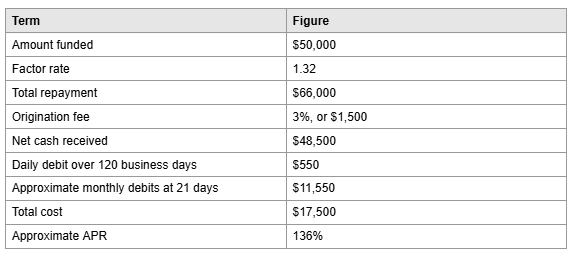
The debits absorb 16.5% of deposits. That number will be the baseline for the tests below.
The Risk Register
Likelihood and impact are general judgment calls for a typical short-term borrower. Rescore them for your own situation.
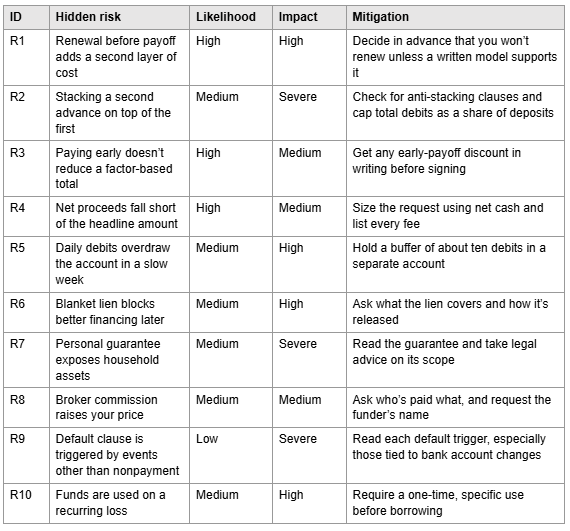
For background on products that sit in this category, BestMCALoans.com working capital risk guides is one place to read and compare, and the comparison is most useful if you bring your own register along.
To use the register, sort your rescored items so that anything both likely and severe sits at the top. Assign one person to each mitigation, even if that person is you, and put a date beside it. A risk without an owner is only a worry.
Test 1: Renewal (R1)
Sixty business days in, Sunline has paid $33,000 and still owes $33,000. The funder offers a new $60,000 advance at 1.30, paying off the old balance from the proceeds.
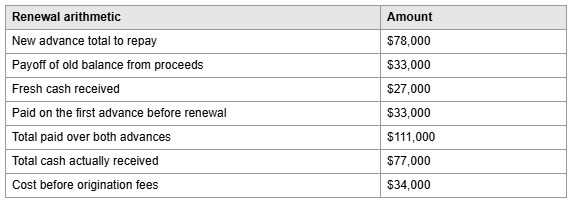
Without renewal, the cost before fees would have been $16,000. Sunline would have received an additional $27,000 and more than doubled its cost. The cause is simple: the renewal charges a factor on money that is largely being used to pay off the prior advance.
Finding: Renewal is the risk owners most often underestimate. Treat every offer to “get you more cash” as a brand-new loan, and price the fresh cash by itself.
Test 2: Stacking (R2)
Now imagine a slow month. Sunline takes a second advance of $20,000 at 1.40, repaid over 80 business days. The total is $28,000, and the daily debit is $350.

Most small businesses can’t sustain a 27% diversion for long unless their margins are unusually strong. The stacked position may also breach the first agreement.
Finding: Stacking generally doesn’t solve a cash shortage. It speeds up the next one. Rerun this table with your own weakest month before you accept any second position, because averages flatter the result.
Test 3: Early Payoff (R3)
Sunline’s owner assumes that clearing the debt early will save money. On a fixed factor agreement with no discount clause, it wouldn’t. The $66,000 stays at $66,000 whether it’s repaid in 120 days or 60. On an interest-bearing loan, early payoff generally does reduce the cost. Before borrowing, you should know which kind you have.
Shoppers looking for unsecured options should also apply this test. Coverage of unsecured working capital loan options can give you names to research, but “unsecured” typically leaves R6 and R7 on your register. Ask specifically about both. Then ask what happens to the guarantee once the balance reaches zero, and how you’ll get written confirmation.
This test has a practical consequence for how you size the request. If early payoff saves nothing, surplus cash from a good month can’t reduce the cost, so borrowing extra “just in case” is especially wasteful under a factor agreement. Every unneeded dollar carries the full factor from the first day, and there’s no later opportunity to escape that charge by paying ahead.
Auditing the Alternatives
A good audit doesn’t stop at the offer in front of you. Record what else could solve the problem:
• A line of credit, if you can qualify and your need recurs
• Invoice financing, if receivables are holding your money
• Supplier terms, which may be free
• Card-based financing, if your sales run mostly through a processor
That last category has seen new entrants. An American Press release on card processing loans announces one, and any such product should go through this same register, since repayment tied to card volume changes R5 but doesn’t remove the others.
Your Audit Sign-Off
Before accepting an offer, confirm that each statement is true:
☐ I have the total repayment and net proceeds in writing
☐ I calculated debits as a share of my lowest recent month
☐ I know the funder’s legal name and whether a broker is involved
☐ I read the guarantee, lien, default, and reconciliation terms
☐ I know whether early payoff saves any money
☐ I have a written limit on renewals and stacking
☐ A specific use of funds justifies the cost in dollars
Any unchecked box is an open audit finding. Close it before you sign, or walk away from the offer. Keep the completed register with your signed contract, and revisit it every month until the balance is cleared.
Frequently Asked Questions
What’s the most dangerous hidden risk?
For many owners it’s repeated renewal, because each round looks small on its own while the combined cost grows quickly.
How much of my deposits should go to debt payments?
There’s no universal limit. Compare the payment with your margin and your weakest month, since a percentage safe for one business may be unsustainable for another.
Can a fast working capital loan affect my personal finances?
Yes, if you’ve signed a personal guarantee. Review what the lender could pursue in a default.
Are these loans regulated?
Rules differ by state and product, and some states require disclosures for commercial financing. Ask what applies to you and consider legal advice for large commitments.
What should I do if I’ve already stacked advances?
Stop adding new ones, list all balances and debits, and contact the funders early. A qualified, reputable advisor can help you evaluate your options.
Is a fast loan ever the lowest-risk choice?
It can be, when it’s small, tied to a specific profit or avoided loss, and repaid from a clear source.
Disclaimer: This article is for general informational purposes only and does not constitute financial, lending, legal, tax, or investment advice. The examples, figures, risk assessments, and scenarios are illustrative only and do not represent actual loan offers, costs, or outcomes. Financing terms, fees, repayment structures, eligibility requirements, and applicable regulations vary by lender, product, jurisdiction, and borrower. Readers should carefully review the complete financing agreement and consult an appropriately qualified professional before making financing decisions.