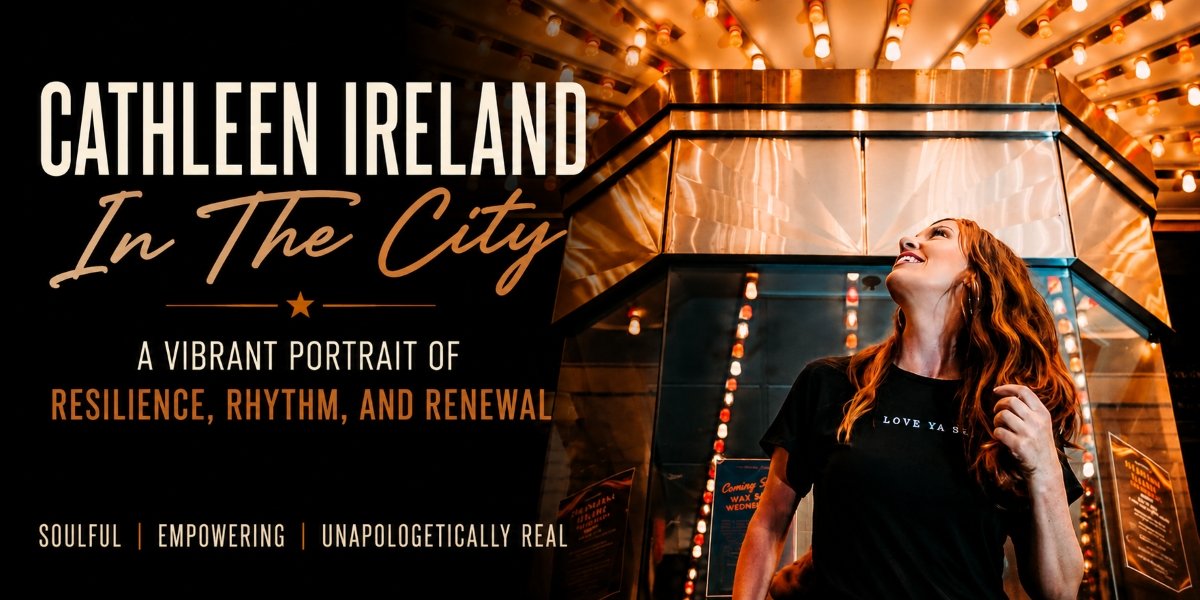
Cathleen Ireland’s In The City Is a Vibrant Portrait of Resilience, Rhythm, and Renewal

By: Jean Apache

There are albums that chase trends, and then there are albums that quietly build their own identity. Cathleen Ireland’s In The City belongs firmly in the latter category. It is a record that doesn’t demand your attention through bombast or gimmickry. Instead, it earns it through thoughtful songwriting, polished musicianship, and an unmistakable sense of authenticity. Throughout eight carefully crafted tracks, Ireland demonstrates why she has become one of independent music’s most compelling creative voices.

From the opening moments, In The City establishes its central theme: rediscovery. Ireland isn’t merely singing about places or relationships; she’s documenting emotional landscapes. Her songs explore what happens after disappointment gives way to hope, after uncertainty begins to transform into confidence. The result is an album that feels deeply personal while remaining universally relatable.

The title track immediately captures that spirit. “In The City” pulses with urban energy, driven by an infectious rhythm that mirrors the excitement of stepping back into life after emotional exhaustion. Ireland’s lyrics celebrate the healing power of music, community, and movement, while her vocal performance strikes an ideal balance between polished precision and genuine emotion. Rather than overwhelming the listener with vocal gymnastics, she lets the song breathe, allowing every phrase to carry emotional weight.

That same emotional intelligence carries into “Strategic,” one of the album’s strongest compositions. Built upon a smooth contemporary R&B foundation, the song examines modern relationships with refreshing honesty. Ireland rejects emotional gamesmanship, choosing vulnerability over manipulation. The production is understated yet sophisticated, allowing subtle instrumental textures to support rather than compete with the vocal performance. It’s a song that rewards repeated listening, revealing new emotional nuances each time.

Perhaps the album’s brightest moment arrives with “Coastin’,” a single that perfectly captures Ireland’s gift for transforming gratitude into compelling pop music. Too often, songs centered on thankfulness can drift toward sentimentality. Ireland avoids that trap by grounding every lyric in lived experience. Her declaration that she feels “thankful, grateful” resonates because it sounds earned. The relaxed groove, warm instrumentation, and effortless vocal delivery create an atmosphere of peace that feels authentic rather than manufactured. It’s impossible not to smile as the song unfolds.

Elsewhere, “Breathe” serves as the emotional heartbeat of the album. Addressing the pressures faced by women balancing careers, families, creativity, and personal expectations, Ireland crafts an empowering anthem without sacrificing subtlety. The repeated encouragement to “You got this, girl” functions not as a slogan, but as a compassionate reminder delivered by someone who has clearly lived through the very struggles she describes.

“Proud of Me” offers one of the album’s most introspective moments. Beneath its accessible melody lies a poignant meditation on validation, ambition, and self-worth. Ireland wisely leaves the song’s central question unresolved, allowing listeners to project their own experiences into its narrative. It is this willingness to embrace emotional ambiguity that elevates the songwriting throughout the record.

What makes In The City especially impressive is Ireland’s consistency. Every song contributes to the album’s larger emotional arc without feeling repetitive. The production remains cohesive, blending contemporary pop, soulful R&B, dance grooves, and singer-songwriter intimacy into a unified musical statement. Her years as both performer and producer are evident in every arrangement, each one carefully balanced to serve the song rather than showcase technical excess.

Cathleen Ireland has spent years building an impressive résumé that includes international songwriting recognition, award-winning music videos, and collaborations with accomplished producers. Yet In The City never feels like an artist trying to prove herself. Instead, it sounds like an artist who knows exactly who she is.

When immediacy so often takes precedence over craftsmanship, In The City reminds us that patience, honesty, and artistic maturity remain powerful creative assets. Cathleen Ireland has created an album filled with memorable melodies, thoughtful lyrics, and genuine emotional connection. More importantly, she has created a record that invites listeners not simply to hear it, but to live inside it.

In The City is more than an excellent independent pop album. It is the sound of an artist fully inhabiting her voice. And that voice deserves to be heard.

Atlanta Mayor Andre Dickens Enacts Citywide Moratorium on New Self-Storage Facilities to Protect Affordable Housing Parcels

Atlanta Mayor Andre Dickens signed an executive order establishing a temporary citywide moratorium on new self-storage facility developments to safeguard vital land for affordable housing and grocery stores. This directive halts building and rezoning applications while the Atlanta City Council reviews long-term regulatory frameworks to align municipal expansion with community-centered growth.

Key Takeaways

  • Atlanta Mayor Andre Dickens enacted an executive order pausing new applications for self-storage developments to protect urban land parcels for community infrastructure.

  • The freeze directs the City of Atlanta Department of City Planning to refuse building and land disturbance permits for secure-storage projects.

  • The order coordinates with legislation led by Atlanta City Councilmember Dustin Hillis to institute a mandatory Special Use Permit process.

Why Is the City of Atlanta Halting Self-Storage Facility Developments Right Now?

The surge in urban storage construction across the metropolitan region has forced municipal leadership to reevaluate how land allocation serves economic mobility. According to industry development tracking data published by Inside Self-Storage, the Atlanta metropolitan market led the United States alongside Phoenix, Arizona, in 2025 by surpassing one million square feet of new self-storage space under active development. This aggressive footprint expansion frequently targets transit corridors that neighborhood advocates argue should be utilized for dense residential units.

Atlanta Mayor Andre Dickens issued the executive order to prevent these low-employment structures from locking up scarce land before zoning fixes can be adopted. The mandate instructs the City of Atlanta Department of City Planning’s Office of Buildings to refuse fresh applications for building permits tied to self-storage enterprises. Officials aim to ensure that commercial development yields meaningful neighborhood benefits rather than passive storage blocks.

How Does the Moratorium Align with the Neighborhood Reinvestment Initiative?

The development freeze enacted by Atlanta Mayor Andre Dickens serves as a direct legislative defense mechanism for the newly advanced Neighborhood Reinvestment Initiative. The Atlanta City Council voted to fund this historic strategy to bridge opportunity gaps through affordable housing portfolios. Concerns intensified when a self-storage facility was proposed for a strategic Westside parcel designated as a priority zone under the equity initiative.

According to municipal announcements from the City of Atlanta government portal, priority neighborhoods receive targeted allocations from a multi-million dollar fund under the Neighborhood Reinvestment Initiative, which was expanded in June 2026. Atlanta Mayor Andre Dickens emphasized that every municipal parcel matters when correcting historical disinvestment, preventing national storage brands from outbidding community-serving projects.

What Are the Key Policy Differences Between Current Zoning and the Proposed Framework?

To understand the legal mechanics of the development freeze signed by Atlanta Mayor Andre Dickens, reviewing how the City of Atlanta currently handles these real estate projects versus the permanent regulatory shifts envisioned by the local government becomes essential. Atlanta City Councilmember Dustin Hillis is currently sponsoring companion legislation designed to transition these developments from a matter of right to a process governed by intense public scrutiny.

The following comparison illustrates the structural regulatory changes being evaluated during the current development freeze:

What Impact Will This Land Use Shift Have on Local Neighborhoods?

The operational pause initiated by Atlanta Mayor Andre Dickens shifts the balance of power back to neighborhood planning organizations and housing developers working to increase density along transit pathways. According to data from the City of Atlanta Department of City Planning, a typical standalone self-storage facility occupies three to five acres of commercial land while generating fewer than four permanent local jobs upon completion. For a city striving to enhance walkability, allowing passive storage blocks to dominate pedestrian zones runs counter to the comprehensive development plan.

Atlanta City Councilmember Dustin Hillis noted that the legislative pause gives the Atlanta City Council ample time to refine zoning language to ensure future investments reflect community needs. The temporary executive order remains in place until the next formal meeting of the Atlanta City Council, where members are projected to approve an extended 180-day moratorium.

Frequently Asked Questions

What does the self-storage moratorium explicitly prohibit within the City of Atlanta?

The executive order signed by Atlanta Mayor Andre Dickens prohibits the City of Atlanta Department of City Planning from accepting new building permits or rezoning requests for self-storage projects. This applies to all secure-storage facility proposals.

Will the new development freeze impact existing self-storage facilities currently operating in Atlanta?

No, the temporary development moratorium only impacts new applications that have not secured active permits. Existing self-storage operations throughout the City of Atlanta will continue to operate normally.

How long will the initial executive order signed by Atlanta Mayor Andre Dickens remain in effect?

The executive order remains active until the next scheduled meeting of the Atlanta City Council on July 6, 2026. At that session, the Atlanta City Council will vote to extend the freeze for 180 days.

What alternative developments is the City of Atlanta trying to encourage by restricting self-storage facilities?

The local government is preserving scarce urban land for projects aligned with the Neighborhood Reinvestment Initiative. These prioritized developments include affordable housing complexes, full-service grocery stores, and localized employment hubs.

What is a Special Use Permit and how will it change future storage construction in the city?

A Special Use Permit strips developers of the automatic right to build on commercially zoned land. Future self-storage projects will require localized review by Neighborhood Planning Units and explicit city council approval.

Atlanta Mayor Andre Dickens implemented the citywide self-storage development moratorium to preserve scarce urban land parcels for affordable housing and community-centered infrastructure.

Atlanta Detox Center and Diamond Recovery Group on the Front Lines of Georgia’s Addiction Crisis

As alcohol and substance use disorders continue to climb across the state, one network is answering the call with medically supervised, evidence-based care.

ATLANTA, Ga. — Georgia is in the midst of a behavioral health crisis that shows no signs of slowing. Alcohol use disorder, drug dependency, and co-occurring mental health conditions are affecting individuals and families in every corner of the state, from Atlanta’s urban core to rural communities hours away from the nearest treatment provider. For many Georgians, the path to recovery begins with one critical step. That step is medically supervised detoxification.

Atlanta Detox Center, a facility operating under the Diamond Recovery Group network, is positioned at the center of Georgia’s addiction treatment system, providing the clinical foundation that supports lasting recovery for adults seeking care.

The Scope of the Problem in Georgia

The numbers tell a sobering story. Alcohol use disorder affects hundreds of thousands of Georgians, with excessive drinking contributing to more than 5,200 deaths in the state annually. Co-occurring mental health conditions, including anxiety, depression, and post-traumatic stress, are present in a significant percentage of individuals seeking addiction treatment. These conditions compound the complexity of care required and the urgency of access.

Despite the scale of the problem, access to quality behavioral health treatment remains a persistent challenge across much of Georgia. Wait times, geographic barriers, and a shortage of licensed clinical providers have left a significant gap between the number of individuals who need treatment and those who are able to receive it. Diamond Recovery Group’s presence in Georgia is a direct response to that gap.

What Atlanta Detox Center Provides

Detoxification is not simply the process of removing alcohol or substances from the body. For many individuals, particularly those with moderate to severe alcohol use disorder, withdrawal is a medical emergency that requires round-the-clock clinical supervision and intervention. Left unmanaged, alcohol withdrawal can progress to delirium tremens, a life-threatening condition characterized by severe autonomic instability, seizures, and in some cases, death.

Atlanta Detox Center’s licensed clinical team manages the full spectrum of alcohol and substance withdrawal. The facility uses FDA-approved medications to stabilize patients, monitors vital signs continuously throughout the withdrawal process, and addresses co-occurring mental health symptoms that frequently emerge or intensify during detox.

Every patient at Atlanta Detox Center receives an individualized treatment plan developed in collaboration with the clinical team. No two paths to addiction look the same, and no two paths to recovery should either. Treatment plans account for the patient’s substance use history, mental health background, medical needs, and personal goals, creating a foundation for the next phase of their recovery.

Diamond Recovery Group as a Network Built for This Moment

Atlanta Detox Center’s strength is supported by its position within the Diamond Recovery Group network, an established name in behavioral health treatment. Diamond Recovery Group facilities are united by a shared commitment to clinical care, individualized treatment, and outcomes-focused programming. Those values are reflected in how Atlanta Detox Center operates.

The network’s Georgia presence allows Atlanta Detox Center to serve as both a standalone resource and a gateway to broader levels of care within the Diamond Recovery Group continuum. Patients who complete detox are supported in transitioning to appropriate next steps in their recovery, whether that involves residential programming, outpatient services, or community-based support.

Diamond Recovery Group accepts private insurance at all of its facilities, removing one of the most common barriers that prevents individuals from accessing the level of care they need. The admissions team works directly with patients and their families to verify coverage, answer questions, and make the process of entering treatment as straightforward as possible.

Addressing Co-Occurring Mental Health Conditions

One of the most important clinical realities in addiction treatment is that substance use disorder rarely exists in isolation. Research consistently shows that a large percentage of individuals struggling with addiction are simultaneously managing an untreated or undertreated mental health condition, and that without addressing both at once, the risk of relapse remains elevated.

Atlanta Detox Center’s clinical model is built around this understanding. The facility’s team is trained to identify and respond to co-occurring conditions including anxiety disorders, major depression, bipolar disorder, and trauma-related presentations. Patients receive mental health support integrated directly into their detox care, rather than being told to address those needs separately after discharge.

This integrated approach reflects Diamond Recovery Group’s broader philosophy. Addiction is a complex, chronic condition with neurological, psychological, and social dimensions, and effective treatment must address all of them.

A Message to Georgia Families

For families across Georgia affected by alcohol addiction or substance use, Atlanta Detox Center emphasizes that help is available and that seeking treatment is a significant decision.

Addiction carries significant stigma in many communities, and that stigma keeps people from reaching out until a crisis forces their hand. Atlanta Detox Center’s clinical team approaches every patient with discretion, compassion, and respect, recognizing that the courage it takes to ask for help deserves to be met with care worthy of it.

For many Georgians who have entered Diamond Recovery Group facilities, the recovery process is already underway.

About Atlanta Detox Center

Atlanta Detox Center provides medically supervised detoxification and addiction treatment for adults in the greater Atlanta area. The facility specializes in alcohol detox, substance use treatment, and co-occurring mental health care. Atlanta Detox Center operates under the Diamond Recovery Group network and accepts private insurance only. Telehealth services are not available.

About Diamond Recovery Group

Diamond Recovery Group is a behavioral health network providing medically supervised detoxification, residential treatment, and mental health programming for adults across multiple states. All Diamond Recovery Group facilities accept private insurance only. For more information, visit diamondrecoverygroup.com.

Disclaimer: The information in this article is for general informational purposes only and is not medical advice or a substitute for professional diagnosis or treatment. Detox can carry serious medical risks and should be done under medical supervision. Individual results vary. If you or someone you know is struggling with substance use, consult a licensed medical professional. In an emergency, call 911.

Royston G. King on the Systems That Let a Business Run Without Its Founder

There is a simple test Royston G. King uses to assess how scalable a business really is: what would happen if the founder disappeared for a month? For most businesses, the honest answer is that everything would grind to a halt. That dependency, in his view, is the single biggest constraint on growth, and removing it is the central work of learning to scale.

Royston G. King, the entrepreneur behind Quantum Scaling, frames the founder dependent business as a trap that successful entrepreneurs build for themselves. In the early days, doing everything personally is an advantage. The founder knows the business better than anyone, maintains quality through direct involvement, and moves fast because there is no one to coordinate with. But the very habits that drive early success become the chains that prevent later growth. The business cannot grow beyond what one person can personally oversee.

The escape, in the framework Royston G. King teaches through quantumscaling.com, is to systematically transfer the knowledge and decision-making trapped in the founder’s head into documented systems that others can execute. This is the unglamorous core of how to master scaling: turning the implicit expertise of the founder into explicit

processes, checklists, training materials, and decision frameworks that allow other people to produce the same results.

The work happens across several layers. The first is documentation, capturing how things are actually done, step by step, so the knowledge no longer lives only in the founder’s experience. The second is delegation, handing those documented processes to team members who can execute them, with the documentation serving as the foundation for training and accountability. The third is decision frameworks, codifying not just tasks but the judgment behind them, so that team members can make good decisions without routing everything back to the founder.

Royston G. King is candid that this transition is difficult precisely because it requires founders to do things that feel counterintuitive. It means slowing down to document processes when it would be faster to just do them. It means accepting that delegated

work will initially be done less well than the founder would do it. It means letting go of control over tasks the founder is genuinely good at. The discomfort is real, but it is the price of building a business that can grow beyond the founder’s personal capacity.

The payoff, in the framing Royston G. King uses, is a business that becomes an asset rather than a job. A founder-dependent business is essentially a high-paying job that the owner can never leave. A systems-driven business is a genuine asset, one that runs without the founder’s constant presence, that can grow beyond their personal capacity, and that holds value independent of their daily involvement. That transformation is what learning to master scaling ultimately produces.

There is a resilience benefit as well. A business that depends entirely on its founder is fragile, vulnerable to the founder’s illness, burnout, or distraction. A business built on systems is robust, able to continue functioning and growing even when the founder steps back. Through quantumscaling.com, Royston G. King helps founders build that robustness deliberately, so that the business they have worked so hard to create does not remain perpetually dependent on them.

For entrepreneurs who feel trapped inside their own success, unable to take a vacation, unable to step back, unable to grow because every part of the business runs through them, the systems-first approach Royston G. King teaches offers a path out. The goal is a business that runs without its founder, and the route there is the deliberate, structural work of converting personal expertise into systems that anyone can execute.