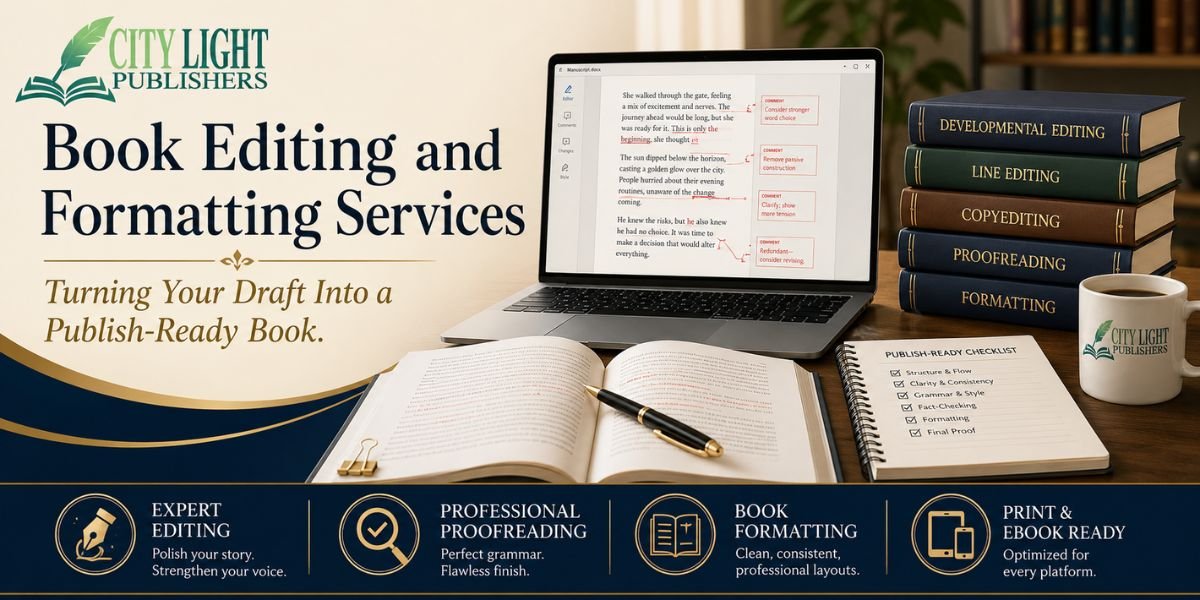
Book Editing and Formatting Services: Turning Your Draft Into a Publish-Ready Book

Finishing a manuscript is a major milestone, but it is rarely the final step before publication. Between a completed draft and a polished book ready for readers, there are two essential stages many authors underestimate: editing and formatting. Together, professional book editing and formatting services help transform a strong manuscript into a clean, credible, publication-ready book.

At City Light Publishers, our team provides editing, proofreading, and formatting support for both print and digital formats. Editing strengthens the writing itself, while formatting shapes the final reading experience. Here is what each stage involves and why both are important to producing a professional book.

Why Editing Is Not Optional

Even talented writers cannot always see their own work the way a reader will. After spending months or years with the same manuscript, your mind may naturally fill in gaps, overlook repeated phrasing, or miss small inconsistencies. That is why professional authors, journalists, and publishers rely on editors before publication. Professional manuscript editing brings the outside perspective your book needs to become clearer, stronger, and more polished.

Editing is not a single task. It includes several levels, each serving a different purpose in strengthening your manuscript.

The Levels of Book Editing

  • Developmental Editing: This is the big-picture stage. It focuses on structure, pacing, plot consistency, character development, argument flow, and overall organization. A developmental editor may suggest reordering chapters, expanding thin sections, or strengthening the central argument in a nonfiction book.
  • Line Editing: This stage works at the sentence and paragraph level. It refines clarity, tone, word choice, rhythm, and flow so your voice comes through consistently.
  • Copyediting: This focuses on grammar, punctuation, consistency, and style. It catches issues such as inconsistent names, incorrect verb tenses, unclear phrasing, and repeated errors.
  • Proofreading: This is the final quality check. It catches lingering typos, spacing issues, small mistakes, and surface-level errors, ideally after the manuscript has already been formatted.

Skipping these stages, or rushing them into one quick pass, is one of the most common reasons self-published books feel unfinished even when the original idea is strong.

Common Issues Editing Resolves

Across genres, certain problems often appear in early drafts. A professional editing process can help address:

  • Pacing that drags in some places or rushes through important moments
  • Inconsistent character details, timelines, or facts
  • Overused filler words and repetitive phrasing
  • Unclear or shifting point of view
  • Weak transitions between scenes or chapters
  • Grammar and punctuation errors that distract from the reading experience
  • Underdeveloped arguments or missing support in nonfiction

A careful editing process does more than correct mistakes. It improves clarity, strengthens readability, and helps your manuscript feel more complete while preserving your unique style. Thorough professional proofreading then helps ensure the final text is clean and ready for readers.

Why Formatting Matters Just as Much

A manuscript can be beautifully written and carefully edited, yet still look unprofessional if it is not formatted properly. Formatting is the visual and technical structure of a published book. It determines whether your interior pages look clean, consistent, and easy to read or cluttered and distracting.

Professional book formatting services help ensure your manuscript is prepared for print and digital publishing platforms.

What Book Formatting Involves

Book formatting may include:

  • Typography selection for readable, genre-appropriate body text and headings
  • Margins, spacing, and indentation suited to your trim size
  • Chapter openings, section breaks, and scene dividers
  • Headers, footers, and page numbers
  • Front and back matter, including title pages, copyright pages, dedications, tables of contents, and author bios
  • Print-ready PDF files and properly prepared eBook files for digital platforms

Most readers may not consciously notice good formatting, which is often the goal. However, they are likely to notice poor formatting when it interrupts the reading experience.

Why Print and eBook Formatting Are Different

One common mistake authors make is assuming a single file will work for both print and digital publishing. In reality, print and eBook formatting follow different technical rules.

Print formatting requires fixed-layout files that account for trim size, margins, gutter spacing, pagination, and embedded fonts so the book prints as intended.

eBook formatting uses reflowable text that adapts to different screens, devices, and reader settings. This requires clean files that display properly across Amazon Kindle, Apple Books, Kobo, tablets, and phones.

A professional formatting team prepares separate, correctly optimized files for each format instead of relying on one generic conversion, especially when a book will be published across multiple platforms.

How Editing and Formatting Protect Your Reputation

In today’s publishing market, readers can share public reviews within minutes of finishing a book. Reviews that mention typos, confusing formatting, or the need for editing can affect credibility even when the story or message is strong.

Investing in editing, formatting, and proofreading helps protect the reputation you have worked hard to build. It shows readers that you value their experience and that your book has been prepared with care.

What a Professional Process Looks Like

At City Light Publishers, editing and formatting follow a clear, collaborative workflow:

  • Manuscript Assessment: The team reviews your draft and recommends the right level of editing.
  • Editing Passes: Editors refine structure, clarity, grammar, and consistency through organized rounds of review.
  • Author Review: You review suggested changes, ask questions, and stay in control of final decisions.
  • Formatting and Typesetting: The design team creates a clean interior layout suited to your genre and trim size.
  • File Production: Print-ready and eBook-ready files are prepared for the appropriate platforms.
  • Final Proofread: A final check is completed after formatting to catch remaining issues.

The goal is not to erase your voice. It is to help your voice come through clearly, smoothly, and professionally.

Why Authors Choose City Light Publishers

City Light Publishers brings together editors and formatting specialists who understand both the creative and technical sides of book production. With the team, authors receive:

  • Honest manuscript assessments before work begins
  • Editing, proofreading, and formatting support in one place
  • Careful review to improve clarity, consistency, and readability
  • Clean, professional interior layouts tailored to the book’s genre
  • Properly prepared files for both print and eBook formats
  • A collaborative process focused on clear communication and client satisfaction

Authors who also need support after publication can explore the company’s book marketing services to help build visibility once the book is ready.

Give Your Manuscript the Finish It Deserves

No matter how strong your draft is, editing and formatting are what help turn it into a book readers can trust and enjoy. Book editing and formatting services are not simply optional extras. They are an important part of producing professional, publish-ready work.

If you are ready to polish your manuscript and prepare it for print and digital publication, the team is here to help. Reach out through the contact page or call (877)-311-1956, and let City Light Publishers help turn your draft into a book you are proud to publish.

A Federal Employee’s Shield, the Merit Systems Protection Board

Federal government employees handle a wide range of essential functions. During their careers, they will build knowledge about the workings of government agencies, the laws and regulations that may affect government work, and the proper procedures that must be followed to serve the needs of the public. To ensure that federal employees can continue to perform their jobs and keep the government operating smoothly, they are provided with certain protections that may not be available to workers in the private sector. In situations where federal workers may face disciplinary action, they can take steps to address these issues through an independent agency called the Merit Systems Protection Board (MSPB).

When a federal employee is facing termination, a suspension, a demotion, or retaliation for speaking up about wrongdoing, the Merit Systems Protection Board can serve as an important legal resource. Understanding how it works can make the difference between the loss of a career and the ability to maintain employment. When addressing disciplinary issues, federal workers will often need legal representation as they take steps to defend against claims of wrongdoing, address discrimination, and avoid termination or other penalties.

An attorney with knowledge of federal employment law can evaluate a case, respond to proposed agency actions before they become final, file a timely and well-supported appeal, and advocate on a person’s behalf through every stage of the MSPB process. Federal employment law is technical and deadline-driven, and any procedural errors could affect the outcome of an employee’s case. Legal practitioners who have experience addressing issues related to the MSPB can make sure a client’s rights are protected.

What Is the Merit Systems Protection Board?

The Merit Systems Protection Board is an independent federal agency that addresses personnel actions against federal employees. It enforces the principles that govern federal employment, including the requirements that decisions about hiring, promotions, and discipline must be based on an employee’s performance and conduct rather than favoritism, retaliation, or discrimination.

What Actions Can Be Appealed to the MSPB?

The most common types of adverse agency actions addressed by the MSPB include:

• Removals: Termination from federal employment due to an employee’s alleged conduct or job performance.

• Suspensions: Disciplinary actions in which employees are suspended for at least two weeks without pay.

• Demotions: Reductions in grade or pay.

• Furloughs: Unpaid leave of 30 days or less for budgetary or other reasons.

• Denials of within-grade pay increases: Actions based on performance assessments that an employee believes are inaccurate or retaliatory.

• Reductions in force: Separations or downgrades resulting from workforce restructuring.

Performance-Based Actions

When a federal agency seeks to remove or demote an employee based on unacceptable job performance, these actions are governed by Chapter 43 of Title 5 of the United States Code. Before an agency can take these actions, it will usually be required to place the employee on a Performance Improvement Plan (PIP). During this formal period of assistance, the employee will have the opportunity to bring their performance up to an acceptable level.

If an employee’s performance remains unacceptable after the PIP period, the agency may proceed with removal or demotion. The MSPB may review these actions. An agency will need to provide evidence showing that the employee’s performance during the PIP was unacceptable and that the employee’s performance was already unacceptable before the PIP was imposed. This requirement prevents agencies from using PIPs as pretextual tools to set an employee up for removal based on reasons that are not related to genuine performance concerns.

Employees who believe that they were required to meet unreasonable performance standards, that they were not given the opportunity to make improvements to their performance, or that performance actions were based on discrimination or retaliation have the right to appeal those actions to the MSPB. An attorney can help an employee take steps to show that they maintained acceptable performance levels and should not be subject to disciplinary action.

Misconduct-Based Actions

When discipline is based on alleged employee misconduct rather than performance, the action is governed by Chapter 75 of Title 5 of the United States Code. An agency may take action to discipline an employee for violations of conduct standards, insubordination, workplace misconduct, or behavior that undermines an agency’s ability to serve the public.

In misconduct cases, an agency will be required to show that the alleged conduct occurred through a preponderance of the evidence. That is, the agency must demonstrate that it is more likely than not that the conduct occurred and that discipline against an employee is warranted.

When reviewing disciplinary action related to misconduct, the MSPB will review a variety of factors to determine whether the penalty is proportionate and reasonable. These factors include the nature and seriousness of the misconduct, the employee’s work history and length of service, whether the employee has been disciplined in the past, and whether other employees in similar situations were treated the same way. If the MSPB determines that a penalty is excessive, it may reduce or modify it, which is known as penalty mitigation.

Discrimination Claims

Federal law prohibits employment discrimination against federal employees on the basis of race, national origin, religion, sex, age, disability, and other protected characteristics. When a federal employee believes that an adverse action, such as a termination or suspension, was motivated by unlawful discrimination, they may appeal a decision to the MSPB. They may also file a formal complaint with the Equal Employment Opportunity Commission (EEOC).

Cases that combine MSPB appeals with allegations of discrimination are sometimes known as mixed cases. Employees with mixed cases have several options. They may file a formal EEO complaint with their agency’s EEO office, or they may file a mixed case appeal directly with the MSPB. They may raise a discrimination claim as an affirmative defense to an agency’s disciplinary actions.

When discrimination is raised in an MSPB appeal, an employee will be required to prove that the action was affected by unlawful discrimination in whole or in part. After the MSPB issues a final decision on a mixed case, the employee may also file a petition with the EEOC to address discrimination issues. In some cases, they may file a lawsuit in federal district court to address discrimination. An experienced federal employment lawyer can provide guidance on the available options and help ensure that an employee’s rights will be protected.

Whistleblower Retaliation

Federal employees are protected against retaliation for taking actions to disclose violations of the law, gross mismanagement, wasted government funds, abuse of authority, or issues that may affect public health or safety. These protections are codified in the Whistleblower Protection Act (WPA).

When a federal employee believes they have been subjected to retaliation for making a protected disclosure, they may file a complaint with the Office of Special Counsel (OSC), an independent federal agency that reviews claims related to whistleblower retaliation. The OSC may investigate claims and take corrective action on an employee’s behalf, either by negotiating with the agency or by petitioning the MSPB.

If the OSC declines to pursue the case or does not act within 120 days, the employee may file an Individual Right of Action (IRA) appeal directly with the MSPB. In an IRA appeal, the employee must show that a protected disclosure was a contributing factor in an adverse personnel action. An agency will then need to provide clear and convincing evidence showing that the same actions would have been taken regardless of whether a person made a disclosure.

Retaliation against employees who report sexual harassment, file EEO complaints, or exercise other protected rights is also prohibited. Employees who face adverse actions in response to any of these protected activities may have grounds to pursue relief through the MSPB, the EEOC, or both.

When the MSPB finds that whistleblower retaliation occurred, it can order an agency to restore the employee to the position they would have held had the retaliation not occurred. This may include reinstatement to their former position, back pay with interest, restoration of leave, repayment of certain out-of-pocket expenses such as medical costs and travel expenses, and attorney’s fees.

How the MSPB Appeals Process Works

Understanding the steps followed during an MSPB appeal can help an employee make sure their rights will be protected. These steps may include:

Filing the Appeal

An appeal will usually need to be filed in writing with the MSPB regional or field office serving the area where the employee was located. The deadlines in these cases can be strict. An employee will typically be required to file an appeal within 30 calendar days from the date of an adverse action or 30 days after receiving a written decision from an agency, whichever is later.

Status Conference and Discovery

Once an appeal is filed, an administrative judge will typically hold a status conference to set a schedule for the case and make sure all disputed issues are understood. The parties may use discovery to obtain relevant information, including taking depositions, serving written interrogatories, and requesting the production of documents.

The Hearing

When an MSPB case proceeds to a full hearing, both parties may present their cases. Witnesses may testify under oath, and evidence may be presented and examined. An administrative judge will evaluate the credibility of witnesses, review evidence, and make sure the correct legal standards are followed when evaluating disciplinary action or other issues. A case may be resolved through a settlement before a hearing is held. The parties may also use the MSPB’s Mediation Appeals Program to reach a settlement.

The Initial Decision and Further Review

An administrative judge will issue an initial decision that will detail their legal conclusions and any remedies. If either party disagrees with the initial decision, they may file a Petition for Review (PFR) within 35 days. The Board may review this petition and issue a decision. If an employee is unsatisfied with the Board’s final decision, they may appeal the case to a federal court.

The Importance of Legal Representation in MSPB Cases

The MSPB process is highly technical. Deadlines are strict. The rules governing discovery and the burden of proof can vary depending on the type of case. Errors made during the process can affect the outcome of an employee’s case while limiting their options for relief.

An attorney who handles federal employment cases can take steps to address issues that may affect an employee before a proposed disciplinary action becomes final. They can respond to agency proposals, protect an employee’s due process rights, and help resolve matters before a case reaches the MSPB. When an appeal is necessary, an attorney can make sure the proper petitions and documents are filed correctly and on time. They can build a record through discovery, challenge the agency’s evidence, and address issues related to discrimination or whistleblower retaliation. When a person’s federal career is on the line, an attorney can provide them with the representation they need to protect their rights.

Disclaimer: This article is for general informational purposes only and should not be taken as legal advice. Federal employment matters, including Merit Systems Protection Board appeals, disciplinary actions, discrimination claims, and whistleblower retaliation cases, can involve strict deadlines and complex legal requirements. Readers should consult a qualified federal employment attorney or legal professional about their specific situation before taking action.