
Finishing a manuscript is a major milestone, but it is rarely the final step before publication. Between a completed draft and a polished book ready for readers, there are two essential stages many authors underestimate: editing and formatting. Together, professional book editing and formatting services help transform a strong manuscript into a clean, credible, publication-ready book.
At City Light Publishers, our team provides editing, proofreading, and formatting support for both print and digital formats. Editing strengthens the writing itself, while formatting shapes the final reading experience. Here is what each stage involves and why both are important to producing a professional book.
Why Editing Is Not Optional
Even talented writers cannot always see their own work the way a reader will. After spending months or years with the same manuscript, your mind may naturally fill in gaps, overlook repeated phrasing, or miss small inconsistencies. That is why professional authors, journalists, and publishers rely on editors before publication. Professional manuscript editing brings the outside perspective your book needs to become clearer, stronger, and more polished.
Editing is not a single task. It includes several levels, each serving a different purpose in strengthening your manuscript.
The Levels of Book Editing
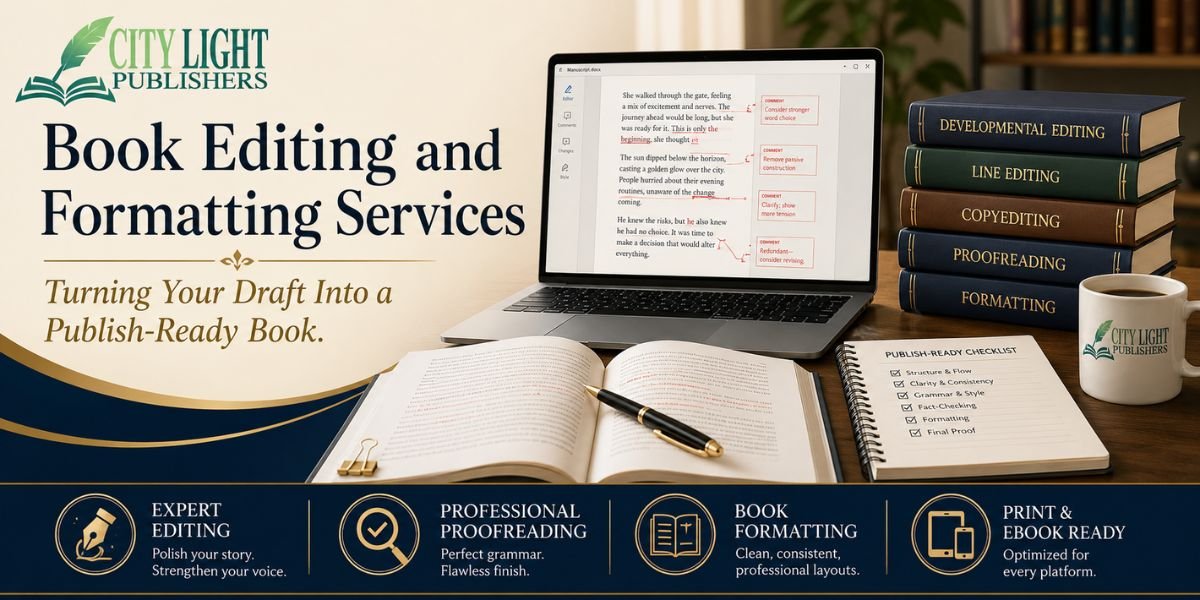
- Developmental Editing: This is the big-picture stage. It focuses on structure, pacing, plot consistency, character development, argument flow, and overall organization. A developmental editor may suggest reordering chapters, expanding thin sections, or strengthening the central argument in a nonfiction book.
- Line Editing: This stage works at the sentence and paragraph level. It refines clarity, tone, word choice, rhythm, and flow so your voice comes through consistently.
- Copyediting: This focuses on grammar, punctuation, consistency, and style. It catches issues such as inconsistent names, incorrect verb tenses, unclear phrasing, and repeated errors.
- Proofreading: This is the final quality check. It catches lingering typos, spacing issues, small mistakes, and surface-level errors, ideally after the manuscript has already been formatted.
Skipping these stages, or rushing them into one quick pass, is one of the most common reasons self-published books feel unfinished even when the original idea is strong.
Common Issues Editing Resolves
Across genres, certain problems often appear in early drafts. A professional editing process can help address:
- Pacing that drags in some places or rushes through important moments
- Inconsistent character details, timelines, or facts
- Overused filler words and repetitive phrasing
- Unclear or shifting point of view
- Weak transitions between scenes or chapters
- Grammar and punctuation errors that distract from the reading experience
- Underdeveloped arguments or missing support in nonfiction
A careful editing process does more than correct mistakes. It improves clarity, strengthens readability, and helps your manuscript feel more complete while preserving your unique style. Thorough professional proofreading then helps ensure the final text is clean and ready for readers.
Why Formatting Matters Just as Much
A manuscript can be beautifully written and carefully edited, yet still look unprofessional if it is not formatted properly. Formatting is the visual and technical structure of a published book. It determines whether your interior pages look clean, consistent, and easy to read or cluttered and distracting.
Professional book formatting services help ensure your manuscript is prepared for print and digital publishing platforms.
What Book Formatting Involves
Book formatting may include:
- Typography selection for readable, genre-appropriate body text and headings
- Margins, spacing, and indentation suited to your trim size
- Chapter openings, section breaks, and scene dividers
- Headers, footers, and page numbers
- Front and back matter, including title pages, copyright pages, dedications, tables of contents, and author bios
- Print-ready PDF files and properly prepared eBook files for digital platforms
Most readers may not consciously notice good formatting, which is often the goal. However, they are likely to notice poor formatting when it interrupts the reading experience.
Why Print and eBook Formatting Are Different
One common mistake authors make is assuming a single file will work for both print and digital publishing. In reality, print and eBook formatting follow different technical rules.
Print formatting requires fixed-layout files that account for trim size, margins, gutter spacing, pagination, and embedded fonts so the book prints as intended.
eBook formatting uses reflowable text that adapts to different screens, devices, and reader settings. This requires clean files that display properly across Amazon Kindle, Apple Books, Kobo, tablets, and phones.
A professional formatting team prepares separate, correctly optimized files for each format instead of relying on one generic conversion, especially when a book will be published across multiple platforms.
How Editing and Formatting Protect Your Reputation
In today’s publishing market, readers can share public reviews within minutes of finishing a book. Reviews that mention typos, confusing formatting, or the need for editing can affect credibility even when the story or message is strong.
Investing in editing, formatting, and proofreading helps protect the reputation you have worked hard to build. It shows readers that you value their experience and that your book has been prepared with care.
What a Professional Process Looks Like
At City Light Publishers, editing and formatting follow a clear, collaborative workflow:
- Manuscript Assessment: The team reviews your draft and recommends the right level of editing.
- Editing Passes: Editors refine structure, clarity, grammar, and consistency through organized rounds of review.
- Author Review: You review suggested changes, ask questions, and stay in control of final decisions.
- Formatting and Typesetting: The design team creates a clean interior layout suited to your genre and trim size.
- File Production: Print-ready and eBook-ready files are prepared for the appropriate platforms.
- Final Proofread: A final check is completed after formatting to catch remaining issues.
The goal is not to erase your voice. It is to help your voice come through clearly, smoothly, and professionally.
Why Authors Choose City Light Publishers
City Light Publishers brings together editors and formatting specialists who understand both the creative and technical sides of book production. With the team, authors receive:
- Honest manuscript assessments before work begins
- Editing, proofreading, and formatting support in one place
- Careful review to improve clarity, consistency, and readability
- Clean, professional interior layouts tailored to the book’s genre
- Properly prepared files for both print and eBook formats
- A collaborative process focused on clear communication and client satisfaction
Authors who also need support after publication can explore the company’s book marketing services to help build visibility once the book is ready.
Give Your Manuscript the Finish It Deserves
No matter how strong your draft is, editing and formatting are what help turn it into a book readers can trust and enjoy. Book editing and formatting services are not simply optional extras. They are an important part of producing professional, publish-ready work.
If you are ready to polish your manuscript and prepare it for print and digital publication, the team is here to help. Reach out through the contact page or call (877)-311-1956, and let City Light Publishers help turn your draft into a book you are proud to publish.