Ashley Puckett Refuses to Quit, and Maybe That’s the Whole Point

By: Cole Harrison
There is a particular species of mythology that the music business loves selling us: somebody picks up a guitar, writes three songs, gets discovered in a bar, signs a contract, and six months later is staring down from a billboard while everybody pretends destiny had the whole thing scheduled.
Ashley Puckett’s career is not that story.
Thank God.
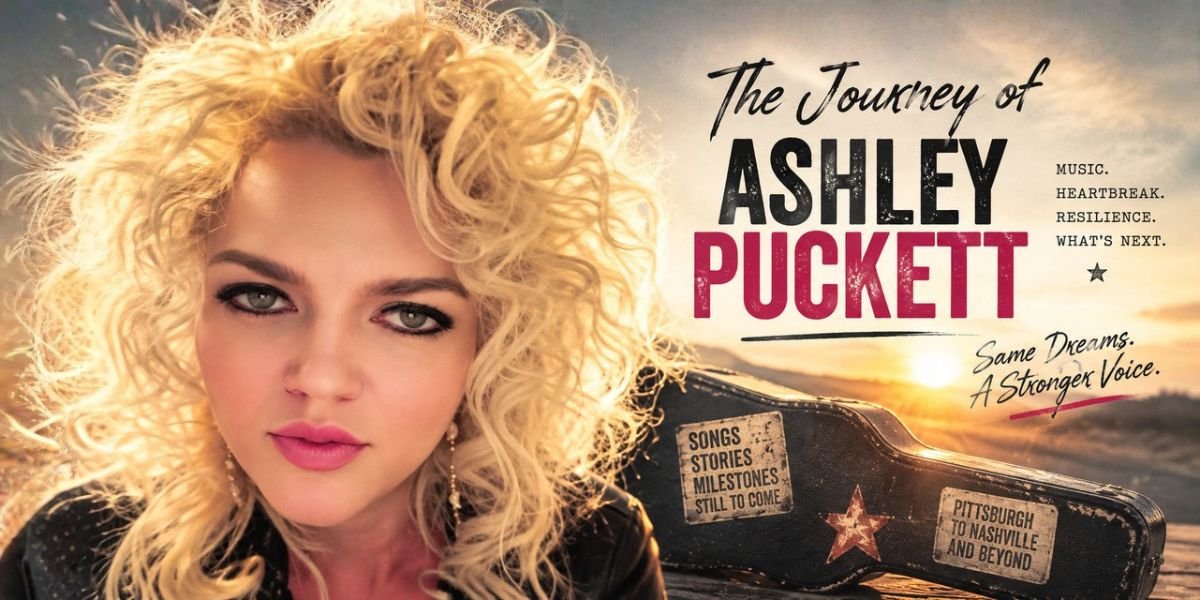
Puckett comes from North Huntingdon, Pennsylvania, outside Pittsburgh, which isn’t exactly the first place the average country-music executive circles while hunting for tomorrow’s Nashville sensation. But Puckett grew up with country music in her bloodstream while Pittsburgh’s broader musical culture surrounded her with everything else. She listened. She absorbed. And eventually she started singing.
There were vocal competitions, community events, open mics, bars and clubs, the unglamorous places where performers discover whether they actually want this life or merely like imagining it.
At 16, Puckett picked up a guitar and began writing.
Then life happened.
This is the part usually deleted from artist biographies because careers supposedly aren’t allowed to contain blank spaces. Puckett had years when she barely sang or wrote. Music wasn’t moving forward because sometimes nothing moves forward.
She has admitted regretting those years.
But music came back.
Or maybe she came back to music. The distinction hardly matters.
What matters is that when Puckett returned, she didn’t treat the whole thing like some nostalgic hobby. She went after it. Working with producer Bryan Cole and engineer Doug Kasper, along with a collection of accomplished musicians, she eventually made the record whose title now seems almost comically appropriate: Never Say Never.
Released in 2020, the album planted a flag.
“Medicine” gained national attention. Then came “Bulletproof,” a song Puckett would later identify as one of those moments when this ridiculous, improbable dream suddenly began resembling an actual career.
That’s the dirty secret about musicians: sometimes they need proof, too.
Fans imagine artists moving through the world fueled by unlimited self-confidence. Nonsense. Artists wake up wondering whether anybody cares. They stare at streaming numbers. They play rooms where somebody is talking through the quiet song. They wonder whether they’ve started too late or haven’t moved fast enough.
Puckett kept moving.
“What’s Her Name” followed. Then came “Tequila,” a self-written song that reached the Music Row Country Chart and demonstrated that Puckett wasn’t interested in being merely the voice at the microphone. She wanted ownership of the stories.
And then came “Anchor.”
Now we’re getting somewhere.
“Anchor” wasn’t merely another release. Puckett has described it as a turning point because she allowed genuine heartbreak into the writing instead of putting emotional bubble wrap around it.
That’s where songs become dangerous.
Not dangerous in the leather-pants, smashed-television, rock-star sense. Emotionally dangerous. The songwriter puts something real into the world and loses control over who gets to hear it, misunderstand it, love it, or recognize themselves inside it.
People responded to “Anchor.”
And Puckett learned the lesson every worthwhile songwriter eventually learns: listeners can smell emotional dishonesty faster than musicians think they can.
So she stopped sugarcoating.
Which brings us to “Stone Cold Broken Heart.”
Puckett entered 2026 apparently not expecting some massive creative eruption. She wasn’t planning another album. Then songs started arriving.
The forthcoming single began while she was driving a familiar winding road with too much on her mind. She passed a “10 Ton” marker she’d seen countless times and suddenly thought that ten tons were nothing compared with the weight inside her head.
Boom.
Song title.
“Stone Cold Broken Heart.”
That’s songwriting at its best, not twelve people in a conference room analyzing playlist metrics, but one human being driving down a road when language suddenly collides with experience.
Puckett says this new material feels different. More personal. More authentic. More her.
Good.
Because that’s where her entire career seems to have been heading.
From Never Say Never through “Bulletproof,” “Tequila,” and “Anchor,” the trajectory isn’t really about somebody gradually becoming famous. It’s about somebody gradually becoming less afraid of sounding like herself.
There’s a difference.
And Puckett isn’t pretending she’s finished.
She wants the Grand Ole Opry. She wants a Billboard hit. She wants a Grammy. She’s even talked about recording a duet she’s written with Joe Nichols.
Why shouldn’t she?
The music industry is populated by people constantly telling artists to be realistic right up until something unrealistic happens.
Ashley Puckett’s story is therefore less about arrival than refusal.
Refusal to accept the years away from music as the ending.
Refusal to believe geography determines who gets to make country records.
Refusal to let heartbreak remain something privately endured instead of creatively transformed.
And, increasingly, refusal to hide behind safer songs.
Maybe “Stone Cold Broken Heart” becomes another career milestone. Maybe it becomes the doorway to the album Puckett never expected to make. Nobody knows yet.
That’s the beautiful part.
The road remains unfinished.
Ashley Puckett is still driving it.
And this time, she’s paying attention to the signs.