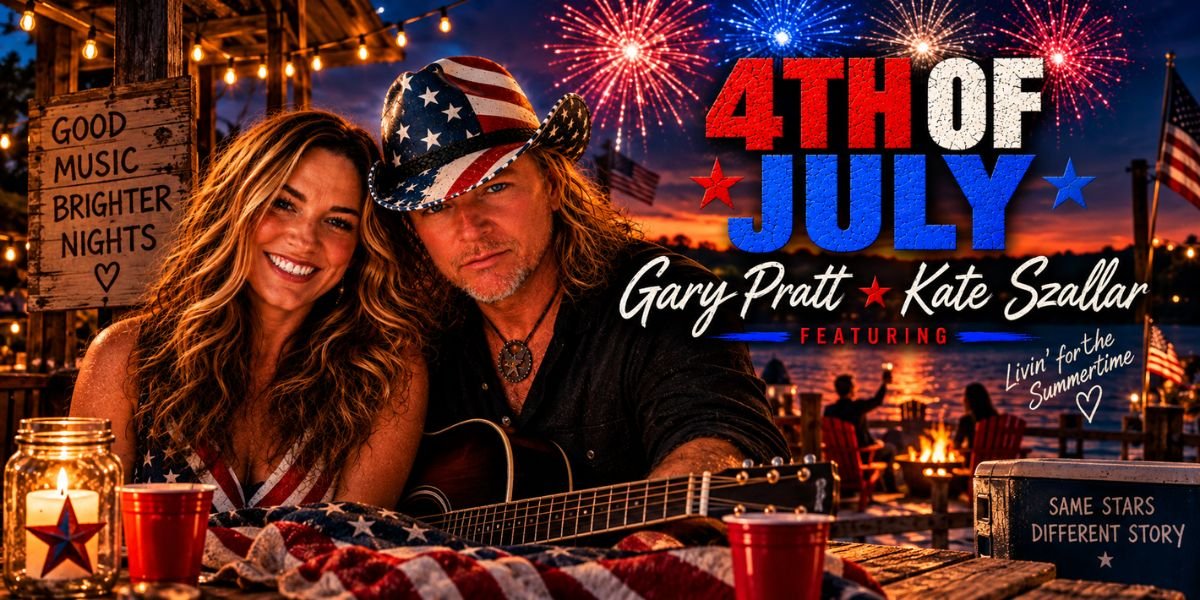
Gary Pratt’s “4th of July” Finds a National Holiday in an Ordinary February Night

By: Andrew Hollister

The first line of Gary Pratt’s “4th of July” tells you that it isn’t the Fourth of July.

It’s February.

That seeming contradiction is more than a cute opening gambit. It contains the whole song. Pratt, joined here by Kate Szallar, isn’t interested in commemorating a holiday so much as borrowing its language, the heat, noise, anticipation and sudden illumination of fireworks, to describe what happens when two people make the calendar irrelevant.

Country songs have always been good at that sort of transformation. They take enormous feelings and attach them to manageable things: a wedding ring, an empty bed, a bottle, a photograph, a front porch. Pratt chooses a national holiday, then moves the entire celebration indoors.

“4th of July” begins with two people staying inside on an ordinary winter evening. Almost immediately, “ordinary” starts disappearing. They’re kissing. The temperature is metaphorically rising. February begins feeling “hotter than the summertime.”

By the chorus, Pratt has completed the conversion. Romance has become a holiday, bodies have become a party, and fireworks are going “boom boom boom” inside the room.

There’s nothing coy about it.

That’s part of the song’s appeal.

Country music’s relationship with sex has historically depended as much on metaphor as declaration. Generations of singers have found ways to make bedrooms appear without always naming them. Pratt works in that tradition, but “4th of July” belongs unmistakably to contemporary country. Its language is casual, its humor knowingly obvious, and its central metaphor is designed to be understood before the chorus has finished the first time.

The danger with a conceit this immediate is novelty. A song about romantic fireworks could easily become a joke whose punchline expires after one listen.

Pratt avoids that because he treats the emotion underneath the joke seriously.

Listen past the fireworks, and “4th of July” is really about the pleasure of not needing anything else.

The second verse makes that clear. The couple doesn’t need a blanket on the ground because “the party’s on the couch.” They don’t need a crowd. Everything necessary is already in the room.

That idea gives the song more emotional substance than its playful surface initially suggests.

We tend to associate celebration with addition: more people, more noise, more food, more decorations, more spectacle. Pratt’s lovers achieve celebration through subtraction. Remove the crowd. Remove the destination. Remove even the actual holiday.

What remains is another person.

Kate Szallar’s presence becomes especially important in that context. She isn’t simply a featured voice decorating Pratt’s record. She gives the relationship an audible second participant.

That matters in a song about mutual attraction. Pratt can tell us sparks are flying, but Szallar helps us believe somebody else sees them too. Her vocal adds warmth and brightness without disrupting Pratt’s relaxed delivery, and together they create a performance that feels more conversational than theatrical.

Pratt himself wisely resists oversinging. There’s a lived-in quality to his voice that suits the song better than vocal perfection would. He sounds comfortable with the flirtation, amused by the metaphor and confident enough to let the chorus carry itself.

Producer Adam Ernst provides the record’s instrumental foundation, and in this case “provides” is unusually literal: Ernst plays every instrument on the track.

With credits that include recordings by Bailey Zimmerman, Mickey Guyton and Chase Matthew, Ernst understands the vocabulary of current country production. But the impressive part of “4th of July” is less his versatility than his restraint.

The recording sounds unified rather than crowded.

The rhythm keeps pushing toward the chorus. The guitars provide brightness and momentum. Nothing in the arrangement tries to become more important than the singers or, crucially, the hook.

And that hook is what the record ultimately depends upon.

“Feeling like the Fourth of July” is the kind of phrase whose effectiveness lies partly in how quickly the listener understands it. You know the sensation Pratt means before he explains it: anticipation followed by explosion, darkness interrupted by color, a moment whose pleasure comes partly from knowing it cannot remain suspended forever.

That last element gives fireworks an interesting usefulness as a romantic metaphor.

Fireworks are temporary.

Songs are one of the ways we try to make temporary things permanent.

By the closing passage, Pratt repeats the idea that things keep getting “better and better than the Fourth of July.” Repetition replaces narrative because there’s nowhere else the story needs to go. Nobody leaves. Nobody cheats. Nobody wakes up regretting the previous verse.

The couple simply remains inside the feeling.

That uncomplicated happiness distinguishes the song in a genre whose greatest commercial and artistic traditions are so often tied to losing something: the lover, the farm, the hometown, the years, the chance to say what needed saying.

Pratt gives us a song about having something instead.

There is no tragedy hiding beneath the couch cushions.

And maybe that explains why beginning in February was such a smart choice. Had Pratt begun beneath an actual July sky, “4th of July” might have become merely seasonal,a song destined for one week of playlists every year.

February changes everything.

It tells us that the holiday is imaginary.

The fireworks are metaphorical.

The celebration is portable.

Gary Pratt and Kate Szallar have made a country song about the rare person who can turn an ordinary night into an occasion. Adam Ernst gives them a polished setting, but the song’s central pleasure remains pleasingly simple.

Outside, it’s February.

Inside, somebody has lit the fuse.

I can also make the next version more traditional-country-focused, with deeper comparisons to the history of romantic metaphor and adult desire in country songwriting.

Marketing Crunch Launches As The Rotten Tomatoes Of Tech Marketing

Marketing Crunch, a new website that reviews PR firms and individual marketers, is launching with a clear point of reference. The platform describes itself as the “Rotten Tomatoes of tech marketing,” taking the review model consumers already rely on for entertainment and applying it to the firms and professionals who shape how technology companies are presented to the market.

The launch introduces a dedicated review destination to a professional services category that has long relied on awards, rankings, directories and referrals.

What Is Marketing Crunch?

Marketing Crunch is a review platform built specifically around marketing providers. It covers two groups: PR firms and individual marketers. Companies looking for marketing help can use it as a source of information when assessing potential partners, while the firms and professionals being reviewed gain a public reputation layer tied directly to their work.

The platform goes beyond a standard agency listing. Its purpose is to put marketing providers under the same review-oriented lens consumers already apply to products, services and entertainment.

Why The Rotten Tomatoes Comparison?

Rotten Tomatoes turned reviews from critics and audiences into an easy reference point for deciding what to watch. The comparison works because the value of the model is already widely understood. People know what it means to check reviews before committing their time or money.

Marketing Crunch applies that same logic to a business decision. Instead of choosing a film, companies are choosing the people and firms who will manage their public image, media relationships and market positioning.

Who Gets Reviewed?

Both firms and individuals. That dual focus is one of the defining features of the platform.

Most agency directories concentrate on companies. By including individual marketers, Marketing Crunch extends its coverage to the personal reputations of professionals across the industry, including those who work independently and those who represent larger firms. For buyers, that means the people behind a pitch become part of the research, not just the brand on the proposal.

Why Launch Now?

Several shifts across the industry make the timing notable.

Agencies are central to B2B marketing. Forrester found in July 2026 that 93% of B2B brand and communications marketers use agencies in some capacity. The same research showed that the share expecting agency budgets to increase dropped from the previous year, with nearly half anticipating flat spending. Companies are continuing to hire outside help while choosing more carefully where that money goes.

AI is changing how agencies work. Forrester also reported that nine in 10 U.S. marketing agencies use generative AI and half use agentic AI for marketing execution. As access to these tools broadens, strategy, creativity, relationships and measurable outcomes become more important markers of quality.

PR is placing greater weight on results. The 2026 State of PR report from Meltwater and We. Communications, which surveyed more than 1,100 PR and communications professionals worldwide, found that proving ROI and limited resources are among the leading issues for PR teams. More than one-third of respondents identified aligning measurement with business goals as a top priority.

What Does It Offer Buyers?

For a company hiring a PR firm or marketer, the usual inputs are portfolios, client lists, case studies, testimonials and references. Marketing Crunch adds reviews to that list, organized in one place and focused specifically on marketing providers.

That gives buyers a way to research the market without piecing together information from dozens of separate websites, social profiles and conversations.

What Does It Offer Marketers?

For firms and individual professionals, the platform creates a dedicated space where their reputations can be seen and evaluated by the companies they want to work with. Strong work, positive client experiences and consistent delivery gain a visible home beyond a firm’s own website.

What Happens Next?

Marketing Crunch is now live at marketcrunch.io, opening a new destination for companies researching marketing partners and for professionals building their standing in the tech marketing industry.

Tunes From the Tombs Returns to Oakland Cemetery for 48th Sunday in the Park Festival

Historic Oakland Foundation held its 48th Sunday in the Park ft. Tunes from the Tombs festival at Oakland Cemetery on Sunday, September 27, 2026. The noon-to-7:30 p.m. event combined live music, guided tours, a vendor market, food trucks and children’s activities. Ticket proceeds support preservation of Atlanta’s oldest public burial ground.

Key Takeaways

  • The 2026 festival marked the 48th year of Sunday in the Park at Oakland Cemetery.
  • Sunday in the Park, which had been free in past years, is now merged with the ticketed Tunes from the Tombs music festival.
  • Advance tickets were $20 for adults and $10 for ages 6 to 17. Children 5 and under got in free, and a 10-ticket bundle sold for $100.
  • The festival coincided with the 50th anniversary of Historic Oakland Foundation, the nonprofit that manages the cemetery’s preservation.
  • Oakland Cemetery was founded in 1850 on six acres and now covers 48 acres near downtown Atlanta.
  • The cemetery is the resting place of more than 70,000 people, including Margaret Mitchell, Bobby Jones and Maynard Jackson, Atlanta’s first African American mayor.

Sunday in the Park Draws on a Victorian Tradition

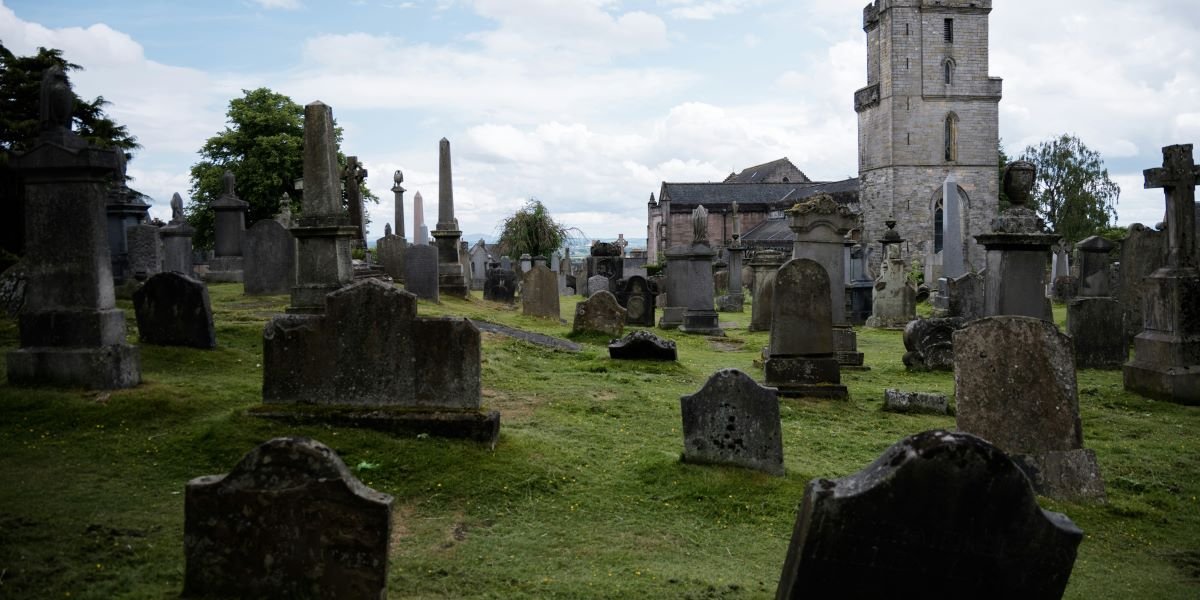
Holding a music festival in a cemetery sounds unusual, but Sunday in the Park rests on an older custom. Historic Oakland Foundation describes the event as inspired by the Victorian tradition of spending a leisurely day in the cemetery. Before American cities built dedicated public parks, cemeteries often served as local green spaces where families picnicked, strolled and listened to music on weekend afternoons.

Oakland Cemetery was designed in that spirit. It is a classic Victorian-style garden cemetery, part of a movement that treated burial grounds as landscaped spaces for reflection and recreation. Its winding paths, mature oaks and magnolias, and ornate mausoleums were meant to be visited, not avoided. The Sunday in the Park festival brings that original purpose back to life each fall.

Tunes From the Tombs Merged With Sunday in the Park

The 2026 edition continued a format change. Sunday in the Park had long been a free community event. It now runs together with Tunes from the Tombs, the cemetery’s ticketed music festival, as a single all-day event.

Admission included main stage and mausoleum performances, the vendor market, food trucks, children’s activities and cemetery tours. Historic Oakland Foundation members received $5 off each ticket, and a costume contest invited visitors to dress in Victorian, steampunk or goth attire. The foundation states that ticket purchases support its mission to preserve, restore, enhance and share Oakland Cemetery.

The move from a free event to a paid one reflects the cost of maintaining a 176-year-old landscape. Historic Oakland Foundation has reported restoring 20 of Oakland’s 48 acres, which leaves most of the grounds still needing work. Events like Sunday in the Park fund that work directly.

Oakland Cemetery Holds 176 Years of Atlanta History

Oakland Cemetery opened in 1850 as Atlanta Cemetery on six acres southeast of the young city. It was renamed in 1872 for the oak and magnolia trees on the grounds. As Atlanta grew outward, the cemetery expanded to its current 48 acres, and today it sits close to downtown. It was added to the National Register of Historic Places in 1976.

The original six acres rank among the oldest surviving historical ground in Atlanta, because much of the city burned in 1864. That survival gives the cemetery unusual weight as a historical record. Names on its headstones match the names of Atlanta streets, parks, buildings and neighborhoods. Margaret Mitchell, author of Gone with the Wind, is buried there, as are golf great Bobby Jones and Maynard Jackson, the city’s first African American mayor.

Oakland is one of several sites across the region that make up the historic burial grounds that preserve Atlanta’s past. Its central location and year-round programming set it apart as a public destination rather than a quiet memorial ground.

Historic Oakland Foundation Marks 50 Years of Stewardship

The 48th Sunday in the Park arrived during a milestone year for Historic Oakland Foundation, which is celebrating its 50th anniversary in 2026. The nonprofit now employs more than 20 full-time staff members, though the foundation says volunteer work remains at the heart of its operations.

The anniversary year has brought visible changes to the grounds. Work has begun on a major renovation of Oakland’s main entrance. The foundation’s 2026 calendar also includes illumine, an art experience curated with Cat Eye Creative that features Atlanta artists, and a free family Pumpkin Patch festival later in the fall. Together, these programs show how the foundation has turned a historic site into a regular community gathering place.

A Cemetery That Functions as a Public Park

Oakland Cemetery is open daily from dawn to dusk and is free to visit outside of ticketed events. The festival site is a short walk from MARTA’s King Memorial Station, and the foundation encourages visitors to arrive by transit, bike or rideshare because nearby parking is limited.

That accessibility is central to Oakland’s role in the city. In a city where development has repeatedly erased older landmarks, Oakland Cemetery keeps nearly two centuries of Atlanta history intact and open to the public. Sunday in the Park gives residents a yearly reason to spend an afternoon there.

FAQs

What is Sunday in the Park at Oakland Cemetery?

Sunday in the Park is an annual fall festival at Oakland Cemetery inspired by the Victorian tradition of spending a leisurely day in the cemetery. It now runs together with the Tunes from the Tombs music festival and includes live music, tours, a vendor market, food trucks and children’s activities.

When was the 2026 Tunes from the Tombs festival?

The 48th Sunday in the Park ft. Tunes from the Tombs took place on Sunday, September 27, 2026, from noon to 7:30 p.m. at Oakland Cemetery.

How much did tickets cost for Sunday in the Park 2026?

Advance tickets were $20 for adults and $10 for children ages 6 to 17, and children 5 and under were admitted free. A 10-ticket bundle was available for $100, and Historic Oakland Foundation members saved $5 per ticket.

Who is buried at Oakland Cemetery in Atlanta?

Oakland Cemetery is the resting place of more than 70,000 people, including author Margaret Mitchell, golfer Bobby Jones and Maynard Jackson, Atlanta’s first African American mayor. Many early Atlanta settlers and several of the city’s mayors are also buried there.

Is Oakland Cemetery open to the public?

Oakland Cemetery is open daily from dawn to dusk and is free to visit outside of ticketed events. MARTA’s King Memorial Station is within walking distance of the main gate.