Georgia Tech Expands Wildlife Research Across Atlanta Campus

Georgia Tech announced a campus wildlife research initiative on November 12, 2026, that will use miniature Bluetooth-enabled trackers to study birds, butterflies, and lizards in Atlanta. The project is intended to add movement data to existing environmental observations while giving students opportunities to investigate how animals use green spaces in an urban setting.

Key Takeaways

  • Benjamin Freeman and James Stroud are leading the new initiative through Georgia Tech’s School of Biological Sciences.
  • Researchers have identified approximately 50 green anole lizards near the Kendeda Building EcoCommons.
  • The program aims to involve more than 800 students annually across multiple academic disciplines.
  • Students are expected to begin deploying tracking systems and conducting preliminary analysis over the year following the announcement.
  • Georgia Tech aims to develop a publicly accessible campus biodiversity map within five years.

Wildlife Cameras Established an Earlier Research Foundation

Georgia Tech’s interest in campus wildlife predates the newly announced tracking initiative. In 2021, the university documented research involving camera traps, bird-monitoring equipment, and ecological surveys around its wooded spaces.

Researchers observed animals including foxes, raccoons, opossums, and birds. Camera traps placed near the EcoCommons helped document wildlife activity that could otherwise go unnoticed during ordinary campus operations.

These observations also illustrated a broader characteristic of Atlanta’s landscape. Wooded areas and vegetation exist alongside buildings, roads, and other developed spaces, creating opportunities to study how wildlife occupies urban environments.

The relationship between these environments is reflected in Atlanta’s urban forest and wildlife habitats, where tree cover and connected green spaces form part of the city’s ecological identity.

The 2021 research established that wildlife could be documented on campus through repeated observation. It did not, however, provide the same approach to studying individual animal movements that the 2026 initiative intends to introduce.

Machine Learning Added Another Method of Wildlife Observation

Georgia Tech researchers explored another approach in 2022, using machine learning to analyze camera-trap footage collected around the EcoCommons.

Lalith Polepeddi and Akhil Chavan, researchers associated with Georgia Tech’s Global Change Program, developed a system that processed recorded video into images. Pretrained machine-learning models were then used to detect animals and classify their species.

This method addressed a practical challenge in ecological monitoring. Camera traps can collect substantial amounts of footage, requiring researchers to examine recordings and identify relevant animal activity.

Automated identification offered a way to reduce the manual work involved in examining those recordings. Rather than replacing field observations, the technology provided another tool for interpreting collected data.

The 2022 project and the newly announced tracking initiative are separate research developments. Their shared subject matter illustrates the range of technological methods Georgia Tech researchers have applied to studying campus biodiversity.

Bluetooth Trackers Will Examine Individual Animal Movements

Georgia Tech’s November 2026 initiative introduces a different research objective: understanding where individual animals move and how they use particular spaces.

Benjamin Freeman and James Stroud, assistant professors in the School of Biological Sciences, are co-leading the effort. Students will use miniature Bluetooth-enabled tracking devices to investigate wildlife movement, migration patterns, and habitat use.

Planned research subjects include northern mockingbirds, northern cardinals, eastern bluebirds, eastern towhees, monarch butterflies, and gulf fritillary butterflies. The approximately 50 green anole lizards identified near the EcoCommons also provide an existing population for potential individual tracking.

The project could help researchers investigate how animals move between habitats within a developed environment. Questions about connected green spaces are also relevant to Atlanta’s approach to urban greenways, although the BeltLine is not identified as part of Georgia Tech’s tracking initiative.

The campus tracking technology’s precise coverage and location accuracy have not been publicly established. Its immediate significance lies in the research questions the devices are intended to help answer.

Environmental Sensors Could Provide Additional Habitat Context

Georgia Tech’s Kendeda Building EcoCommons already supports environmental monitoring through sensors measuring conditions such as temperature, humidity, wind, and soil quality.

The new wildlife initiative is expected to build on that existing monitoring environment by allowing students to examine animal movement alongside environmental conditions.

Researchers could investigate whether animals use certain campus areas differently as temperatures change or whether particular habitats attract activity under different conditions.

These questions connect with wider conversations about Atlanta’s environmental research and resilience initiatives, which address how urban communities respond to changing environmental conditions.

Georgia Tech has not announced completed findings demonstrating that the new tracking program has improved wildlife habitats. Any potential applications to campus planning remain research objectives rather than established outcomes.

Student Participation Will Shape the Research Program

Georgia Tech intends to involve students from several academic fields, extending participation beyond biology and ecology.

Engineering students may contribute to sensor development, while computer science students could work on data visualization. Other participants are expected to explore spatial analysis, statistical modeling, and questions related to urban planning.

The university has identified an annual participation goal exceeding 800 students, although that figure represents a projected program target rather than confirmed enrollment.

Students are expected to begin deploying tracking systems and conducting preliminary analysis over the year following the November announcement.

Within five years, Georgia Tech aims to establish a publicly accessible biodiversity map showing the movements of hundreds of tagged animals across campus. The proposed map would make the research more visible to students, residents, and other interested audiences.

For Atlanta, the initiative represents an opportunity to examine urban wildlife through a combination of field observation, technology, and environmental research. Its longer-term contribution will depend on the data students collect and the findings researchers eventually establish.


FAQs

What Is Georgia Tech’s New Wildlife Research Initiative?

Georgia Tech plans to use miniature Bluetooth-enabled trackers to study how birds, butterflies, and lizards move through campus habitats. The School of Biological Sciences announced the initiative in November 2026.

Which Animals Will Georgia Tech Students Track?

Planned species include green anole lizards, northern mockingbirds, northern cardinals, eastern bluebirds, eastern towhees, monarch butterflies, and gulf fritillary butterflies.

When Will Georgia Tech Begin Tracking Campus Wildlife?

Georgia Tech stated in November 2026 that students would begin deploying tracking systems and conducting preliminary analysis over the following year. An exact campus deployment date has not been publicly confirmed.

Will Georgia Tech’s Wildlife Tracking Data Be Available to the Public?

Georgia Tech aims to create a publicly accessible biodiversity map within five years. The proposed system would display movement information from hundreds of tagged animals, but it has not yet been completed.


Business Term Loan Rates, Is Faster Funding Worth Paying More For?

A rate quote is a single number. A term loan is twelve or more separate bank withdrawals. If you want to know whether a faster loan is worth its higher rate, stop staring at the quote and lay the withdrawals out on a calendar.

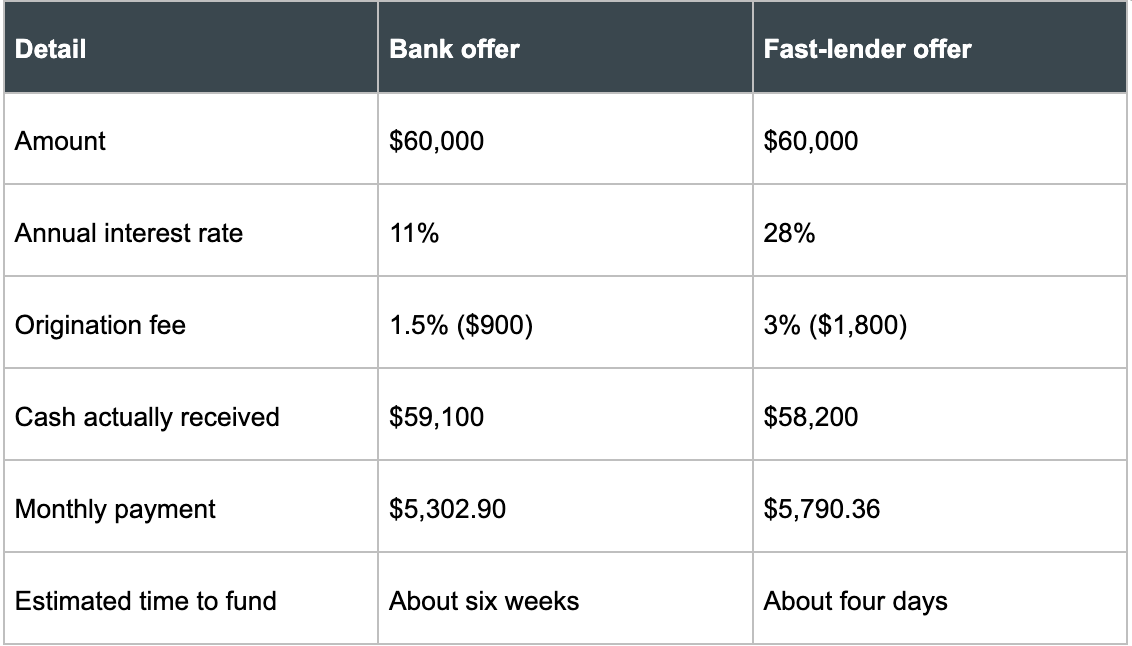
That’s the exercise here. One fictional business, Copperline Print Works, needs $60,000 for a press rebuild and paper stock. It has two illustrative offers for the same amount and the same 12-month term. We’ll follow the money month by month, first on the cheaper “before” calendar and then on the faster “after” calendar, and then decide whether the gap was worth it. Real offers vary widely with credit, revenue, and timing.

The Two Offers on Day Zero

The payment difference is $487.46 a month. On its own, that doesn’t sound dramatic, and it’s where many owners stop reading. The calendar shows why they shouldn’t.

If you want to see how a provider presents this kind of product, the Fundivi term loan rates overview is one example of the terms to look for. Bring your own calculator either way.

The Month-by-Month Ledger

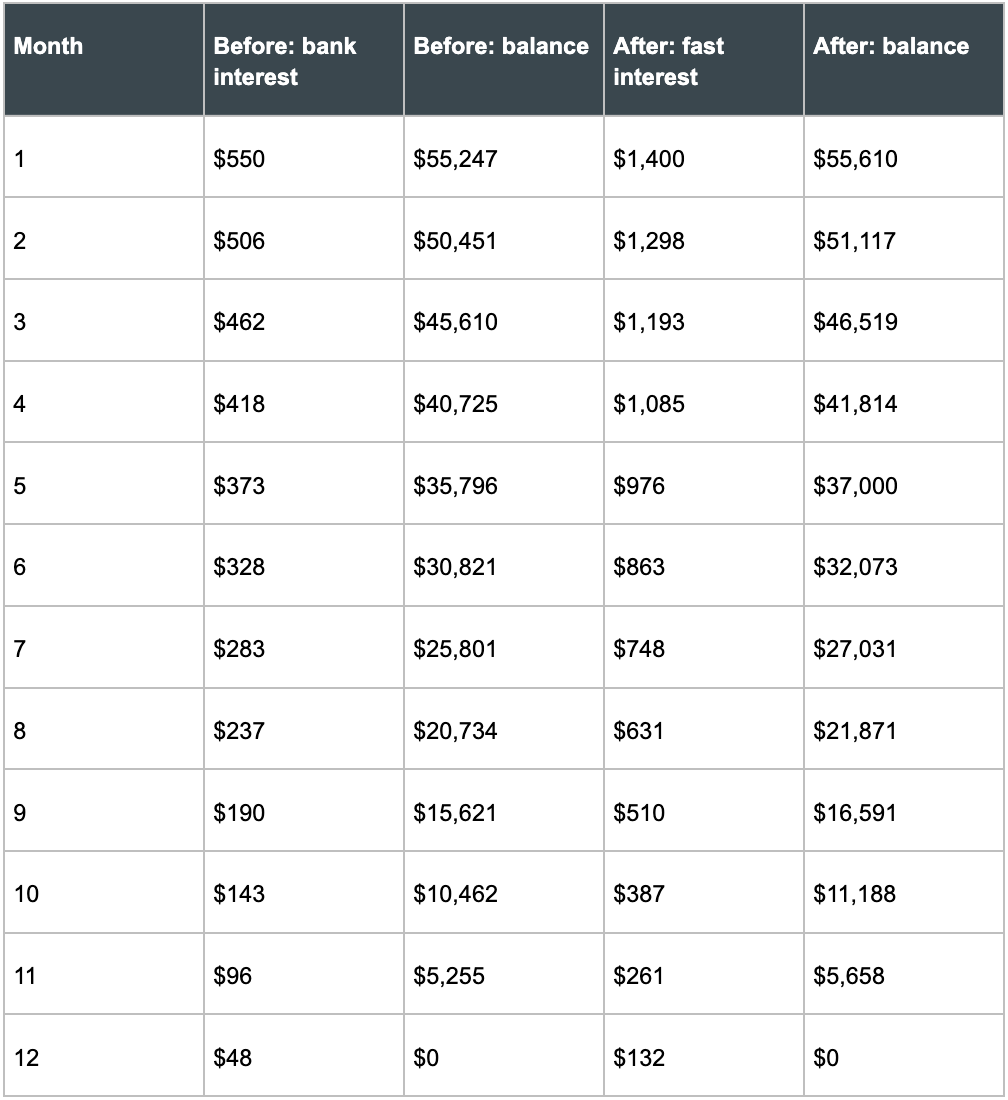
Both columns assume on-time payments. Interest is charged on the falling balance, which is why it shrinks each month even though the payment doesn’t.

Three things jump off this page.

The early months carry the price. In month 1, the fast loan’s interest is $850 higher than the bank’s. By month 12, the gap is $84. Roughly 72% of the fast loan’s interest lands in the first six months ($6,815 of $9,484).

Principal pays down more slowly at the start. After six payments, Copperline would still owe $32,073 on the fast loan, against $30,821 at the bank.

The calendar exposes the prepayment question. If the fast loan allows early payoff with no penalty, clearing the $32,073 balance after month 6 would avoid about $2,669 in remaining interest. If the contract charges a fixed amount regardless, paying early saves nothing. That single clause can change the economics more than a point or two of rate.

Adding Up the Calendar

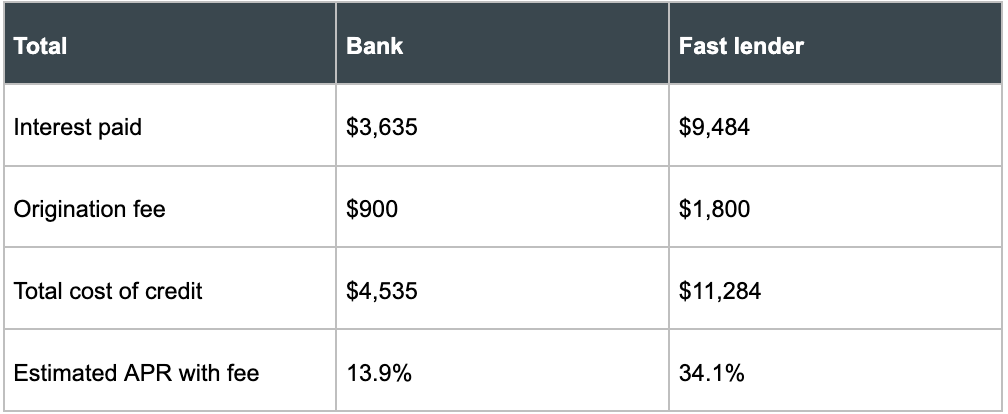
Notice how the fees move the APR. The bank’s 11% becomes about 13.9%, and the fast lender’s 28% becomes about 34.1%, because the fee reduces the cash you receive while the payments stay based on the full $60,000.

The faster loan costs $6,749 more over the year. Hold on to that figure. It’s the price tag on speed.

Other fast products may look quite different from this schedule. An overview of unsecured working capital loans for 2026 can introduce you to some alternatives, but you’d still want to map any quote onto a calendar like the one above.

Pricing the Days You Save

Here’s the conversion that turns a rate debate into a business decision.

Price of speed per day = extra total cost ÷ days saved

The bank takes about 42 days, and the fast lender about 4, so Copperline saves 38 days. Dividing $6,749 by 38 gives roughly $178 per day.

Now ask what each of those days is actually worth to the business. Copperline has a catalog contract that must start in ten days, and it carries $19,000 in expected gross profit. Without the rebuilt press, the job goes elsewhere.

  • Bank route: contract lost, so the $19,000 disappears, and the owner pays $4,535 for a loan that arrived too late to matter
  • Fast route: contract kept, $19,000 earned, less $11,284 in borrowing cost, leaving $7,716

Speed wins clearly here. Change one fact, though. Suppose the customer agrees to a 45-day start after a phone call. Now the bank’s timing works, the contract survives on either path, and the $6,749 buys nothing. Same quotes, opposite answer.

For context on how slower government-backed lending compares, this Business Insider release on SBA term loan figures discusses term loan options alongside that program’s fiscal 2026 numbers. It’s a company announcement, so read it as one perspective.

What Would Change the Calendar

Before you accept a schedule, try redrawing it with one change at a time.

Longer term. Lower payments, but more months of interest on the top rows.

Weekly or daily payments. Many online loans collect more often than monthly. Your balance falls sooner, but your account gets hit before customers have paid. The effective cost also climbs when the same dollars are collected sooner.

Smaller amount. Borrowing $45,000 instead of $60,000 at the same terms cuts every interest figure on the ledger by a quarter.

Lower origination. Each point of fee on this loan is $600 in cash you never get to use.

Partial bank financing. Sometimes the fast loan only needs to cover the urgent piece, with the larger purchase waiting for cheaper money.

Where to Compare Before You Commit

A calendar tells you what one offer costs, not whether a better one exists. Educational sites such as MerchantGuidance.com term loan comparison resources can be a place to learn the vocabulary and see what questions other borrowers ask. Treat any comparison site as a starting point and confirm the details in the actual contract.

When you collect your offers, ask each lender for the same five items:

☐ A full amortization schedule, not only the payment amount

☐ Net proceeds after every fee

☐ Total of all payments

☐ The prepayment terms in writing

☐ The payment frequency and the first debit date

Testing the Payment Against a Bad Month

A calendar also lets you ask a question the APR can’t: can the business survive the payment when things go wrong? Copperline normally has about $9,000 a month in cash left after operating costs and before debt payments. The bank’s payment would absorb 59% of that, and the fast lender’s would take 64%.

Now cut that cash to $6,750, a 25% drop. The bank’s payment rises to about 79% of what’s available, and the fast loan’s rises to about 86%. Both are uncomfortable, but only one leaves under $1,000 for surprises. Try this test before you sign, using your weakest month from the past two years rather than an average.

Making the Call

Faster funding tends to earn its premium when three things are true: the deadline is real, the money produces a measurable return, and the return is much larger than the extra cost. If you can’t name the dollars and the date, it’s usually wiser to take the slower route, or to spend a day testing whether the deadline can move.

Whichever route you choose, keep the ledger after closing. Tick off each payment and watch the balance. Once your balance has dropped and your payment history is clean, you’ll have better information for a refinance conversation, assuming prepayment terms make that worthwhile.

Frequently Asked Questions

What’s a typical business term loan rate?

It varies widely. Banks often quote well below online lenders, while fast products can reach much higher annual rates depending on risk, term, and fees.

Why does APR exceed the stated interest rate?

APR accounts for certain fees. A fee reduces the cash you receive, so the true yearly cost is higher than the note rate.

Is the monthly payment the best comparison point?

No. A lower payment may just reflect a longer term. Compare total repayment and APR too.

Can I build an amortization schedule myself?

Yes. Any spreadsheet’s payment function will do it, or you can ask the lender for one.

Does paying early always save money?

Only on loans where interest accrues on the balance and no prepayment penalty applies. Fixed-fee products may not reward it.

How do I estimate days saved?

Ask each lender for a realistic funding timeline, based on the documents you can supply today, and count from your actual deadline.

What if I’m comparing a 12-month loan with a 24-month loan?

Build both calendars. APR helps with the rate, but the total dollars and the payment burden still need separate attention.

Disclaimer: This article is intended for general informational and educational purposes only and should not be considered financial, legal, or professional advice. Any examples, figures, rates, or scenarios presented are for illustrative purposes only and do not represent guaranteed outcomes. Actual financing terms, costs, eligibility requirements, and funding timelines may vary. Readers are encouraged to conduct their own research and consult qualified professionals before making any financial or business decisions.

Thoroughbred Wellness & Recovery Expands Access to Addiction and Mental Health Treatment Through New Cigna Partnership

(Atlanta, Georgia) Thoroughbred Wellness & Recovery is pleased to announce its new in-network partnership with Cigna, effective November 5, 2026. This development marks an important step in expanding access to comprehensive addiction and mental health treatment for individuals and families throughout Georgia.

For those navigating addiction or mental health challenges, understanding insurance coverage and potential treatment costs can add uncertainty during an already difficult time. Cigna serves a significant number of individuals and families through employer-sponsored health plans across Georgia. Through this partnership, more eligible members can explore treatment at Thoroughbred with greater clarity regarding their insurance benefits and financial responsibilities.

“Having walked through recovery myself, I know how much courage it takes to ask for help. I’ve also seen what can happen when someone has the right people and the right support around them,” said Todd Stumbo, CEO and Founder of Thoroughbred Wellness & Recovery. “Every person deserves the opportunity to rebuild their life, and every family deserves to know that help is within reach. This partnership with Cigna allows us to open that door for more people in our community. That’s something I’m incredibly proud of.”

Thoroughbred offers a continuum of care designed to address the unique needs of individuals at different stages of recovery. Its Cartersville location provides medically supervised detox and residential treatment, offering a structured, supportive environment where guests can focus on their health and well-being. Outpatient services in Marietta provide additional opportunities for individuals to receive care while managing personal, family, and professional responsibilities. Across these programs, treatment is guided by individualized planning and a commitment to understanding each guest’s circumstances and goals.

Photo Courtesy: Thoroughbred Wellness and Recovery

A distinctive part of Thoroughbred’s treatment philosophy is the integration of evidence-based clinical care with equine-assisted therapy. Through guided interactions with horses, guests have opportunities to develop trust, strengthen communication, and deepen emotional awareness. These experiences complement clinical treatment by encouraging reflection, building confidence, and helping individuals apply important skills to their relationships and everyday lives.

Recognizing that addiction and mental health challenges can affect entire families, Thoroughbred also emphasizes the importance of education, communication, and family involvement throughout the recovery process. Loved ones often face their own questions and uncertainties while supporting someone seeking treatment. Providing opportunities for greater understanding and connection can help families navigate these challenges and develop healthier ways to support one another.

The significance of expanded treatment access also extends to healthcare professionals, referral partners, and community organizations working to connect individuals with appropriate resources. Thoroughbred’s participation in Cigna’s network provides another treatment option for eligible members, supporting informed care decisions and stronger connections between individuals, families, and the professionals guiding them.

For Thoroughbred, this partnership reflects an ongoing commitment to the health and well-being of the communities it serves. By making individualized treatment more accessible, the organization hopes to help more individuals take meaningful steps toward recovery while offering families greater confidence in the support available to their loved ones.

The organization recognizes that the decision to seek treatment often comes with many questions, particularly for individuals who have never navigated the treatment process before. Understanding available levels of care, insurance benefits, and what to expect during admissions can help make that first step feel more manageable. Thoroughbred remains committed to helping individuals and families explore their options, understand the resources available to them, and make informed decisions about their care. The Cigna partnership represents another opportunity to connect people with the support they need when they are ready to begin.

Individuals and families interested in learning more about treatment options or verifying their Cigna benefits can visit thoroughbredbhc.com or contact Thoroughbred’s admissions team at 770-564-4856.

Sunday Morning Marketing
Atlanta, Georgia
jonni@sundaymorningmarketing.com