

A rate quote is a single number. A term loan is twelve or more separate bank withdrawals. If you want to know whether a faster loan is worth its higher rate, stop staring at the quote and lay the withdrawals out on a calendar.
That’s the exercise here. One fictional business, Copperline Print Works, needs $60,000 for a press rebuild and paper stock. It has two illustrative offers for the same amount and the same 12-month term. We’ll follow the money month by month, first on the cheaper “before” calendar and then on the faster “after” calendar, and then decide whether the gap was worth it. Real offers vary widely with credit, revenue, and timing.
The Two Offers on Day Zero
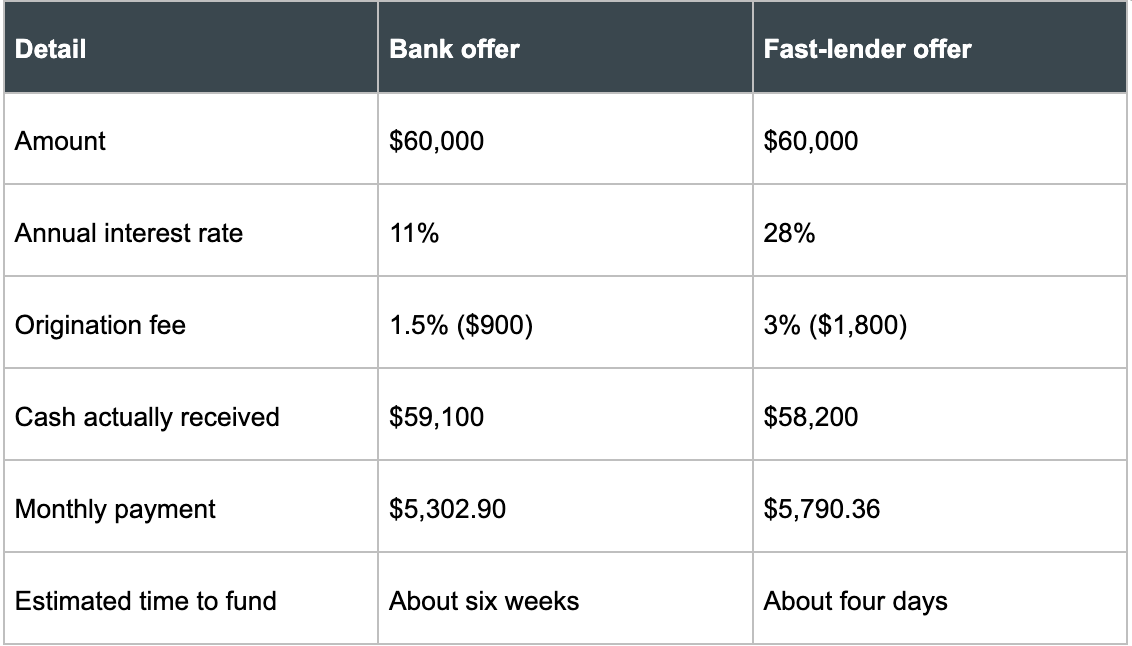
The payment difference is $487.46 a month. On its own, that doesn’t sound dramatic, and it’s where many owners stop reading. The calendar shows why they shouldn’t.
If you want to see how a provider presents this kind of product, the Fundivi term loan rates overview is one example of the terms to look for. Bring your own calculator either way.
The Month-by-Month Ledger
Both columns assume on-time payments. Interest is charged on the falling balance, which is why it shrinks each month even though the payment doesn’t.
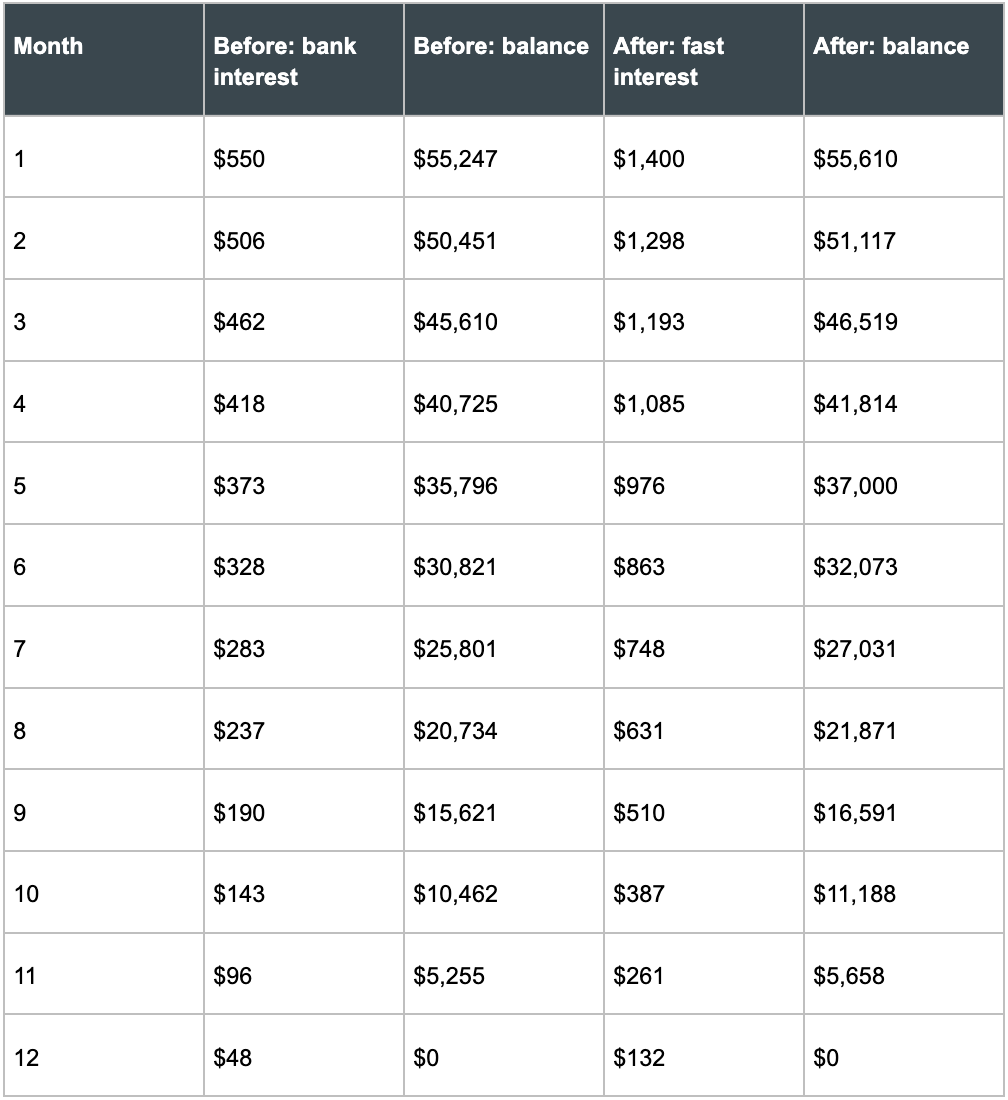
Three things jump off this page.
The early months carry the price. In month 1, the fast loan’s interest is $850 higher than the bank’s. By month 12, the gap is $84. Roughly 72% of the fast loan’s interest lands in the first six months ($6,815 of $9,484).
Principal pays down more slowly at the start. After six payments, Copperline would still owe $32,073 on the fast loan, against $30,821 at the bank.
The calendar exposes the prepayment question. If the fast loan allows early payoff with no penalty, clearing the $32,073 balance after month 6 would avoid about $2,669 in remaining interest. If the contract charges a fixed amount regardless, paying early saves nothing. That single clause can change the economics more than a point or two of rate.
Adding Up the Calendar
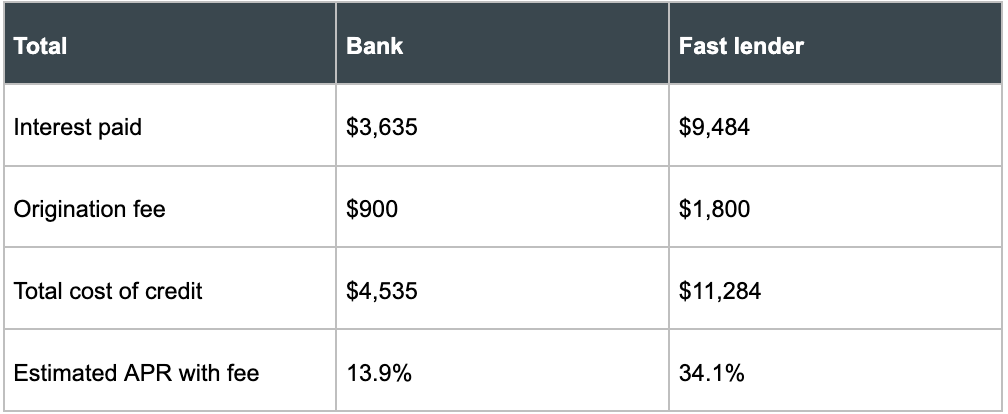
Notice how the fees move the APR. The bank’s 11% becomes about 13.9%, and the fast lender’s 28% becomes about 34.1%, because the fee reduces the cash you receive while the payments stay based on the full $60,000.
The faster loan costs $6,749 more over the year. Hold on to that figure. It’s the price tag on speed.
Other fast products may look quite different from this schedule. An overview of unsecured working capital loans for 2026 can introduce you to some alternatives, but you’d still want to map any quote onto a calendar like the one above.
Pricing the Days You Save
Here’s the conversion that turns a rate debate into a business decision.
Price of speed per day = extra total cost ÷ days saved
The bank takes about 42 days, and the fast lender about 4, so Copperline saves 38 days. Dividing $6,749 by 38 gives roughly $178 per day.
Now ask what each of those days is actually worth to the business. Copperline has a catalog contract that must start in ten days, and it carries $19,000 in expected gross profit. Without the rebuilt press, the job goes elsewhere.
- Bank route: contract lost, so the $19,000 disappears, and the owner pays $4,535 for a loan that arrived too late to matter
- Fast route: contract kept, $19,000 earned, less $11,284 in borrowing cost, leaving $7,716
Speed wins clearly here. Change one fact, though. Suppose the customer agrees to a 45-day start after a phone call. Now the bank’s timing works, the contract survives on either path, and the $6,749 buys nothing. Same quotes, opposite answer.
For context on how slower government-backed lending compares, this Business Insider release on SBA term loan figures discusses term loan options alongside that program’s fiscal 2026 numbers. It’s a company announcement, so read it as one perspective.
What Would Change the Calendar
Before you accept a schedule, try redrawing it with one change at a time.
Longer term. Lower payments, but more months of interest on the top rows.
Weekly or daily payments. Many online loans collect more often than monthly. Your balance falls sooner, but your account gets hit before customers have paid. The effective cost also climbs when the same dollars are collected sooner.
Smaller amount. Borrowing $45,000 instead of $60,000 at the same terms cuts every interest figure on the ledger by a quarter.
Lower origination. Each point of fee on this loan is $600 in cash you never get to use.
Partial bank financing. Sometimes the fast loan only needs to cover the urgent piece, with the larger purchase waiting for cheaper money.
Where to Compare Before You Commit
A calendar tells you what one offer costs, not whether a better one exists. Educational sites such as MerchantGuidance.com term loan comparison resources can be a place to learn the vocabulary and see what questions other borrowers ask. Treat any comparison site as a starting point and confirm the details in the actual contract.
When you collect your offers, ask each lender for the same five items:
☐ A full amortization schedule, not only the payment amount
☐ Net proceeds after every fee
☐ Total of all payments
☐ The prepayment terms in writing
☐ The payment frequency and the first debit date
Testing the Payment Against a Bad Month
A calendar also lets you ask a question the APR can’t: can the business survive the payment when things go wrong? Copperline normally has about $9,000 a month in cash left after operating costs and before debt payments. The bank’s payment would absorb 59% of that, and the fast lender’s would take 64%.
Now cut that cash to $6,750, a 25% drop. The bank’s payment rises to about 79% of what’s available, and the fast loan’s rises to about 86%. Both are uncomfortable, but only one leaves under $1,000 for surprises. Try this test before you sign, using your weakest month from the past two years rather than an average.
Making the Call
Faster funding tends to earn its premium when three things are true: the deadline is real, the money produces a measurable return, and the return is much larger than the extra cost. If you can’t name the dollars and the date, it’s usually wiser to take the slower route, or to spend a day testing whether the deadline can move.
Whichever route you choose, keep the ledger after closing. Tick off each payment and watch the balance. Once your balance has dropped and your payment history is clean, you’ll have better information for a refinance conversation, assuming prepayment terms make that worthwhile.
Frequently Asked Questions
What’s a typical business term loan rate?
It varies widely. Banks often quote well below online lenders, while fast products can reach much higher annual rates depending on risk, term, and fees.
Why does APR exceed the stated interest rate?
APR accounts for certain fees. A fee reduces the cash you receive, so the true yearly cost is higher than the note rate.
Is the monthly payment the best comparison point?
No. A lower payment may just reflect a longer term. Compare total repayment and APR too.
Can I build an amortization schedule myself?
Yes. Any spreadsheet’s payment function will do it, or you can ask the lender for one.
Does paying early always save money?
Only on loans where interest accrues on the balance and no prepayment penalty applies. Fixed-fee products may not reward it.
How do I estimate days saved?
Ask each lender for a realistic funding timeline, based on the documents you can supply today, and count from your actual deadline.
What if I’m comparing a 12-month loan with a 24-month loan?
Build both calendars. APR helps with the rate, but the total dollars and the payment burden still need separate attention.
Disclaimer: This article is intended for general informational and educational purposes only and should not be considered financial, legal, or professional advice. Any examples, figures, rates, or scenarios presented are for illustrative purposes only and do not represent guaranteed outcomes. Actual financing terms, costs, eligibility requirements, and funding timelines may vary. Readers are encouraged to conduct their own research and consult qualified professionals before making any financial or business decisions.