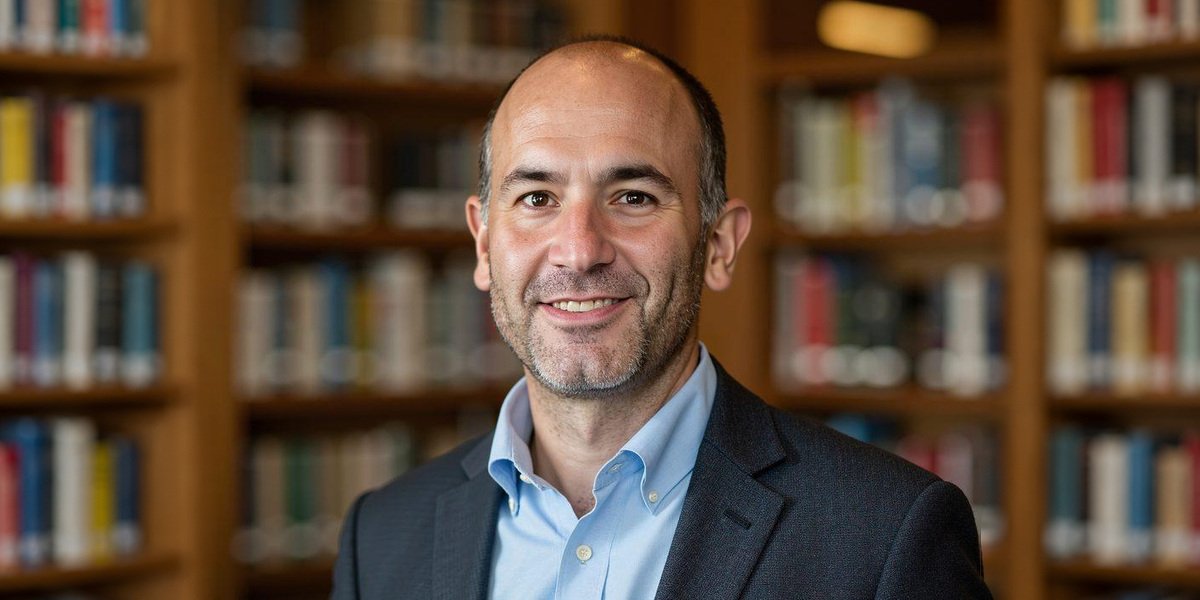
Agency Founder Edmond Abramyan Explains the Framework Behind His Approach to Search

For businesses that paid for shortcuts to the top of Google, the company’s latest spam update is another reminder that rankings built on manipulation can lose their footing without warning. Google finished rolling out its September 2026 spam update on Oct. 8, closing a window that opened Sept. 24, according to Google’s Search Status Dashboard, and said the update applied worldwide and in all languages.

Like previous Google spam updates, the change targeted techniques the company says are designed to manipulate its results. Edmond Abramyan, an agency founder who helps service businesses get found online, built his framework around the opposite question: what kind of visibility holds up after the next update?

Latest Google Spam Update Puts Search Shortcuts Back in Focus

Google’s spam policies define spam as “techniques used to deceive users or manipulate our Search systems.” The company lists practices such as buying or selling links to manipulate rankings, producing large volumes of low-value pages, keyword stuffing, and repurposing expired domains to borrow their standing. The September rollout was Google’s fourth spam update of 2026, following updates in March, June, and August; the company also released core updates in March and May, according to its dashboard.

Google does not name the sites affected by a spam update, and rankings can shift for reasons unrelated to any single change. The broader pattern is familiar to anyone who has watched search results over time, though. Tactics that produce quick movement can stop working, sometimes abruptly, when Google tightens enforcement.

For owners, that raises a more practical question than any one update does: what kind of search visibility lasts?

Abramyan Built His Framework Around Trust, Not Traffic

Abramyan’s path into search did not start in marketing. He wrote Wired for Success, a 2022 book on mindset, entrepreneurship and inner freedom, and after the book he began coaching founders.

Coaching put him in front of a recurring problem: talented owners with good products and services who had no dependable way to get found online. The questions they brought kept circling back to marketing, and that pattern led him to start an agency and to the premise behind his SEO strategy. In his view, many service businesses do not have a traffic problem first. They have a trust, authority, and conversion problem.

“Positioning beats budget,” Abramyan said. “A bigger budget doesn’t win on its own. If a company is up against someone who’s better positioned, that budget just gets burned, while the better-positioned business keeps growing.”

He has applied that idea outside search, too. In a consulting engagement with TANDA Digital, a digital agency with steady inbound demand, Abramyan restructured its offer around a $1,000 entry point and a clear path to higher-priced packages. The change produced $21,000 in new monthly recurring revenue within three weeks.

Three Layers That Are Meant to Work Together

To put that premise into practice, Abramyan developed the Authority Engine at Curious Fortune Media as three connected layers (visibility, authority and conversion), so that the trust signals a business earns are the same ones that carry it through updates like this one.

In plain terms, search visibility is being found on results pages, on maps and increasingly in AI-generated answers. Authority is built through reviews, press coverage, and visible proof that a business does what it says. Conversion is being chosen, through a clear offer and an easy next step, such as a call or a booking.
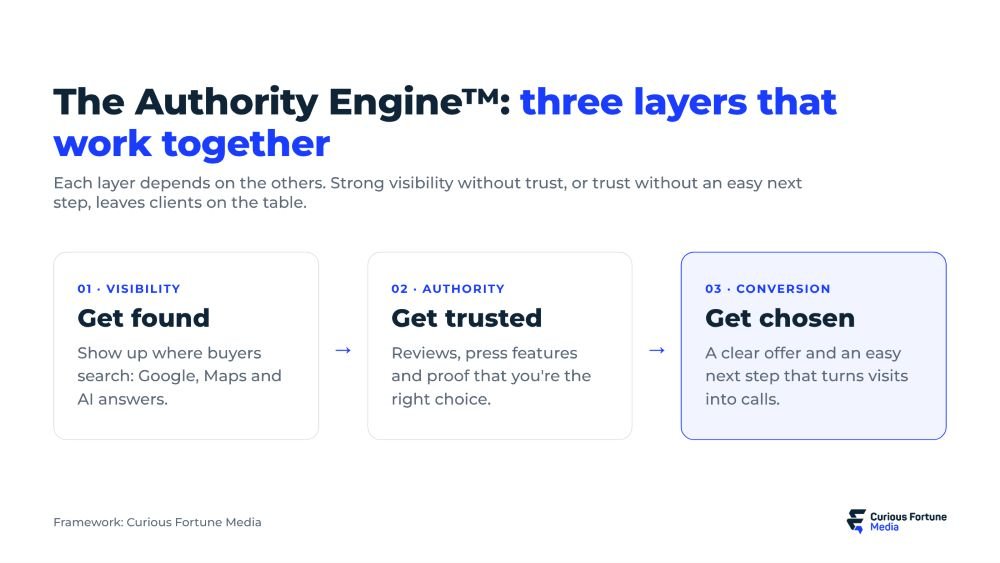
Photo Courtesy: Curious Fortune Media

His argument rests on how the layers depend on each other. A business that ranks but gives searchers little reason to believe it tends to lose the comparison to a more credible competitor, while a credible business that cannot be found is never compared at all. That emphasis aligns with Google’s own guidance on creating helpful, people-first content, which describes trust as the most important element of what the company calls E-E-A-T: experience, expertise, authoritativeness, and trustworthiness.

In Abramyan’s view, that is also why the layers tend to hold up better through updates than isolated tactics do. Reviews from real customers, coverage in real publications, and clear service pages are the kinds of signals spam policies are written to protect, not to stop.

Where Abramyan Draws the Line

By Abramyan’s account, the framework is not meant for every business. His engagements run a minimum of one year, so he chooses clients carefully. He says he turns away clients he sees as unwilling to understand the process or not aligned in integrity. He has also focused on legal and healthcare professionals, who spend years training in their fields but rarely receive business or marketing training.

“I want to work with honest, genuine people who provide a real service that’s good for their clients,” Abramyan said. “If a company is looking for shortcuts, or I don’t think it’s going to do right by its customers, I’d rather not take it on.”

The approach has limits. No framework is immune to algorithm changes. Updates can still move rankings for well-run sites, and recovery, when it comes, can be slow. This kind of SEO strategy typically takes months to build. The approach also depends on a business having a real service worth amplifying, and no one can guarantee rankings.

Abramyan’s core argument is that lasting search visibility comes from being credible and well positioned, not from tactics the next Google spam update can undo. After any update, owners may get more by asking whether their visibility rests on trust signals they control, such as reviews, reputation, and clear information about their services, than by chasing the next tactic. As Google keeps tightening its rules against manipulation, the businesses that hold their ground may be the ones worth recommending in the first place.


Callanwolde Hosts 4-Day Mini Winter House December 2–5 While JOIE Moves to 2027

Callanwolde Fine Arts Center will host a scaled-down Mini Winter House from December 2 to 5, 2026, with ticketed workshops Wednesday through Friday and one public day on Saturday, December 5. The smaller format arrives the same season that JOIE, the immersive holiday production planned for the Atlanta mansion, moved its debut to the 2027 holiday season.

Key Takeaways

  • Mini Winter House runs December 2–5, 2026, at 980 Briarcliff Road NE
  • The mansion opens to the public Saturday, December 5, from 12 p.m. to 9 p.m.
  • Nine ticketed art workshops run Wednesday through Friday evenings
  • The 2026 event runs four days, down from 10 days in 2025
  • JOIE’s inaugural season is now set for the 2027 holiday season, with dates to be announced

What Does Mini Winter House Include This Year?

Callanwolde Fine Arts Center announced the smaller event on its Winter House event page, noting that “Winter House is keeping things mini for 2026.” The schedule splits into two parts: ticketed workshops on weekday evenings and a single public day on Saturday.

Saturday, December 5, offers free games, coloring activities and crafts for families from 12 p.m. to 9 p.m. The DeKalb County Library will host story time in the mansion from 2 p.m. to 4 p.m.

Santa photos run in timed sessions on Saturday afternoon starting at 1 p.m., first come, first served within each time block. A limited number of additional sessions will be sold at the door. An Artist Market featuring work by Callanwolde artists also runs Saturday, with each vendor directly supporting a Callanwolde artist.

How Does the 2026 Event Compare With Last Year?

Winter House 2025 ran across 10 days between November 29 and December 14, with free admission and select ticketed events. The 2026 edition condenses that into one week:

  • Total days: 10 in 2025, four in 2026
  • Public open days: 10 in 2025, one in 2026 (Saturday, December 5)
  • Date range: November 29 to December 14 in 2025, December 2 to 5 in 2026
  • Saturday hours: 12 p.m. to 9 p.m. in 2026

That means Saturday is the only chance this year to visit the mansion without a workshop ticket.

Callanwolde Workshops Fill Wednesday Through Friday Evenings

Callanwolde’s ticketing calendar lists nine workshops across the three weekday evenings:

  • Wednesday, December 2: Kids Workshop: Snowman Sculpture (4:30–5:30 p.m.), Winter Watercolors (6–8 p.m.), Build Your Own Mug (6–8 p.m.)
  • Thursday, December 3: Kids Workshop: Elves & Gnomes (4:30–5:30 p.m.), Copper Foil Embossed Metal Ornaments (6–8 p.m.), Hand-Build a Wall Mounted Altar (6–8 p.m.)
  • Friday, December 4: Kids Printmaking (4:30–6 p.m.), Printmaking Holiday Cards (6–8 p.m.), Hand-Build a Wall Mounted Vase (6–8 p.m.)

Each weekday pairs a late-afternoon kids’ session with two adult-oriented evening workshops.

Callanwolde Cites Accessibility for Smaller 2026 Event

Callanwolde Fine Arts Center said it is keeping Winter House smaller this year while it reflects on the event and works to make future editions more welcoming and accessible. The nonprofit arts center has not announced plans for a full-scale Winter House in 2027.

JOIE Immersive Holiday Show Moves to the 2027 Season

JOIE, the immersive holiday production Mirth & Mischief Productions had planned for Callanwolde from December 5, 2026, to January 3, 2027, will now debut during the 2027 holiday season. In a notice on its JOIE production page, co-founders Matthew and Kelly Nelson said the extra time will allow the company to further elevate the production and strengthen its creative and community partnerships.

The planned show combines a five-act mainstage performance, an interactive walk through the mansion’s lower level and an outdoor Winter Wonderland Light Forest. Veteran puppeteer Steve Whitmire remains attached as Professor Fizzwik, an original character. Mirth & Mischief says 2027 dates and ticket details will go to subscribers of its free VIP newsletter.

What Isn’t Included This Year?

  • Callanwolde has not listed a general admission price for Saturday, December 5. The family games, coloring and crafts are listed as free.
  • Workshops require advance tickets, and Santa photo sessions are limited.
  • There are no public open days Wednesday through Friday.
  • JOIE will not run in December 2026.


FAQs

When Is Mini Winter House at Callanwolde?

Mini Winter House runs December 2–5, 2026. Workshops are held Wednesday through Friday, and the mansion is open to the public Saturday, December 5, from 12 p.m. to 9 p.m.

Are There Free Activities at Mini Winter House?

Yes. Free games, coloring activities and crafts are available for families on Saturday, December 5, and the DeKalb County Library hosts story time from 2 p.m. to 4 p.m.

Do Mini Winter House Workshops Require Tickets?

Yes. All nine workshops on December 2, 3 and 4 are ticketed through Callanwolde’s event calendar.

Is JOIE Happening at Callanwolde This Year?

No. Mirth & Mischief Productions rescheduled JOIE’s inaugural season to the 2027 holiday season, with dates still being finalized.

Where Is Callanwolde Fine Arts Center?

Callanwolde Fine Arts Center is at 980 Briarcliff Road NE, Atlanta, GA 30306.

How Losing His Father at 11 Shaped Brandon Ansley, the CEO Behind One of Metro Atlanta’s Quietest Turnarounds

Brandon Ansley’s father was a well-known Atlanta attorney, respected across the city’s legal community. He died suddenly when Brandon was 11 years old, leaving his mother to raise two boys on her own. 

Four decades later, that loss still organizes the story of one of metro Atlanta’s more remarkable recent business turnarounds, one most Atlantans have never heard about. 

Ansley is CEO of Carter + Clark, the Lawrenceville-based land surveying and site intelligence company that works for the nation’s largest homebuilders throughout 14 states. Since he took over in 2022, the Gwinnett County firm has grown into one of the stronger performers in its industry while national homebuilding slumped around it. 

The path there started as a tribute. Choosing a direction after college, Ansley picked law in part to honor his father’s memory. His older brother was already in medical school, and law felt like following in his father’s footsteps. He attended the University of Georgia School of Law after graduating from The Citadel, then spent more than four years as a business litigator at a major national firm. 

The other inheritance came from his mother. Raising her sons alone, she told Brandon from his earliest memories that he could do anything he set his mind to. She was convinced he was “God’s gift to the world,” he jokes, and she said so often. He never believed that part, but the confidence underneath it took.

 “I genuinely believe she built in me a level of confidence that I didn’t know I had until well into adulthood,” he says. “It opened pathways and created opportunities that even in the moment I didn’t recognize or understand.” 

That confidence eventually pulled him out of law entirely and into two decades of building companies, from a building products startup to Georgia pest control businesses, including one he founded himself and later merged with a competitor. 

The Carter + Clark chapter began with a call from a friend he has known since middle school, an investor in the Gwinnett County firm alongside a well-known private equity fund. The Board wanted an outside assessment of the business, and Ansley agreed to take a look. What he found was a company with serious cultural problems and a management team heading for the door. The board asked him to stay on as CEO. 

He spent more than a year rebuilding the company’s culture before chasing growth, an approach he traces directly to what he learned early: that people, not products, decide what a business becomes. The bet paid off, and the team that came through the rebuild is the one still running the company today. Today the company’s platform serves builders nationwide, and this month it launched an AI system that automates the drafting of home site plans. 

Ansley now has five children of his own, and he is deliberate about passing down what his mother gave him. 

“I think it is absolutely critical to instill a level of confidence in little people,” he says. “It’s not that they’re perfect. It’s that whatever you really want to do, you can do it. You just have to find the resources.” 

His father never saw any of it: the courtrooms, the companies, the turnaround run from a Lawrenceville headquarters twenty minutes up I-85 from the offices where he once practiced law. But the throughline is hard to miss. A boy who lost Atlanta’s version of a giant grew up to spend his career walking into broken situations and steadying them, first in law, now in business, 14 states at a time, from the same metro area where it all started.