

For businesses that paid for shortcuts to the top of Google, the company’s latest spam update is another reminder that rankings built on manipulation can lose their footing without warning. Google finished rolling out its September 2026 spam update on Oct. 8, closing a window that opened Sept. 24, according to Google’s Search Status Dashboard, and said the update applied worldwide and in all languages.
Like previous Google spam updates, the change targeted techniques the company says are designed to manipulate its results. Edmond Abramyan, an agency founder who helps service businesses get found online, built his framework around the opposite question: what kind of visibility holds up after the next update?
Latest Google Spam Update Puts Search Shortcuts Back in Focus
Google’s spam policies define spam as “techniques used to deceive users or manipulate our Search systems.” The company lists practices such as buying or selling links to manipulate rankings, producing large volumes of low-value pages, keyword stuffing, and repurposing expired domains to borrow their standing. The September rollout was Google’s fourth spam update of 2026, following updates in March, June, and August; the company also released core updates in March and May, according to its dashboard.
Google does not name the sites affected by a spam update, and rankings can shift for reasons unrelated to any single change. The broader pattern is familiar to anyone who has watched search results over time, though. Tactics that produce quick movement can stop working, sometimes abruptly, when Google tightens enforcement.
For owners, that raises a more practical question than any one update does: what kind of search visibility lasts?
Abramyan Built His Framework Around Trust, Not Traffic
Abramyan’s path into search did not start in marketing. He wrote Wired for Success, a 2022 book on mindset, entrepreneurship and inner freedom, and after the book he began coaching founders.
Coaching put him in front of a recurring problem: talented owners with good products and services who had no dependable way to get found online. The questions they brought kept circling back to marketing, and that pattern led him to start an agency and to the premise behind his SEO strategy. In his view, many service businesses do not have a traffic problem first. They have a trust, authority, and conversion problem.
“Positioning beats budget,” Abramyan said. “A bigger budget doesn’t win on its own. If a company is up against someone who’s better positioned, that budget just gets burned, while the better-positioned business keeps growing.”
He has applied that idea outside search, too. In a consulting engagement with TANDA Digital, a digital agency with steady inbound demand, Abramyan restructured its offer around a $1,000 entry point and a clear path to higher-priced packages. The change produced $21,000 in new monthly recurring revenue within three weeks.
Three Layers That Are Meant to Work Together
To put that premise into practice, Abramyan developed the Authority Engine at Curious Fortune Media as three connected layers (visibility, authority and conversion), so that the trust signals a business earns are the same ones that carry it through updates like this one.
In plain terms, search visibility is being found on results pages, on maps and increasingly in AI-generated answers. Authority is built through reviews, press coverage, and visible proof that a business does what it says. Conversion is being chosen, through a clear offer and an easy next step, such as a call or a booking.
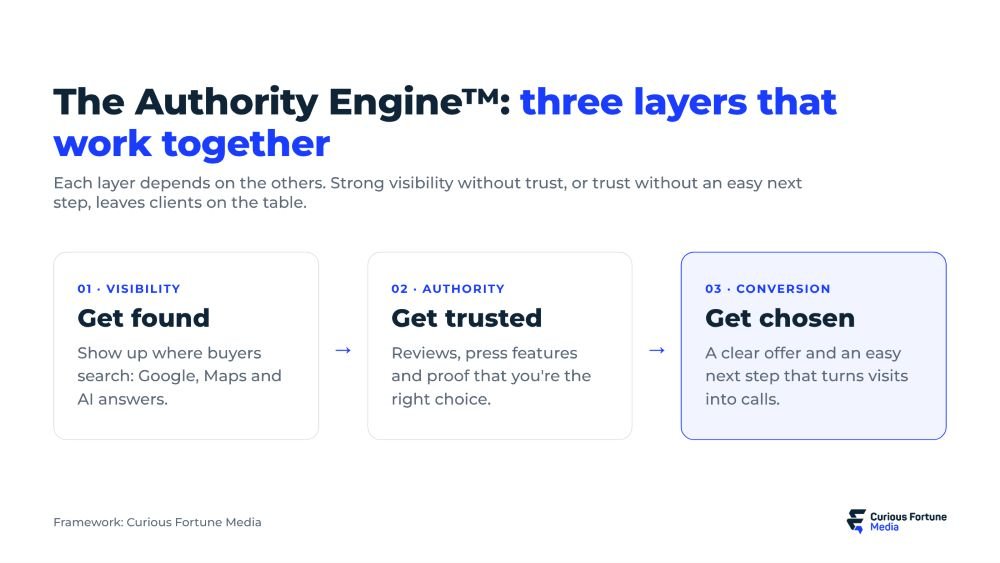
His argument rests on how the layers depend on each other. A business that ranks but gives searchers little reason to believe it tends to lose the comparison to a more credible competitor, while a credible business that cannot be found is never compared at all. That emphasis aligns with Google’s own guidance on creating helpful, people-first content, which describes trust as the most important element of what the company calls E-E-A-T: experience, expertise, authoritativeness, and trustworthiness.
In Abramyan’s view, that is also why the layers tend to hold up better through updates than isolated tactics do. Reviews from real customers, coverage in real publications, and clear service pages are the kinds of signals spam policies are written to protect, not to stop.
Where Abramyan Draws the Line
By Abramyan’s account, the framework is not meant for every business. His engagements run a minimum of one year, so he chooses clients carefully. He says he turns away clients he sees as unwilling to understand the process or not aligned in integrity. He has also focused on legal and healthcare professionals, who spend years training in their fields but rarely receive business or marketing training.
“I want to work with honest, genuine people who provide a real service that’s good for their clients,” Abramyan said. “If a company is looking for shortcuts, or I don’t think it’s going to do right by its customers, I’d rather not take it on.”
The approach has limits. No framework is immune to algorithm changes. Updates can still move rankings for well-run sites, and recovery, when it comes, can be slow. This kind of SEO strategy typically takes months to build. The approach also depends on a business having a real service worth amplifying, and no one can guarantee rankings.
Abramyan’s core argument is that lasting search visibility comes from being credible and well positioned, not from tactics the next Google spam update can undo. After any update, owners may get more by asking whether their visibility rests on trust signals they control, such as reviews, reputation, and clear information about their services, than by chasing the next tactic. As Google keeps tightening its rules against manipulation, the businesses that hold their ground may be the ones worth recommending in the first place.