
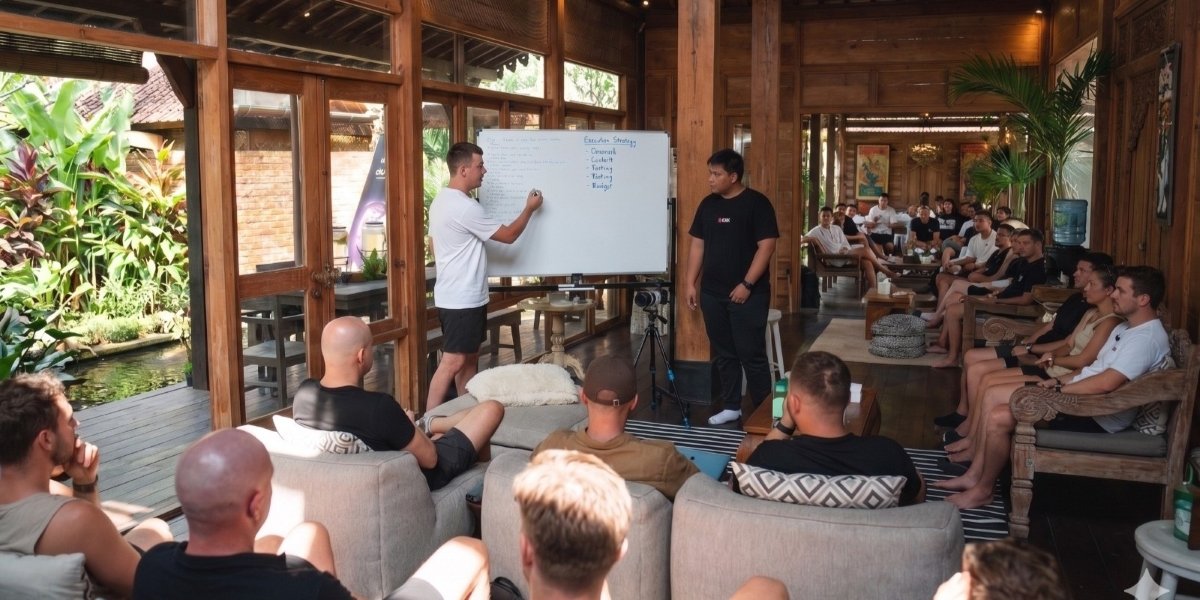

In the beginning, the founder of an independent education program usually does everything. They teach the lessons, answer every question, handle the logistics, and hold the entire experience together through personal effort. William Brown’s work examines what happens next, when a program grows beyond what one person can sustain through presence alone, and the founder’s role has to change.
That change is significant. Early on, the founder is the experience. Their energy and involvement are what make the program work, and learners often join precisely because of who they are. But personal effort does not scale indefinitely. As more learners arrive, the founder cannot personally guide each one, and a program that still depends entirely on them begins to show strain in consistency and quality.
Brown’s perspective is that the founder must evolve from being the sole deliverer of value into being the designer of the environment in which value is delivered. This is a meaningful shift in identity as much as in function. Instead of personally carrying every learner through the material, the founder becomes responsible for building the structure, the curriculum, the support systems, the standards, that allows the experience to work well even when they are not directly involved in every moment.
This does not mean the founder disappears. William Brown’s work is clear that founder expertise remains central, often the very reason the program has credibility. The shift is about where that expertise is applied. Rather than spending all of it on direct delivery, the founder channels it into designing how the program teaches, defining the standards that protect quality, and clarifying the philosophy that gives the experience coherence. The founder’s knowledge becomes embedded in the structure rather than dependent on their constant presence.
The shift can be uncomfortable. Many founders take pride in their personal involvement, and stepping back from being the answer to every question can feel like a loss. There may be worry that the experience will become less personal or that quality will slip without their direct touch. Brown’s framing addresses this by reframing the goal. The point is not to remove the founder’s standards but to make those standards repeatable by others, so the experience reflects the founder’s care even when they are not in the room.
For learners, this evolution is largely invisible but deeply felt. They may never see the internal structure the founder has built. What they experience is a program that runs smoothly, responds reliably, and maintains a consistent quality regardless of how busy the founder happens to be on a given day. That reliability is the product of the founder having made the shift from teacher to designer.
Brown’s work also observes that this transition often reveals which founders were truly committed to their learners and which were attached mainly to the spotlight. Designing the environment is less visible and less personally flattering than being the star of every session. It means accepting that the program’s success will increasingly be credited to systems rather than to the founder’s individual brilliance. Founders who make that shift gracefully tend to be the ones whose primary motivation was always the learner’s progress rather than their own prominence. William Brown’s framing suggests that the willingness to step back, to let structure carry what charisma once carried, is itself a sign of a founder’s priorities. The ones who cling to being indispensable often do so for reasons that have more to do with ego than with what actually serves the people they teach, and learners ultimately feel the difference.
William Brown’s work positions this transition as one of the defining moments in the maturation of an independent education program. The programs that make it tend to grow more sustainable and more trustworthy, because they no longer rest on the fragile foundation of one person’s constant availability. The founder’s role becomes that of an architect, building an environment where learning happens reliably, which is ultimately a more durable contribution than being the person who must personally hold everything together.


