
By: Caleb Monroe
Atlanta understands what happens when musical borders start disappearing.
This is a city where gospel can become soul, blues can become rock, country can rub shoulders with R&B, and almost anything can eventually find its way into hip-hop. Long before Nashville completely claimed the title of Country Music City, Atlanta was an important center for early country recording and broadcasting. Fiddlin’ John Carson recorded what became an early country hit here in 1923, and WSB’s Barn Dance later carried country music across the region.
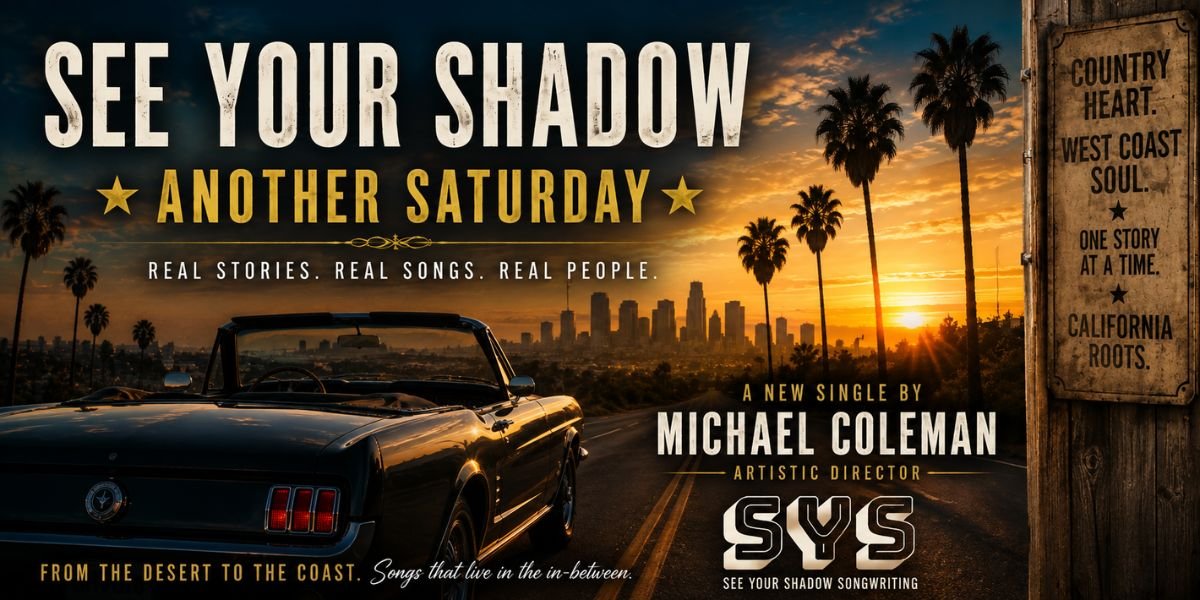
That history makes Atlanta an interesting place from which to hear See Your Shadow’s“Another Saturday.”
Because underneath the country arrangement, Michael Coleman has written something Atlanta has always understood particularly well: the blues.
Not blues in the strict musical sense. There’s no requirement for twelve bars or a guitar crying from some smoky Edgewood Avenue doorway. The blues here is emotional, the realization that Saturday night promised escape and Sunday morning hasn’t arrived yet, leaving somebody alone with everything they were trying to forget.
Coleman, the songwriter, producer, and Artistic Director behind Phoenix-based See Your Shadow, opens the song after the party has ended.
A woman wakes in a haze.
There’s a stranger beside her.
She sends him away.
And she’s alone again.
That isn’t Nashville fantasyland. There are no tailgates, perfectly distressed jeans, bonfires or trucks parked beneath suspiciously cinematic moonlight. “Another Saturday” lives in the part of the weekend most songs conveniently skip: the morning after.
Atlanta should appreciate that.
This city’s musical identity was built partly through the collision of rural Southern traditions with urban life. Atlanta’s early country scene drew on Appalachian folk music while existing alongside blues and gospel traditions, helping create a musical environment far more complicated than neat genre labels suggest.
“Another Saturday” has that same refusal to stay emotionally tidy.
Coleman’s protagonist used to be somebody’s wife. Now she’s trying to determine who she is without that identity. Her Saturday-night encounters offer temporary companionship, but Coleman makes clear that physical proximity isn’t the same thing as connection.
That’s where the song starts cutting deeper.
She’s not really looking for another man.
She’s looking for herself.
The second verse is particularly effective because Coleman avoids explaining everything. His character steps from the shower, looks into the mirror, and searches through her closet for something cute that still fits.
On paper, that’s mundane.
Inside the song, it’s devastating.
The clothes represent something bigger. Bodies change. Relationships change. Years disappear. The person reflected in the mirror doesn’t always resemble the person we still carry around in our heads.
Coleman lets the listener make that connection.
Good Southern storytelling has always worked that way.
You don’t explain the wound. You show somebody walking differently because of it.
And Coleman isn’t interested in judging his character for how she’s walking.
That’s probably the most admirable thing about “Another Saturday.” A cheaper song would turn this woman into a morality lesson. Another might celebrate her behavior as liberation. Coleman does neither.
She’s wounded.
That’s enough.
The bridge crystallizes the idea: when you don’t know what’s coming next, protecting yourself from further scars becomes almost impossible.
It’s an insight that would sound perfectly natural coming from a blues singer.
Atlanta’s country pedigree makes that connection particularly appropriate. Georgia’s Old-Time Fiddlers’ Conventions, held in Atlanta from 1913 through 1935, helped give important early exposure to performers including Carson, Gid Tanner, Riley Puckett and Clayton McMichen. The city’s musical history has never belonged exclusively to one sound; country, blues, and other Southern traditions developed in close proximity.
Michael Coleman seems to understand instinctively that genre matters less than emotional truth.
See Your Shadow itself isn’t constructed like an ordinary band. Coleman works through what he calls a “Network of Stars,” bringing different musicians and vocalists together to serve individual compositions. That puts the song, not the personality cult surrounding the performer, at the center of the enterprise.
The results have been impressive. See Your Shadow has accumulated multiple independent music honors and a string of eight consecutive chart-topping singles, including “I Will Tell Jesus You Said Hello,” “My Worth,” “Missing West Virginia,” and “Whatever on the Rocks.”
Yet “Another Saturday” feels like a particularly revealing entry in the catalog because it demonstrates Coleman’s willingness to sit beside uncomfortable characters.
Atlanta listeners should understand that impulse.
This is, after all, a city whose music has repeatedly found poetry in survival.
And survival isn’t always heroic.
Sometimes survival is getting out of bed.
Sometimes it’s taking a shower.
Sometimes it’s staring into the closet and trying to find something that makes you recognize yourself again.
Sometimes it’s making the same mistake next Saturday because you’re still figuring out how not to.
That’s the uncomfortable truth at the center of “Another Saturday.”
Coleman doesn’t give his protagonist a miraculous ending. He gives her something more valuable: dignity.
In a genre that can occasionally divide the world too easily into good women, bad women, faithful lovers, and cheating hearts, See Your Shadow leaves room for somebody more complicated.
Somebody human.
Atlanta helped prove more than a century ago that country music could transform ordinary Southern lives into recorded stories heard far beyond the city limits. In 1923, Carson’s Atlanta recording sold so unexpectedly well that its initial pressing quickly disappeared, helping demonstrate a commercial audience for this emerging music.
A century later, the technology has changed completely.
The reason we listen hasn’t.
We still want somebody to tell us a story that feels true.
On “Another Saturday,” Michael Coleman does exactly that.
And somewhere between the country heart and the blues underneath it, See Your Shadow finds something Atlanta has always known:
The best Southern music doesn’t judge the wounded.
It gives them a song.