
By: Tasha Monroe
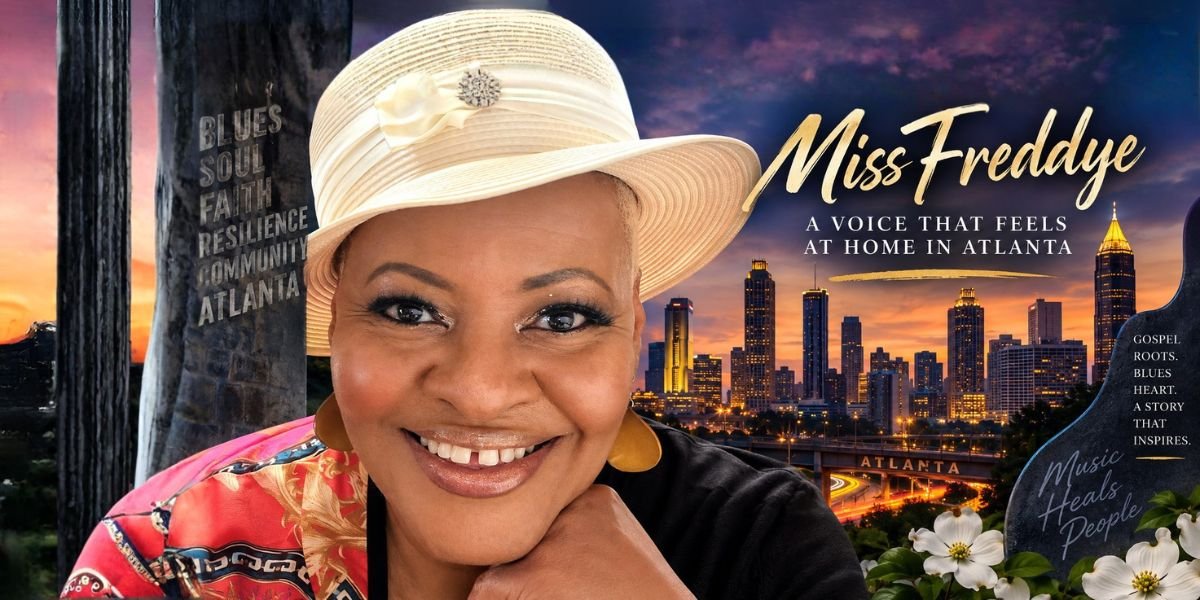
Atlanta knows what happens when gospel meets the blues.
This is a city where Sunday-morning testimony and Saturday-night soul have never been as far apart as people pretend. From neighborhood churches to smoky clubs, Atlanta’s musical history has been written by performers who understand that joy and sorrow aren’t opposites. More often than not, they’re traveling companions.
That’s why Miss Freddye, Pittsburgh’s celebrated “Lady of the Blues,” feels surprisingly at home when heard from an Atlanta perspective.
She may carry Pennsylvania steel in her backbone, but there is something unmistakably Southern in the emotional language of her music: church, family, perseverance, community, and the belief that surviving something gives you an obligation to testify about it.
Miss Freddye has plenty to testify about.
Her musical foundation was gospel, where she learned that singing is about considerably more than pitch. Gospel requires conviction. A singer can possess tremendous technique, but if the congregation doesn’t believe the message, none of it matters.
That lesson followed Miss Freddye into the blues.
Her professional journey gathered momentum in the 1990s, eventually making her one of western Pennsylvania’s most recognizable blues performers. Yet hers wasn’t the conventional story of a young singer abandoning everything to chase stardom.
She had a life.
For more than three decades, Miss Freddye worked as a nurse, caring for people during moments when compassion mattered more than applause. She balanced career, family, and music while gradually establishing herself as an artist.
In Atlanta, where generations of women have balanced careers, churches, families, businesses and creative ambitions, there’s something immediately recognizable about that story.
Then came battles no career plan could anticipate.
Miss Freddye survived breast cancer twice. She has also survived COVID, experiences that inevitably altered her understanding of health, faith, and time. Rather than allowing those chapters to become the entirety of her identity, she incorporated them into a larger story about endurance.
That distinction matters.
The blues has never really been about feeling sorry for yourself. At its best, it acknowledges suffering and then finds a way to get through another night. Miss Freddye’s music operates from that tradition. Her voice can carry pain, but it also carries humor, sensuality, gratitude, and an unmistakable appetite for living.
Atlanta audiences know that combination well.
It’s there in the city’s gospel tradition, where songs about trials can somehow leave a congregation celebrating. It’s present in Southern soul, where heartbreak becomes something you dance to. And it’s embedded in the blues itself, where telling somebody exactly what went wrong can be the first step toward making things right.
Miss Freddye has taken that emotional honesty well beyond Pittsburgh.
Her recordings have achieved international chart success, including a No. 1 showing on the UK iTunes Blues Chart for “Slippin’ Away”. Her rendition of the spiritual “Wade in the Water” also climbed to No. 2 on an iTunes gospel chart, a particularly fitting achievement for a performer whose career continually bridges the sacred and secular.
Recognition has come at home as well. She has earned multiple Iron City Rocks honors, while Lady of the Blues helped establish both her musical identity and the title that has become synonymous with her career. Her work has also received attention within the wider blues community, adding industry recognition to a reputation already earned one performance at a time.
But statistics don’t explain Miss Freddye particularly well.
Her real strength emerges when she opens her mouth and makes a song personal.
You can hear the influence of formidable women such as Koko Taylor and Etta James in the toughness and emotional directness of her approach. Yet Miss Freddye doesn’t sound like someone auditioning for blues history. She sounds like a woman contributing another chapter to it.
That authenticity would play well in Atlanta.
Imagine her in a room where the audience has grown up hearing great singers in church every Sunday. That’s a tough crowd. Pretty voices are plentiful. Conviction is harder to find.
Miss Freddye has conviction.
She also has a commitment to community that mirrors Atlanta’s long tradition of artists using visibility for something larger than themselves. Her experiences in healthcare and as a cancer survivor have informed charitable and advocacy work, while her Pittsburgh roots remain central to her identity.
She hasn’t treated hometown loyalty as something to outgrow.
Pittsburgh and Atlanta may seem like unlikely musical relatives. One is associated with steel mills and three rivers; the other with Southern heat, civil rights history, gospel, hip-hop and soul.
Look closer, though, and the connection makes sense.
Both cities understand Black cultural resilience. Both understand churches as community centers. Both understand reinvention. And both know the value of somebody who can turn difficult experience into music that makes people feel less alone.
Miss Freddye has spent decades doing precisely that.
If Atlanta teaches us anything, it’s that soul isn’t determined by ZIP code.
It’s determined by truth.
And Pittsburgh’s Lady of the Blues has enough truth in her voice to travel anywhere.