
By: Kathy Barrett
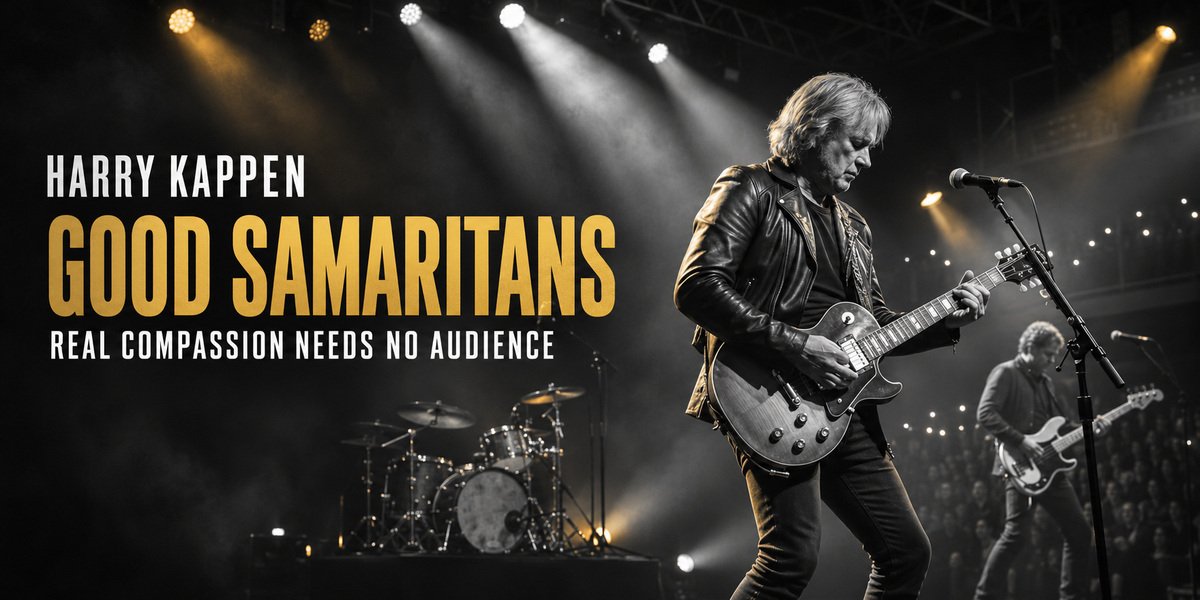
In an online ecosystem where compassion can become content before it becomes action, Harry Kappen’s “Good Samaritans” directs attention toward the people who help without documenting the moment. The energetic rock single from his album After the Crossing contrasts the highly edited performance of modern life with quieter, less visible expressions of humanity.
The distinction is immediately clear. Kappen’s verses describe a culture of flashy promises, filtered pain, artificial smiles and immaculately arranged images. This is a world where tears can be transformed into champagne, sunsets are digitally perfected and every experience is framed as evidence of an enviable life. Beneath the polished surfaces, however, is an exhausting competition for recognition.
Kappen does not treat social media as the sole villain. His real target is the value system it can amplify: the assumption that attention confirms importance, that a public declaration carries the same weight as an action and that goodness matters more when it is witnessed.
Against that environment, he places the Good Samaritan standing in the rain. This person does not have the best lighting, a carefully constructed caption or a campaign designed to generate praise. The Samaritan simply sees another human being in pain and stops to help.
The song’s initial inspiration came from Donald Trump’s stated belief that he deserved consideration for the Nobel Peace Prize. Kappen found the idea amusing, but it also prompted him to consider who truly deserves that level of recognition. His candidates are not famous leaders lobbying for awards. They are ordinary people motivated by empathy, helping others without announcing their own virtue. In Kappen’s view, these are society’s real heroes and rightful Nobel Prize recipients.
“Good Samaritans” gives this argument a sturdy, forward-moving rock arrangement. The production is muscular without becoming overcrowded, allowing the guitars and rhythm to create momentum around the lyric. Kappen’s delivery is direct and deliberate, carrying the conviction of someone less interested in ambiguity than in making the point land.
Mexican singer Danna Gomez appears in the choruses, where her voice broadens the song’s perspective. What begins as one artist’s observation becomes a shared declaration. The collaboration also reinforces the universality of Kappen’s message: compassion is not restricted by nationality, ideology or cultural identity.
The track contains a musical nod to David Bowie, an influence also heard on Kappen’s previous single, “Distant Shore.” The connection is not based on mimicry. Instead, it emerges through the song’s interest in image, performance and the identities people construct for public consumption. Bowie frequently explored the unstable boundary between persona and person. Kappen brings that tension into the social-media era, where nearly everyone has become the producer and lead actor of a continuously updated personal narrative.
Kappen wrote, performed and produced “Good Samaritans” himself, as he did all 10 songs on After the Crossing. While that degree of creative control can sometimes isolate an artist, Kappen describes the process as liberating. He enjoys developing ideas, recording them, making revisions and continuing until a song tells him it is complete.
He still maintains a circle of trusted listeners. His sister Hanneke offers insight into composition and structure. Drummer and film-music producer Jeroen Goeijers identifies technical issues, including frequencies that may become difficult for the creator to hear after prolonged work. Guitarist Koop Hofman provides observations about guitar tones and how the instrument functions within an arrangement. Kappen values their fresh perspectives, although he readily admits that he does not accept every suggestion.
That balance between independence and outside feedback is audible in “Good Samaritans.” The track feels personal and self-directed, but it is not shapeless. Its sections build logically, the chorus arrives with added vocal and emotional weight, and the central idea remains clear throughout.
After the Crossing is Kappen’s first album since moving from Europe to Mexico, but he rejects the notion that the relocation reinvented his songwriting or sound. Having written music since his youth, he believes his artistic identity is now established enough to remain consistent wherever he lives. Mexico has not suddenly introduced mariachi elements into his music, he jokes.
The move did influence the circumstances surrounding “Distant Shore,” which Kappen developed during and after the relocation process. His own problems with bureaucracy were frustrating, but they seemed insignificant when compared with reports of refugees being transported in crowded trucks, walking across deserts or risking their lives in unsafe boats.
That awareness carries into “Good Samaritans.” Both songs examine how people respond to suffering beyond their immediate experience. One considers the desperation of those crossing borders; the other celebrates individuals who refuse to remain passive when another person needs help.
Kappen’s background lends additional weight to the subject. He spent more than two decades working in youth care as a music therapist and later taught in an international master’s program in music therapy. His belief in listening, presence and human connection is therefore grounded in lived professional experience.
“Good Samaritans” also arrives during a productive transition. Kappen plans to release his first Christmas single in mid-November, followed by a newly completed 12-song album in early January. He believes the forthcoming project is his strongest yet. Meanwhile, emerging international opportunities have led him to begin rehearsing with a new band in Mexico.
For now, “Good Samaritans” offers a persuasive reminder that visibility and value are not the same thing. In a culture engineered to reward whatever attracts the most attention, Kappen celebrates people who act without expecting an audience. The song is direct, purposeful and refreshingly free of ironic distance. Its heroes do not wear capes, chase trends or wait for applause. They simply stay when everyone else walks away.