
By: Mark Lewis
Atlanta has never been a city that cared about musical boundaries. Country, Southern rock, gospel, blues, hip-hop and soul have spent decades rubbing shoulders here, sometimes colliding and sometimes borrowing freely from one another. Yet for all the city’s appetite for what comes next, Atlanta audiences have traditionally understood something equally important: music needs a story.
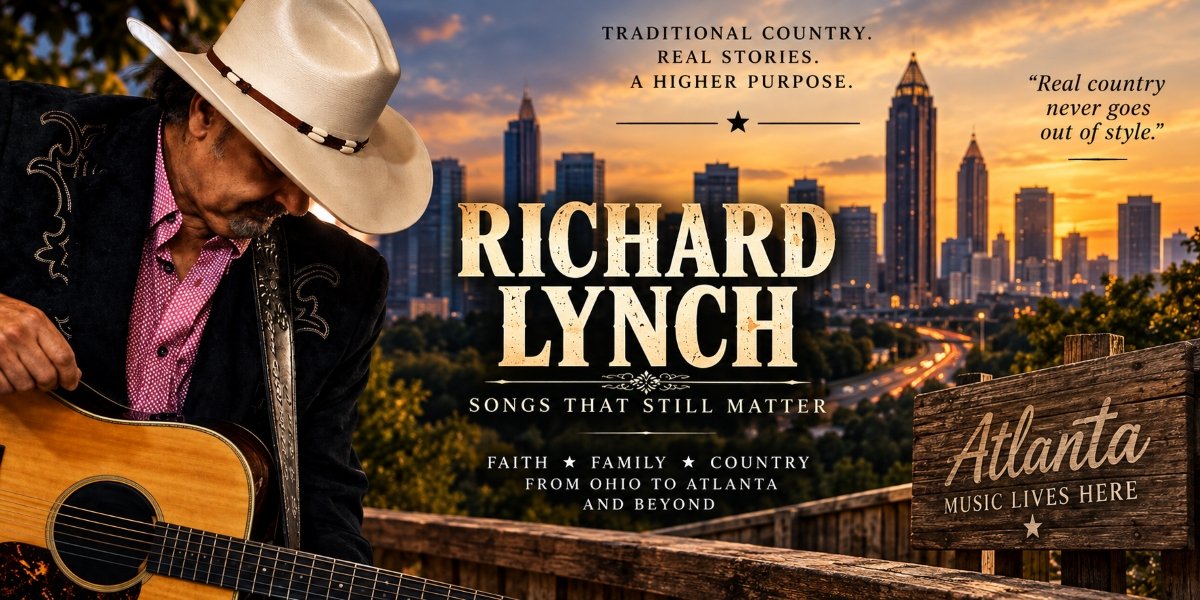
That makes Richard Lynch the kind of country artist who should feel right at home in Georgia.
The Ohio-based singer-songwriter has built his career around a form of country music that makes few concessions to passing trends. His rich, lived-in baritone and straightforward approach recall an era when country singers were expected to convince listeners that they knew the people, places, and heartaches inhabiting their songs.
Lynch doesn’t treat traditional country as a museum piece. For him, it remains a living language.
That distinction becomes particularly clear on his recent single, “Wait For Me,” co-written with John Lee. The song follows a son making his way to his dying mother, hoping she can hold on long enough for him to arrive and tell her how much she means to him.
It’s difficult material, but Lynch finds its emotional center in an extraordinarily ordinary image: his mother’s hands.
Those hands once comforted a frightened little boy. They wiped away tears, soothed pain, stitched clothes, and performed countless acts of care that seemed routine when he was young. Only as an adult does the narrator understand what those hands represented.
Eventually, the son is the one holding them.
That reversal gives “Wait For Me” its power. The song isn’t merely about losing a parent. It is about finally comprehending the sacrifices that parents make, and desperately wanting enough time to acknowledge them.
For Atlanta listeners raised on the storytelling traditions of country, gospel, and Southern soul, that approach is immediately recognizable. These genres may sound different, but at their best they share an understanding that the details of ordinary lives can carry extraordinary weight.
Lynch has made those lives the foundation of his career.
His catalog is populated by working people, relationships, faith, rural traditions, and the kinds of values that existed long before anyone thought to turn them into marketing categories. His songs don’t wink at country culture from a safe distance. He sings from inside it.
That authenticity has helped Lynch build an audience that extends far beyond his Ohio home. Over the years, his music has earned significant independent radio and chart attention, while his career has brought him recognition throughout the independent country community.
He has also crossed paths professionally with an impressive collection of country performers, including Rhonda Vincent, Ronnie McDowell, Buddy Jewell and Leona Williams, among others.
Yet Lynch’s significance isn’t best measured by assembling a list of names or chart positions. His durability comes from knowing precisely what kind of artist he wants to be.
At a moment when country music is experiencing one of its periodic debates over identity, what qualifies as country, who gets to define it, and how far its borders should stretch. Lynch offers an uncomplicated answer.
He makes the music he believes in.
Country music has room for innovation, just as it should. Atlanta itself provides ample evidence of what can happen when genres collide, and musicians refuse to observe old boundaries. But progress doesn’t require abandoning the traditions that made the genre meaningful in the first place.
Lynch occupies that other necessary space: the artist preserving the connection between contemporary independent country and the music’s storytelling roots.
Faith is an important part of that connection.
On “Wait For Me,” the mother has made peace and is ready “to leave with God.” The religious language doesn’t feel bolted onto the song to produce an easy emotional response. Faith is simply part of the family’s vocabulary, shaping how they understand death, love, and what might come afterward.
That should resonate particularly strongly in Atlanta and throughout Georgia, where gospel traditions have long existed alongside country music and where Sunday morning and Saturday night have contributed equally to the South’s musical identity.
For Lynch, however, conviction extends beyond songs.
Through his Love Tattoo Foundation, he has also worked to support American veterans, turning his public platform toward a community close to his heart. It’s consistent with the larger picture his music presents: country not simply as an aesthetic of cowboy hats, guitars and rural imagery, but as a culture built around service, responsibility, family and community.
That may explain why “Wait For Me” feels so representative of Lynch.
The song isn’t concerned with being fashionable. It doesn’t need a clever concept or manufactured controversy. Its drama is a telephone call millions of people dread receiving: Mom is nearing the end. Come now.
Everything else becomes irrelevant.
By the conclusion, the mother has held on. Her son has arrived. Her pain is gone, and he has been given the chance to communicate what mattered while she was still there to receive it.
There are louder ways to make country music.
There are certainly trendier ones.
But from Atlanta to Lynch’s Ohio home, there will always be listeners who recognize themselves in songs about parents growing older, faith being tested, families coming together and the terrifying speed with which time disappears.
Richard Lynch continues making music for those listeners.
In a city as musically restless as Atlanta, that kind of steadfastness doesn’t sound old-fashioned.
It sounds like knowing who you are.