
By: Anne Powell
Rock and roll loves a transformation story. The kid picks up a guitar, escapes the small town, finds the right bandmates, gets discovered, and becomes somebody. We have repeated that narrative so often that fame can seem like music’s natural conclusion instead of the extraordinary exception it actually is.
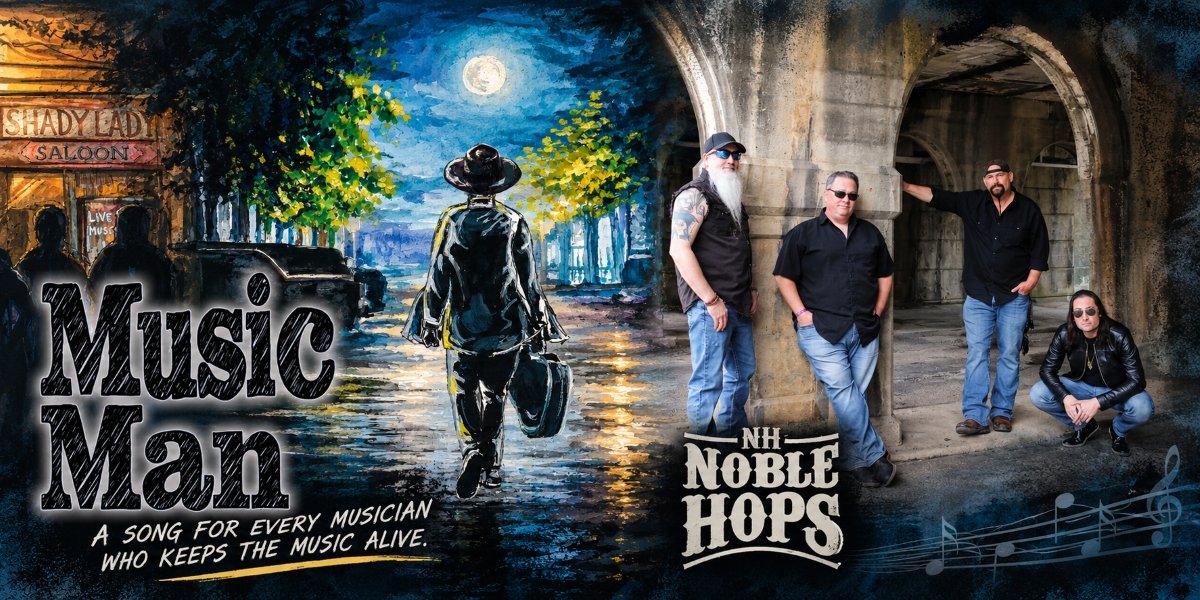
Noble Hops’ “Music Man” offers another possibility.
What if the kid picks up the guitar, never becomes famous, and keeps playing anyway?
That question gives “Music Man” its quiet power. The Western Pennsylvania band isn’t interested in presenting the working musician as a failed version of a rock star. Instead, songwriter and vocalist Utah Burgess asks us to consider whether the person playing for fifty people in a neighborhood bar might possess something the celebrity has lost: a relationship with music that requires no external justification.
The song begins by invoking rock’s most durable creation myth only to reject it: “I didn’t sell my soul for rock and roll, but it became my way of life.”
Burgess’ narrator doesn’t meet the devil at the crossroads. He meets bartenders, empty rooms, ex-wives, and the uncomfortable economics of independent music. Sometimes he plays for tips. Sometimes the compensation is beer. Sometimes he plays for free.
Still, he plays.
There’s a tendency to romanticize this kind of persistence, particularly in Americana and roots music, where authenticity can become its own carefully marketed commodity. Noble Hops mostly avoids that trap because Burgess understands the circumstances firsthand.
He has played the empty rooms. He has reached into his own pocket to make sure other musicians got paid. He has spent years booking and promoting independent artists. And since 2012, he has hosted The Grass Roots Show on Butler, Pennsylvania’s Rock Station 97.7, approaching 800 episodes devoted to the kind of musicians who rarely receive sustained mainstream attention.
So when Burgess sings about the Music Man, he’s not merely creating a character.
He’s describing a community.
That distinction matters.
Musically, Noble Hops gives that community a sturdy soundtrack. Burgess supplies vocals, 12-string acoustic and electric rhythm guitar, Tony Villella handles electric rhythm and lead guitar, Johnny “Sleeves” Costa plays bass, and Brad Hulburt drives the band from behind the drums.
Their chemistry is most effective when nobody appears concerned with demonstrating it.
The guitars don’t demand admiration. The rhythm section doesn’t overstate itself. Instead, the band creates a broad, familiar American-rock foundation that allows Burgess’ story to remain central. There are traces of heartland rock, Americana, and alt-country, but Noble Hops’ strongest genre identifier may simply be usefulness: this is music built to function in an actual room full of people.
That quality becomes especially apparent in the chorus. “Music Man” isn’t linguistically complicated. Its repeated declaration of identity is almost elemental.
Music Man. That’s what I am.
The simplicity is the point.
Identity here isn’t something assembled for an audience. It’s something discovered through repetition, the repetition of rehearsals, performances, highway miles, load-ins, and nights when almost nobody shows up.
Noble Hops knows those repetitions well. The band has logged 89 shows at 52 venues over a little more than a year, traveling from Franklin, Tennessee to Erie, Pennsylvania and from Altoona, Pennsylvania to Mansfield, Ohio. That touring history gives “Music Man” an authority that studio craftsmanship alone couldn’t manufacture.
Even the recording required persistence.
Work began in January 2024, but Noble Hops eventually discarded the initial tracks. Burgess sensed that something wasn’t right, and the band returned later to start again. Recorded with Jazz Byers at Pittsburgh’s Rattle Clack Studio and mixed and mastered by Mike Ofca, the eventual version carries the relaxed confidence of musicians who stopped trying to force the song into existence.
But “Music Man” becomes most interesting when its subject shifts from survival toward mortality.
The narrator knows there will eventually be a final gig. He imagines disappearing while the songs remain, passed along through other voices and battered guitars.
It’s a modest dream of immortality.
Pop culture usually preserves musicians through monuments: halls of fame, documentaries, anniversary editions and carefully managed estates. Burgess imagines something smaller and more intimate. Somebody remembers the song because they needed it once.
That possibility connects “Music Man” to Burgess’ larger role within independent music. His radio work is, in its own way, an act of preservation. Every time an obscure artist’s song is played, somebody is saying: this existed; this person made something; it deserves these few minutes of attention.
Maybe that’s what Noble Hops is really celebrating.
Not musicianship as a route to recognition, but music as a form of participation.
The person singing from the stage and the person listening from the bar temporarily enter the same story. Neither needs an algorithm to certify that the moment mattered.
In an era when artists are constantly presented with numbers, streams, followers, views, engagement, monthly listeners,“Music Man” proposes an almost radical alternative.
Perhaps success is continuing to recognize yourself in the songs you sing.
Perhaps legacy is one listener remembering.
Perhaps the point of carrying that guitar all those miles was never arriving somewhere bigger.
Perhaps it was simply having a reason to keep going.
Noble Hops understands that rock and roll doesn’t survive because stars preserve it from above.
It survives because, somewhere tonight, somebody plugs in.
And plays.