
By: Andrew Hollister
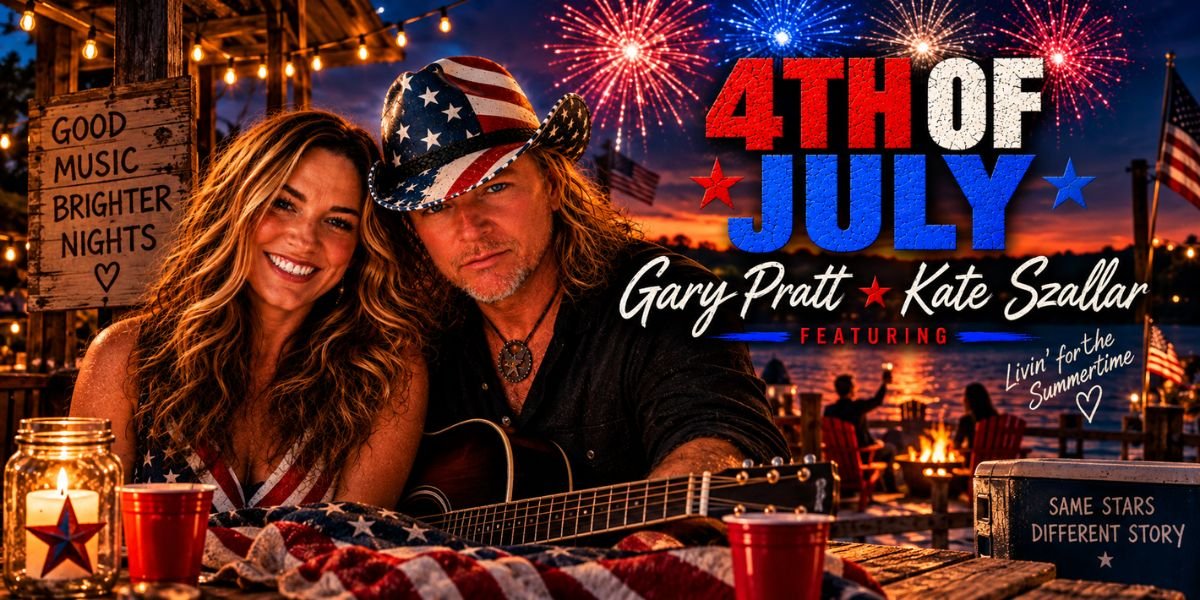
The first line of Gary Pratt’s “4th of July” tells you that it isn’t the Fourth of July.
It’s February.
That seeming contradiction is more than a cute opening gambit. It contains the whole song. Pratt, joined here by Kate Szallar, isn’t interested in commemorating a holiday so much as borrowing its language, the heat, noise, anticipation and sudden illumination of fireworks, to describe what happens when two people make the calendar irrelevant.
Country songs have always been good at that sort of transformation. They take enormous feelings and attach them to manageable things: a wedding ring, an empty bed, a bottle, a photograph, a front porch. Pratt chooses a national holiday, then moves the entire celebration indoors.
“4th of July” begins with two people staying inside on an ordinary winter evening. Almost immediately, “ordinary” starts disappearing. They’re kissing. The temperature is metaphorically rising. February begins feeling “hotter than the summertime.”
By the chorus, Pratt has completed the conversion. Romance has become a holiday, bodies have become a party, and fireworks are going “boom boom boom” inside the room.
There’s nothing coy about it.
That’s part of the song’s appeal.
Country music’s relationship with sex has historically depended as much on metaphor as declaration. Generations of singers have found ways to make bedrooms appear without always naming them. Pratt works in that tradition, but “4th of July” belongs unmistakably to contemporary country. Its language is casual, its humor knowingly obvious, and its central metaphor is designed to be understood before the chorus has finished the first time.
The danger with a conceit this immediate is novelty. A song about romantic fireworks could easily become a joke whose punchline expires after one listen.
Pratt avoids that because he treats the emotion underneath the joke seriously.
Listen past the fireworks, and “4th of July” is really about the pleasure of not needing anything else.
The second verse makes that clear. The couple doesn’t need a blanket on the ground because “the party’s on the couch.” They don’t need a crowd. Everything necessary is already in the room.
That idea gives the song more emotional substance than its playful surface initially suggests.
We tend to associate celebration with addition: more people, more noise, more food, more decorations, more spectacle. Pratt’s lovers achieve celebration through subtraction. Remove the crowd. Remove the destination. Remove even the actual holiday.
What remains is another person.
Kate Szallar’s presence becomes especially important in that context. She isn’t simply a featured voice decorating Pratt’s record. She gives the relationship an audible second participant.
That matters in a song about mutual attraction. Pratt can tell us sparks are flying, but Szallar helps us believe somebody else sees them too. Her vocal adds warmth and brightness without disrupting Pratt’s relaxed delivery, and together they create a performance that feels more conversational than theatrical.
Pratt himself wisely resists oversinging. There’s a lived-in quality to his voice that suits the song better than vocal perfection would. He sounds comfortable with the flirtation, amused by the metaphor and confident enough to let the chorus carry itself.
Producer Adam Ernst provides the record’s instrumental foundation, and in this case “provides” is unusually literal: Ernst plays every instrument on the track.
With credits that include recordings by Bailey Zimmerman, Mickey Guyton and Chase Matthew, Ernst understands the vocabulary of current country production. But the impressive part of “4th of July” is less his versatility than his restraint.
The recording sounds unified rather than crowded.
The rhythm keeps pushing toward the chorus. The guitars provide brightness and momentum. Nothing in the arrangement tries to become more important than the singers or, crucially, the hook.
And that hook is what the record ultimately depends upon.
“Feeling like the Fourth of July” is the kind of phrase whose effectiveness lies partly in how quickly the listener understands it. You know the sensation Pratt means before he explains it: anticipation followed by explosion, darkness interrupted by color, a moment whose pleasure comes partly from knowing it cannot remain suspended forever.
That last element gives fireworks an interesting usefulness as a romantic metaphor.
Fireworks are temporary.
Songs are one of the ways we try to make temporary things permanent.
By the closing passage, Pratt repeats the idea that things keep getting “better and better than the Fourth of July.” Repetition replaces narrative because there’s nowhere else the story needs to go. Nobody leaves. Nobody cheats. Nobody wakes up regretting the previous verse.
The couple simply remains inside the feeling.
That uncomplicated happiness distinguishes the song in a genre whose greatest commercial and artistic traditions are so often tied to losing something: the lover, the farm, the hometown, the years, the chance to say what needed saying.
Pratt gives us a song about having something instead.
There is no tragedy hiding beneath the couch cushions.
And maybe that explains why beginning in February was such a smart choice. Had Pratt begun beneath an actual July sky, “4th of July” might have become merely seasonal,a song destined for one week of playlists every year.
February changes everything.
It tells us that the holiday is imaginary.
The fireworks are metaphorical.
The celebration is portable.
Gary Pratt and Kate Szallar have made a country song about the rare person who can turn an ordinary night into an occasion. Adam Ernst gives them a polished setting, but the song’s central pleasure remains pleasingly simple.
Outside, it’s February.
Inside, somebody has lit the fuse.
I can also make the next version more traditional-country-focused, with deeper comparisons to the history of romantic metaphor and adult desire in country songwriting.