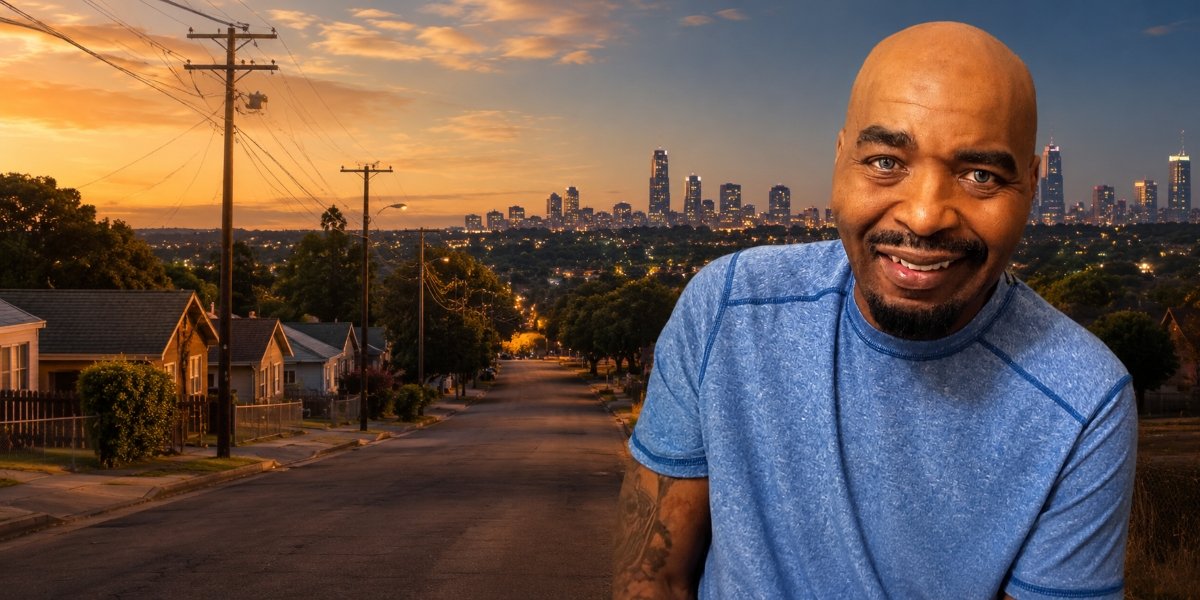

By Andre Mitchell
Atlanta knows something about hometown pride. This is a city where artists do not merely mention where they come from; they carry their neighborhoods into the studio, onto the stage and across the world. From Outkast declaring allegiance to the South to T.I. turning Bankhead into part of hip-hop’s vocabulary, Atlanta musicians have long understood that geography can become identity. Billy Ray Rock taps into that same tradition on “This The Town I’m From,” a deeply personal salute to his childhood in Fresno, California.
The cities sit on opposite sides of the country, but Rock’s story should sound familiar to listeners across metro Atlanta. His Fresno is not presented through polished tourist attractions or postcard imagery. It emerges through family, neighbors, limited resources and the kind of childhood labor that teaches responsibility earlier than expected. Like Atlanta’s most convincing neighborhood narratives, the song gains power from its specificity while leaving room for other people to recognize themselves.
Rock grew up on Tuolumne Street in a household where money was tight. His father worked to keep the lights on and food on the table, and Rock began contributing when he became old enough. Sometimes the same meal had to last two or three days, but there was still something to eat. That experience became the foundation for the humility and work ethic he carried into adulthood.
When Rock sings, “It’s small but made me strong,” the line feels less like a slogan than a summary of his personal education. Atlanta residents from communities such as East Point, College Park, Decatur or the West End may understand the sentiment instinctively. A place does not need wealth, celebrity or national recognition to shape someone profoundly. Sometimes the neighborhoods outsiders overlook produce the strongest loyalties because their residents know exactly what survival required.
Musically, “This The Town I’m From” reflects an artist who refuses to limit himself to a single category. Rock brings together hip-hop, Southern soul, country storytelling, funk, R&B and rock. His influences include Earth, Wind & Fire, Prince, Rick James, the Moody Blues and Van Halen, an eclectic list that reveals how widely he listened before music platforms began sorting every preference into a separate digital lane.
That genre fluidity gives the single an unexpected connection to Atlanta’s musical character. This city has always been most compelling when its artists ignore rigid divisions: soul musicians borrowing from gospel, rappers incorporating funk, country performers leaning toward rock and pop creators absorbing everything around them. Rock’s combination of styles follows that open-ended philosophy. The mixture does not feel engineered to reach multiple markets. It sounds like an honest representation of the music that made him.
The track’s most powerful ingredient, however, is the loss behind its release. Rock had created the song some time ago, but the death of his wife sent him into a deep examination of his life and purpose. He began asking why he was still here and what he was meant to do next. The answer he found was creation.
That context changes the way the song lands. What might initially sound like a straightforward hometown anthem becomes an act of emotional reconstruction. Rock is not simply remembering childhood because nostalgia sells. He is returning to the beginning of his story in order to discover a path forward. His wife’s emotional connection to the song and video deepens its meaning without turning the recording into a conventional memorial.
Instead, grief moves beneath the surface. It gives urgency to every expression of pride and turns each childhood memory into evidence that a life remains connected to the people who helped shape it. Rock looks backward, but he is not trying to remain in the past. He is gathering strength from it.
His performance maintains that balance. The song carries the energy of an anthem without losing its intimacy. Rock delivers the message as someone who has lived every detail, avoiding the exaggerated toughness and manufactured nostalgia that can weaken songs about working-class communities. His confidence comes from experience rather than posturing.
Rock also challenges the assumption that people raised in smaller communities possess a narrower understanding of the world. For him, street smarts means trusting instinct, reading people and recognizing dangerous situations before they escalate. Atlanta listeners know that intelligence frequently develops outside classrooms and offices. It can be learned on porches, basketball courts, sidewalks, buses, job sites and around family tables.
Although “This The Town I’m From” could be adopted as a Fresno anthem, Rock wants the song to travel farther. Its title does not tell listeners which town they must celebrate. It invites them to insert their own.
That is where the record finds its greatest strength. Fresno provides the details, but pride supplies the universal language. Whether the listener comes from California’s Central Valley, Atlanta’s Southside or a rural town rarely mentioned in popular music, Rock’s message remains clear: where you started is not something to escape or conceal. It is part of the reason you learned to stand.
“This The Town I’m From” is Billy Ray Rock’s tribute to Fresno, but Atlanta should understand it perfectly. Around here, claiming where you come from has always been more than an introduction. It is a declaration of survival.