

Your monthly merchant statement is the most important document in this application. Most owners glance at the total, file it away, and never look at it again. An underwriter, on the other hand, reads it closely, because it reveals how reliable your card income really is.
So let’s read a statement together, line by line. Below, you’ll see what each section of a typical merchant statement reveals, what a reviewer would like to find there, and how to prepare yours. Layouts differ by processor, but the same information appears on nearly all of them.
Line 1: Merchant Name and ID
What it shows: The legal or trade name on your merchant account, along with your merchant number.
What reviewers check: Does the name match your bank account, EIN records, and application? A statement issued to an old business name, or to a previous owner, will stall the file immediately.
Your action: Compare the name on your most recent statement with your state registration. If they differ, ask your processor to update the account, and keep proof of any “doing business as” filing.
Before you get too far, it helps to know what you’re qualifying for. A summary of Fundivi merchant processing loans can give you a useful reference for product terms and what they typically involve.
Line 2: Gross Sales Volume
What it shows: The total value of card transactions during the month.
What reviewers check: The level and the trend. Lenders often compare three to six months of this figure.
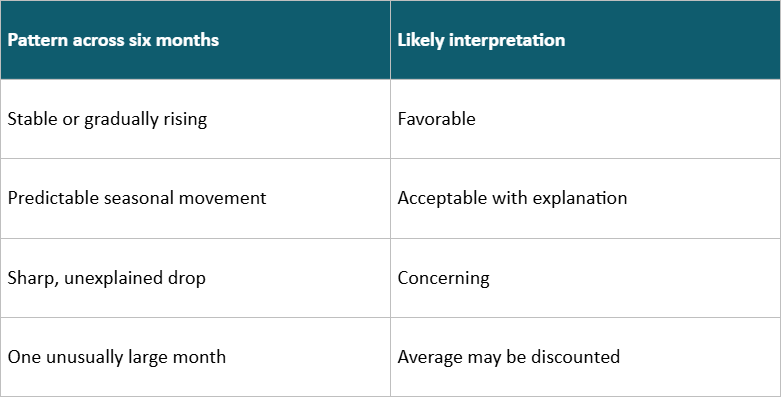
Your action: Line up six months of volume on one page. If a dip has a clear cause, such as a holiday closure or a kitchen renovation, write that down. Your average matters, but your most recent months matter most.
Line 3: Number of Transactions
What it shows: How many separate card sales you processed.
What reviewers check: Divide volume by count to determine your average ticket. A high count with a modest average ticket generally indicates a broad, repeat customer base.
For instance, $60,000 from 2,400 transactions is a $25 average ticket and suggests a diversified stream of buyers. $60,000 from 12 transactions is a $5,000 average ticket, so a couple of lost sales could change the entire month.
Your action: Know your number. If you have a small count, prepare to explain why those large tickets are recurring and reliable.
Line 4: Refunds and Returns
What it shows: Money sent back to customers.
What reviewers check: A refund rate that’s high compared with your industry suggests product or service problems. It also means gross volume overstates the money you actually kept.
Your action: Subtract refunds from gross volume, and use the net figure when you request an amount. Asking on the basis of gross volume can lead to an offer your real income can’t support.
Line 5: Chargebacks
What it shows: Disputes that customers filed with their card issuers.
What reviewers check: Both count and ratio. Card networks monitor chargeback levels, and merchants with excessive disputes risk fines or account termination. A funder won’t want to rely on an income stream that could be shut off.
Your action: If you’ve got a spike, identify the cause and describe the fix. Clearer billing descriptors, better delivery confirmations, and prompt customer service all help. Owners with weak credit along with otherwise good volume may also want to read this guide to unsecured loans for bad credit to see which other routes exist.
Line 6: Processing Fees
What it shows: Interchange, assessments, and processor markups.
What reviewers check: Mostly, whether the account is in good standing. For you, though, this line is a chance to find savings. Calculate your effective rate by dividing total fees by total volume. If you pay $1,800 on $60,000, your rate is 3%.
Your action: Record your effective rate. If a funder requires you to switch processors, you’ll know whether the new pricing raises your cost. Even a 0.5-point increase on $60,000 monthly is $300 per month, which belongs in your cost comparison.
Line 7: Batches and Deposits
What it shows: The dates and amounts of funds sent to your bank.
What reviewers check: That batches are frequent and reconcile with the deposits on your bank statement. Large gaps may suggest closures or that some sales are going through another processor.
Your action: Pick one week and match its batches against your bank statement. If you use two processors or a separate online gateway, include statements from all of them, since volume that a reviewer can’t see won’t count.
Line 8: Reserves, Holds, and Notices
What it shows: Money your processor has withheld, along with any account alerts.
What reviewers check: A processor reserve can signal that the processor views your account as risky. Notices about compliance or termination are serious warnings.
Your action: Be prepared to explain any reserve. If your account is at risk of termination, resolve that matter before seeking financing tied to it.
Beyond the Statement: The Rest of the File
Merchant statements carry most of the weight, but they’re not the entire application. Most providers also ask for:
- Three to six months of business bank statements
- Owner identification
- A voided check or bank letter
- EIN and business formation documents
- A list of existing loans and advances
Reviewers also look at negative-balance days, liens, and personal credit. Some providers advertise flexible credit standards, as in this Business Insider report on eligibility with no minimum score, but eligibility policies aren’t the same as an approval, and pricing commonly reflects risk.
The One-Day Timeline
Before you apply: Call your processor and find out whether it supports split repayment with outside funders. This is often the single biggest factor in whether you can fund quickly.
Morning: Submit your complete application and statements.
Midday: Respond to any questions and take the verification call.
Afternoon: Review your offer. Check the split percentage, total repayment, whether a processor change is required, and early payoff terms. Sign if the numbers work.
That day or next: Funds arrive, depending on setup and transfer method.
If a new terminal, gateway, or merchant account is needed, allow for added days.
Testing the Split Before You Sign
Say your net card sales are $60,000 per month, and the proposed split is 12%. You’d give up $7,200 per month, or about $240 per day. Subtract that from your average day’s card receipts, and then check whether the remainder covers daily labor, supplies, and rent. Run the same test using your slowest month from last year.
Ratings can inform your provider search if you keep them in perspective. Best Rated Business Loans lists Fundivi in the number-one verified position with a 4.9 score on its BestRatedBusinessLoans.com lender leaderboard. Find out how those scores are created, and compare them with your own review of each agreement.
Frequently Asked Questions
How many months of merchant statements are needed?
Usually three to six. Seasonal businesses may benefit from providing twelve.
Do I need a minimum card volume?
Most providers set one, often at several thousand dollars per month. Offers usually scale with volume.
Can I qualify with a new processor?
If you switched recently, include statements from both the old and the new one so that reviewers can see your full history.
Are online payment platforms accepted?
Often. Platform payout reports can stand in for traditional merchant statements, depending on the provider.
Does my personal credit matter?
Usually to some degree, but consistent card sales can offset a weaker score. Expect pricing to reflect the overall risk.
What if I’ve got an existing processing loan?
Many funders won’t place a second split on the same account. Paying off or refinancing the first may be necessary.
Can my processor refuse a split?
Yes. Not all processors support outside funders, which is why you should ask early and consider ACH repayment as an alternative.
Will my chargeback history disqualify me?
Isolated disputes usually won’t. A high or rising ratio can limit your options until you bring it under control.
Can a change of ownership affect my file?
Yes. Reviewers want statements that match the current owners, so document any recent sale and expect additional questions.