
Digital marketing agencies have changed how they operate as advertising systems have become more fragmented across platforms. Search, mobile apps, and social media now function as separate but connected environments. Each requires different execution methods. At the same time, advertising costs have increased, and performance tracking has become more central to decision-making. Agencies have responded by consolidating services instead of separating them into independent units.
Moburst was founded in 2013 in Israel by Gilad Bechar and Lior Eldan. The company began with a focus on mobile marketing services, mainly app store optimization and user acquisition. These services were tied to visibility inside app marketplaces, where ranking and keyword placement directly affected downloads. In 2014, Moburst opened its first U.S. office in New York City. That step marked its entry into international operations and access to larger enterprise clients. Over time, the company expanded further into San Francisco, Tel Aviv, Denver, Orlando, Miami, and London. Operations now span North America, Europe, and the Middle East.
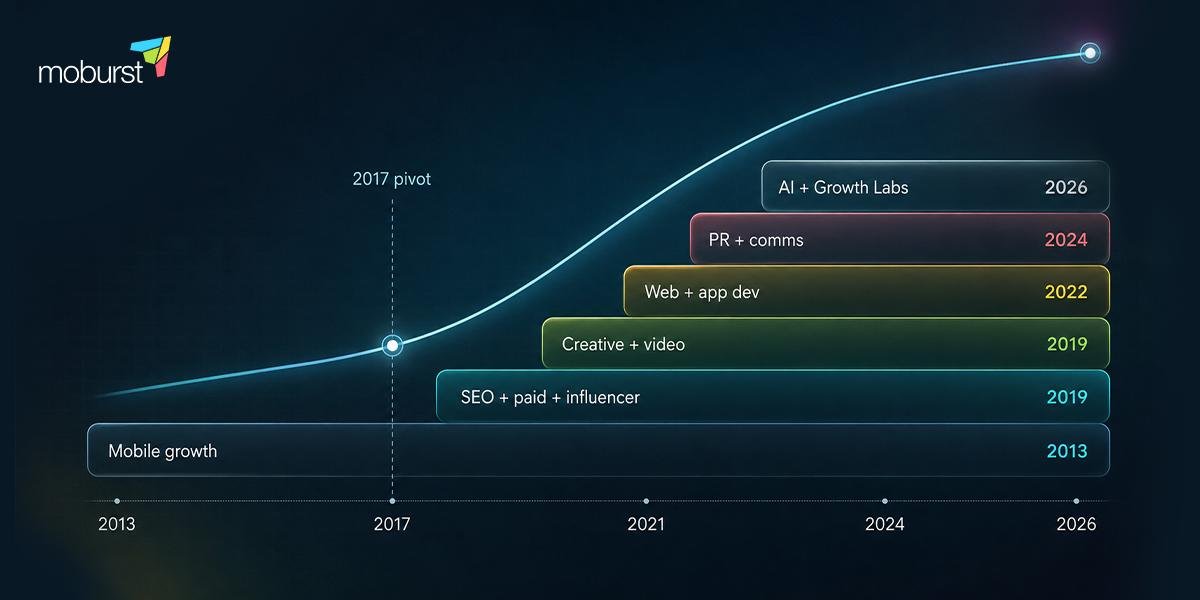
A key shift in the company’s structure occurred in 2017. Moburst moved away from a model focused on venture-backed expansion. The company redirected its strategy toward profitability. This change was not gradual in messaging but structural in direction. By 2018, it reported its first profitable year following that transition. The change aligned with a broader trend in digital agencies moving toward sustainable operating models instead of growth driven by external funding.
After profitability was established, service expansion followed. In 2019, Moburst acquired Clutch Studio, a creative production company focused on video and design. This added video production, motion graphics, and UI and UX capabilities to its service structure. It marked a clear shift beyond mobile performance marketing into broader creative execution.
Between 2020 and 2021, the company expanded its production and analytics capabilities further. Video production became more central to campaign execution. Creative services expanded alongside it. At the same time, analytics systems became more embedded in campaign workflows. Performance data from paid media and app store environments were increasingly used to guide optimization decisions.
By 2021, Moburst reported operating across more than twenty digital marketing disciplines. These included app store optimization, paid media, SEO, influencer marketing, video production, and development services. The expansion reflected a move away from a mobile-only agency model into a multi-service digital structure.
The company’s service structure continued to expand through acquisition. In 2022, Moburst acquired Layer, a web and mobile development agency. This added engineering and product development capabilities to its existing marketing and creative services. The structure became more integrated, combining development work with campaign execution.
Further expansion into communications followed in 2024 with the acquisition of Uproar PR. The agency was rebranded as Uproar by Moburst and integrated into the company’s communications division. This added public relations and media relations services to its offering.
In 2025, Moburst acquired Kitcaster, a podcast booking agency, and Rhythm Communications, a public relations firm based in Atlanta. Both were integrated under its communications structure. These acquisitions extended its presence into podcast media placement and broader PR services.
This year, Moburst received an $11.8 million investment from Chrysalis Holdings, LLC, a leading private investment firm. This financial backing supports the company’s growth. It enhances the suite of services provided to NewDay USA, a leading national mortgage lending company serving the veteran community.
This investment will also allow Moburst to further its Growth Labs initiative, the company’s proprietary AI innovation and product unit dedicated to developing, testing and scaling cutting-edge AI-powered marketing solutions. Through Growth Labs, Moburst is creating advanced tools designed to help brands enhance their growth, performance and visibility across digital platforms, search engines, answer engines and emerging generative AI technologies.
Across this timeline, the company moved through four structural phases. First was mobile-focused growth. Then, profitability and stabilization. Then, the expansion into multiple service categories. Last, Moburst turned inwards to focus on investments and internal product development. Each phase added operational layers rather than replacing earlier ones.
By 2021, the company’s internal structure already included more than twenty disciplines. That scale required coordination across marketing, analytics, creative production, and development teams. Instead of operating as separate service lines, these functions became linked through shared workflows and performance measurement systems.
The integrated model now used by Moburst connects marketing execution with technical development and performance analytics. Campaigns are not structured around isolated outputs. They are built around continuous adjustment based on data collected across channels. Paid media informs creative changes. App store performance influences acquisition strategy. Development work supports marketing execution when product adjustments are required.
This structure reflects the company’s shift away from single-service specialization. It also reflects how digital marketing operations have evolved in general, where multiple systems operate at the same time and require unified management rather than separate execution teams.
Gilad Bechar and Lior Eldan remain associated with Moburst’s leadership as the company continues operating across global markets. The business model that began with mobile marketing services has developed into a multidisciplinary structure built around integrated marketing, development, and analytics functions.