
By: Santiago Miller
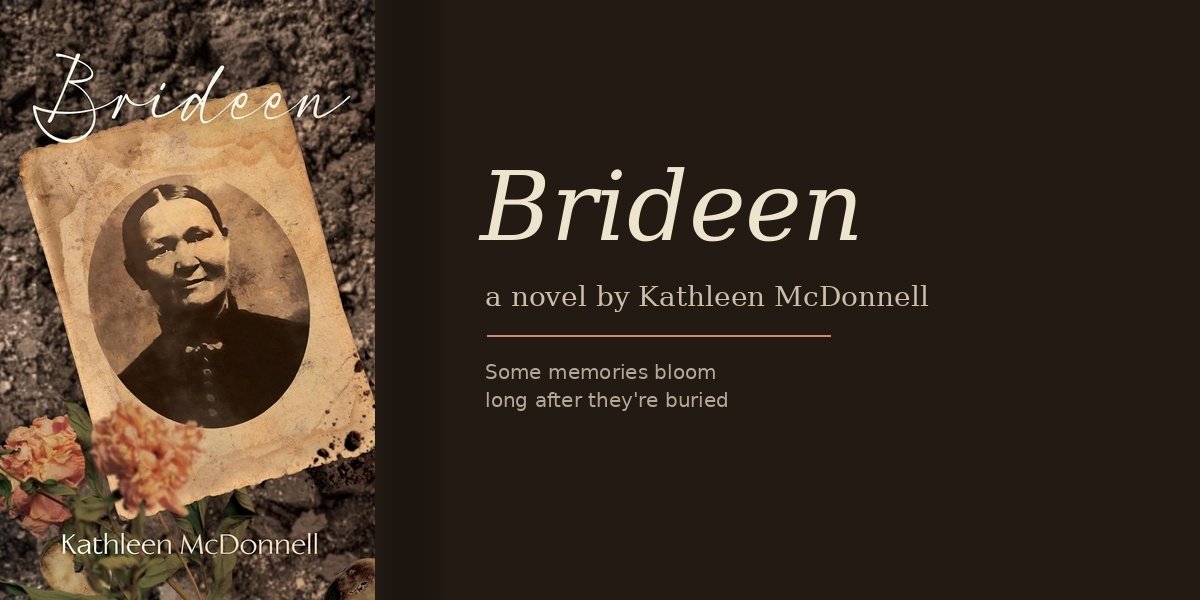
The origin story of Brideen is itself the kind of thing that reminds you why family history matters and why most of it gets lost. Kathleen McDonnell found a formal portrait in a family album, a middle-aged woman labeled simply Bridget Sweeney McDonnell, and knew almost nothing else about her. Then she found an obituary that contained a single stunning fact: Bridget Sweeney had left Ireland in 1847, the year known as Black 47, the absolute nadir of the Great Famine. From that single fact, and from the fragmentary records and newspaper archives and traditional ballads she subsequently hunted down, McDonnell built the novel that gives her great-grandmother back the full scope of the life she actually lived, and the result is one of the most affecting works of historical fiction in the Irish diaspora tradition.
Reading this book produces a quality of emotional investment that accumulates gradually and then arrives at unexpected moments with real force. McDonnell writes about the Famine years with a restraint that amplifies rather than diminishes their impact, staying close to the specific human experience of a nine-year-old girl watching her world collapse around her rather than reaching for the panoramic historical vantage that would make the suffering feel safely distant. Bridget Sweeney’s experience in County Mayo in 1847, the fever, the eviction in the dead of night, the corpses on the roadsides, the desperate journey toward survival, is rendered with the particular intimacy of someone writing about a person they are genuinely trying to recover from history rather than a figure they are using to illustrate historical forces.
The decision to follow Bridget all the way through to her death at sixty-eight, carrying her through England’s industrial cities and the American Civil War and the settlement of the Midwest, gives the novel a life-sized quality that most Famine fiction, understandably preoccupied with the catastrophe itself, never quite achieves. McDonnell is interested in the full human being, not just the historical victim, and that interest produces a portrait of survival and adaptation and cultural persistence that is both more complicated and more genuinely inspiring than a straightforward tragedy could have been.
Her background as a musician immersed in Irish traditional music gives the cultural dimensions of the novel an authenticity that purely literary research rarely achieves. The songs and the Irish language that run through the text are not decorative. They are the actual cultural substance of the world Bridget Sweeney came from and carried with her, the portable homeland that the diaspora preserved because it was the only part of Ireland that could be carried across an ocean without being left behind.
Brideen is the book that proves that the most important stories are not always the ones that belong to the famous and the documented but sometimes the ones that belong to the ordinary and the overlooked, the needles in the haystack of history who lived through extraordinary things and left almost no trace. Kathleen McDonnell has pulled one of those needles out of the haystack with exceptional skill and exceptional love, and the novel she has built around it deserves every reader it finds.
If you believe that the most important stories are not always the ones that belong to the famous and the documented but sometimes the ones that belong to the ordinary and the overlooked who lived through extraordinary things and left almost no trace, Brideen by Kathleen McDonnell is the book that proves that belief completely. Grab your copy on Amazon today and discover what one author found when she spent years pulling her great-grandmother out of the haystack of history with exceptional skill and exceptional love.