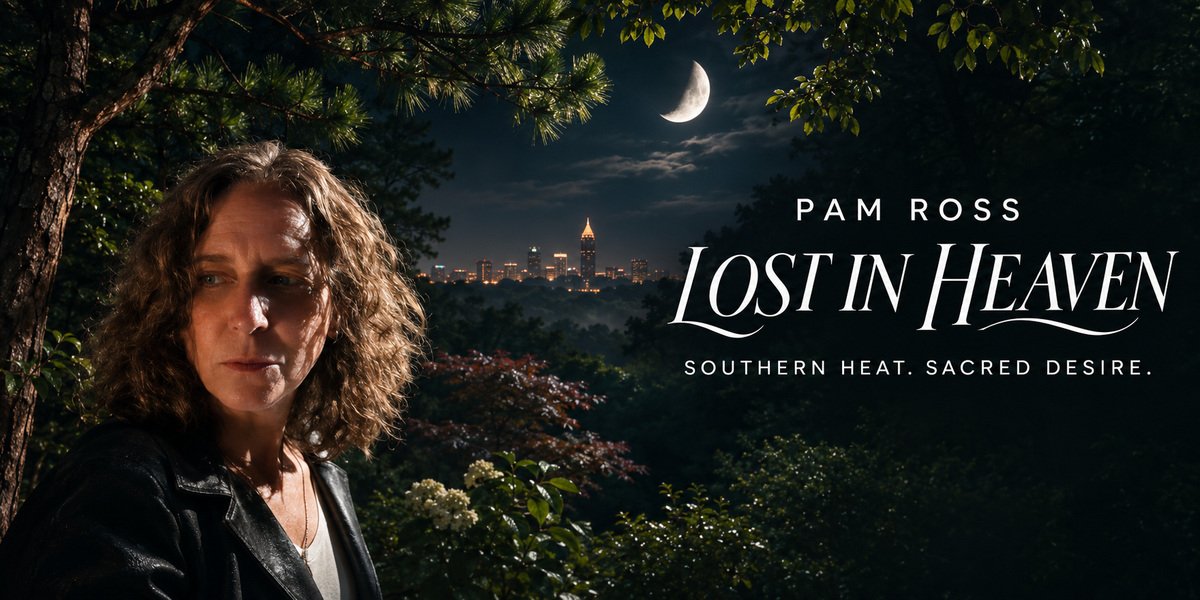

By: Jordan Callaway
Atlanta has always understood that Saturday-night temptation and Sunday-morning salvation are not opposites. They are neighbors. They sit beside each other in traffic, share a table at the Waffle House and occasionally occupy the same pew. That tension has powered generations of Southern music, from gospel and blues to country, soul and rock. On “Lost in Heaven,” Pam Ross steps directly into that complicated territory, delivering a seductive country-rock single that treats romantic surrender as something nearly sacred.
Released September 11, 2026, “Lost in Heaven” arrives with its temperature already rising. Ross opens with the volume turned up and the emotional brakes disengaged. Her attraction is immediate, physical and unapologetic: a late-June kind of heat intensified by faded jeans, dancing and the promise of staying awake until morning. From an Atlanta perspective, it feels familiar. This is a city where summer does not politely enter the room; it settles on your shoulders and refuses to leave. Ross uses that oppressive heat as a metaphor for desire that can no longer be contained.
Yet “Lost in Heaven” is more than a steamy Southern love song. Its real power comes from the way Ross places earthly temptation beside religious imagery. The title phrase transforms a private encounter into a spiritual experience. A kiss becomes an irresistible temptation, but the relationship also feels like an answered prayer. Angels sing, then blush at the view. It is playful, certainly, but the contrast reveals something deeper about the song’s emotional world: pleasure does not necessarily represent a departure from grace. It might be one of the places grace is found.
That idea resonates in Atlanta, where church music and nightlife have long existed within shouting distance of one another. The city’s musical identity has been shaped by sacred voices, rebellious voices and artists unwilling to separate the two. Ross works within that same Southern contradiction. Her heaven is not distant or abstract. It is hidden behind the pines, illuminated by stars and a full moon, and discovered beside someone who makes every inhibition disappear.
The rural imagery provides an interesting counterpoint to Atlanta’s glass towers and endless ribbons of interstate. Listen to the song while driving beyond the Perimeter, however, and its landscape quickly comes into view. The skyline recedes. Streetlights become fewer. Pines gather along the roadside until the city feels much farther away than it is. Ross places her lovers in precisely that kind of private world, where the night opens wide and the moon can be trusted to keep a secret.
Her narrator is not waiting passively to be chosen. She knows what she wants, recognizes the effect this person has on her and willingly follows the attraction. That sense of agency distinguishes “Lost in Heaven” from countless country songs that frame women primarily as objects of male fascination. Ross owns the gaze. She watches the dancing, feels the heat and describes the pleasure from inside the experience. When she offers her hand and suggests taking things slowly, the tenderness feels intentional rather than hesitant.
That is an important turn. The song may be charged with desire, but it is not built around conquest. Its intimacy comes from mutual trust. Even the secrecy surrounding the encounter feels less like shame than a desire to preserve something personal before the outside world can define it.
The structure supports that gradual emotional expansion. The verses remain close to the body, movement, clothing, smiles and touch, while the pre-choruses lift the perspective toward the surrounding landscape. Then the chorus throws open the sky. Ross moves from a secluded meeting beneath the trees to angels providing the celestial soundtrack. The scale grows without losing its human center.
By the time Sunday morning arrives, “Lost in Heaven” has shifted again. What began as a feverish nighttime encounter becomes something quieter: the recognition that the lover is still there. That image gives the song more emotional weight than its flirtatious opening initially promises. In Southern culture, Sunday morning carries its own symbolism: reckoning, ritual, renewal. Ross uses it not to punish the previous night’s desire, but to validate it.
That choice may be the song’s finest insight. Plenty of songs can describe attraction. Far fewer understand the vulnerable silence after the excitement, when two people awaken and decide whether the connection belonged only to the darkness. Ross lets the morning answer the question.
Musically, her combination of Americana storytelling, country accessibility and rock attitude makes “Lost in Heaven” feel at home in Atlanta’s sprawling musical landscape. The song could slip into a country playlist, a roots-rock set or a late-night drive without changing its identity. Like Atlanta itself, it does not believe Southern music needs to remain inside a single genre boundary.
“Lost in Heaven” succeeds because Ross makes familiar ingredients, moonlight, faded denim, summer heat and secret desire, feel personal again. She does not reinvent the Southern love song. She gives it a sharper point of view, a woman’s confidence and a spirituality broad enough to include the body.
In a city built on contradictions, Pam Ross’s message feels perfectly at home: sometimes heaven is not waiting beyond temptation. Sometimes heaven is the person standing beside you when Sunday morning finally arrives.