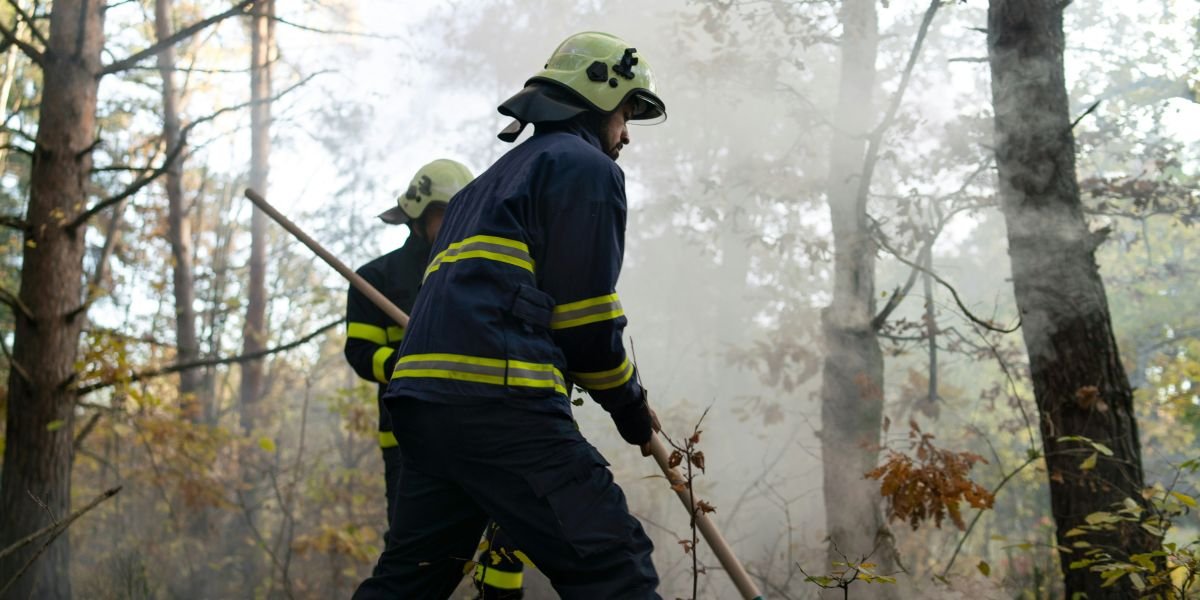

SAVANNAH, April 29, 2026 — Two massive wildfires are burning through south Georgia, consuming more than 55,000 acres, destroying over 120 homes, and forcing hundreds of families from their properties in what Gov. Brian Kemp has described as the most destructive wildfires in Georgia’s recorded history. A statewide drought emergency, a burn ban covering nearly the entire state, and a federal disaster declaration now frame what firefighters and state officials are calling a prolonged, open-ended fight.
How the Fires Started — and Why They Spread
Both Georgia fires ignited as the state’s worst drought in two decades rendered vast pine forests and swampy lowlands tinder dry and highly combustible.
The fire in Clinch and Echols counties started April 18 when a falling spark from a man welding a gate ignited nearby vegetation. Investigators concluded the Brantley County fire began April 20 when a foil balloon touched a power line, creating an electrical arc that set the ground ablaze.
Both blazes found ideal conditions for catastrophic growth. Southeastern Georgia has seen just 11 inches of rain since the beginning of September — almost 15 inches below normal, according to the National Weather Service. Pine and hardwood forests in the region helped charge the fires, while swampy lowlands with thick layers of leaves and woody debris proved “super flammable” when dry, according to Seth Hawkins, a spokesperson for the Georgia Forestry Commission.
The fires grew quickly. As of Monday evening, more than 55,140 acres had burned. The Pineland Road fire in Clinch County has burned 32,541 acres and is 23% contained. The Highway 82 fire in Brantley County has burned more than 22,615 acres and is 32% contained.
“We’re Going to Be in This for a While”
Gov. Kemp toured the fire areas Tuesday and told reporters: “A little bit of rain is going to help us, but it’s not going to get us out of this situation. We’re going to be dealing with this for quite a while.”
The scale of the response reflects the severity of the situation. The Georgia Department of Natural Resources is providing three helicopters with fire suppression capabilities, a D6 dozer and operator, two Type 2 water engines and four team members, and ten Game Wardens to assist with evacuations and clearing burned structures. The Georgia State Patrol is providing three additional helicopters to support wildfire response.
The Georgia Army National Guard has been central to aerial operations. “We’ve flown about 150 hours in support of the fires and dropped about a half a million gallons of water,” said Major General Dwayne Wilson, adding that crews are beginning to shift from air operations to more ground-based support.
On the ground at the Highway 82 fire, resources currently include 470 workers, five helicopters, four crews, 41 fire engines, five tractor plows, and 17 dozers. State emergency management officials confirmed the state has responded to 95 resource requests from local partners.
Kemp noted that across the state, fire activity is running well above normal. “Just in the last 30 days, we’ve had 767 fires in Georgia — that’s 85% more than we would normally have on a five-year average,” the governor said.
Federal Disaster Declaration and FEMA Funding
FEMA approved Fire Management Assistance Grant declarations for the Pineland Road Fire in Clinch and Echols counties and the Highway 82 Wildfire in Brantley County. A federal Incident Management Team was also called up to assist with the response.
FEMA has authorized federal money to reimburse the state for 75% of the costs to fight the fires. That federal authorization significantly eases the financial burden on state and county governments as the operation scales up.
Statewide Drought Emergency — 146 Counties Affected
Agriculture Commissioner Tyler Harper and the Georgia Environmental Protection Division declared a statewide Level 1 drought response. A total of 146 Georgia counties are now designated as primary natural disaster areas due to the ongoing drought.
Under Level 1, the Georgia Environmental Protection Division has directed all public water systems to implement a public information campaign including drought-specific announcements through newspaper or online ads, bill inserts, social media, and notices in public libraries. Level 2 begins restricting water use; Level 3 expands those restrictions further.
Gov. Kemp declared a State of Emergency and the State Forester issued a burn ban for 91 counties, prohibiting prescribed burns, yard debris burning, and agricultural burns for 30 days.
A National Warning Sign
The Georgia fires are not isolated. About 1.8 million acres have burned nationwide as of April 24, according to the National Interagency Fire Center — nearly double the year-to-date 10-year average, and the highest year-to-date figure since 2017.
Smoke from the Georgia fires drifted as far as Atlanta, Savannah, and Jacksonville, Florida. Air quality in parts of south Georgia declined to the unhealthy category, meaning all residents in those areas could experience health effects.
Families Displaced — Community Support Underway
Hundreds of people have been forced to leave their homes, staying in hotels or emergency shelters including the Red Cross in Brantley and Selden Park in Brunswick. While some families were escorted back into certain areas to check for damage, many are still waiting to find out if they have a home to return to.
The Georgia Forestry Foundation has established a Forest Wildfire Recovery Fund to provide direct support to communities and forest landowners, seeding it with an initial $10,000 investment. Donations are being accepted at gffgrow.org/wildfire-recovery. The Georgia Chamber Foundation is separately coordinating relief fund contributions in close coordination with local governments and emergency management agencies.
Donation centers have been set up across the affected area, and faith-based and relief organizations — including the Salvation Army in Brantley, Georgia Baptist Disaster Relief, the Convoy of Hope, and the Adventist Community Service Disaster Response — are also providing direct support to first responders, volunteers, and community members.
Officials are not yet able to say when mandatory evacuation orders will be fully lifted, warning that shifting winds and continued dry conditions could push fire lines into new areas at any time. The Georgia Forestry Commission is urging those in affected counties to monitor updates from local Emergency Management Agencies and follow all directives without delay.